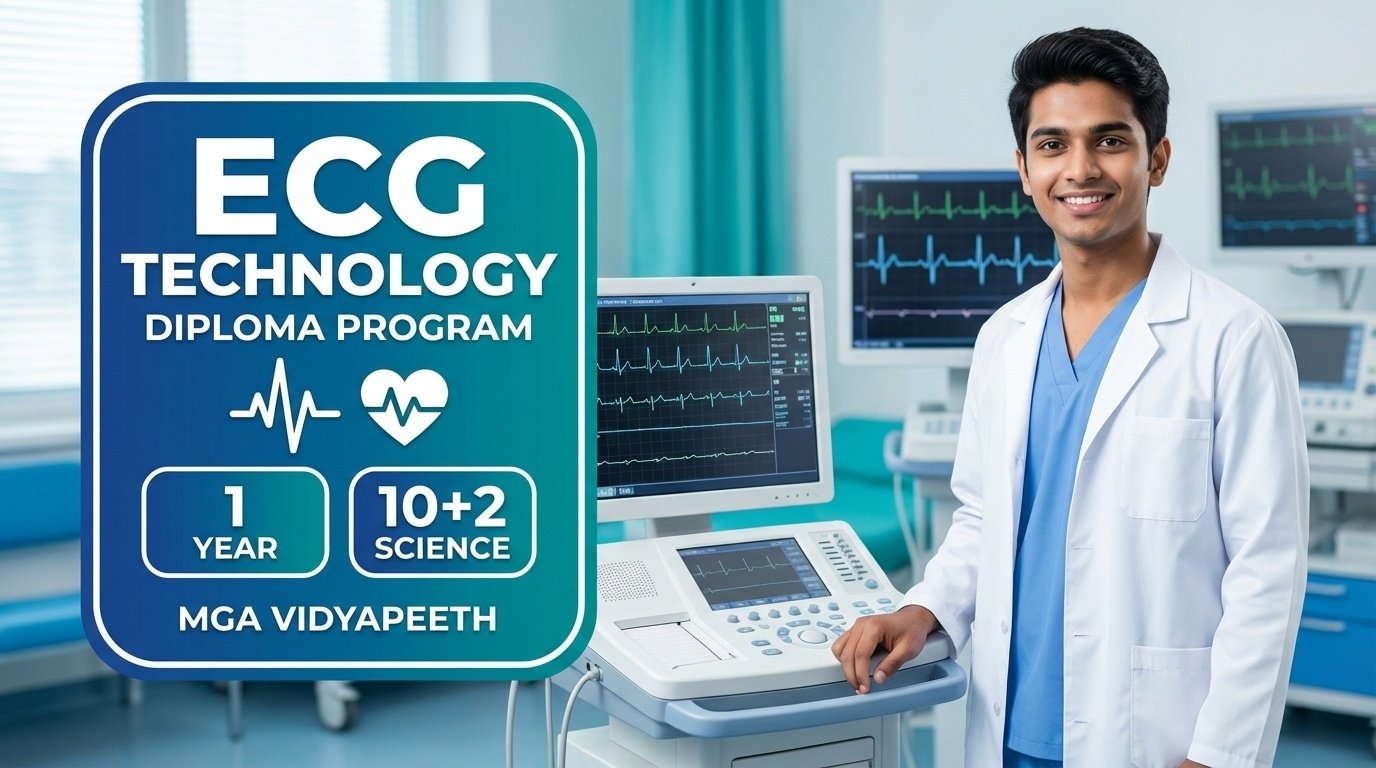
The Diploma in ECG Technician is a specialized 2-year paramedical program designed to train students in electrocardiography and cardiac monitoring techniques. This comprehensive course focuses on understanding the electrical activity of the heart, operating ECG equipment, performing various cardiac diagnostic tests, and assisting cardiologists in patient care. Students gain expertise in recording, analyzing, and interpreting heart rhythms, preparing them for critical roles in cardiology departments and cardiac care units.
An Electrocardiogram (ECG/EKG) is one of the most fundamental diagnostic tools in modern medicine, used to detect heart diseases, arrhythmias, heart attacks, and other cardiac conditions. ECG Technicians are essential healthcare professionals who perform these life-saving tests, monitor cardiac patients, and provide critical support to cardiologists. With cardiovascular diseases being the leading cause of death globally and in India, skilled ECG technicians are in constant demand across hospitals, clinics, and cardiac care centers.
Course Highlights
✅ Eligibility Criteria
Academic Requirements
- Educational Qualification: 10+2 (Higher Secondary) from a recognized board
- Stream: Science - Physics, Chemistry, Biology (PCB) OR Physics, Chemistry, Mathematics (PCM)
- Minimum Marks: 45-50% aggregate in Science subjects
- Age Limit: Minimum 17 years at the time of admission
- Medical Fitness: Good physical and mental health
Preferred Skills & Qualities
- Basic understanding of human biology
- Interest in medical science and cardiology
- Attention to detail and precision
- Good hand-eye coordination
- Patient and compassionate nature
- Ability to work under pressure
- Good communication skills
- Comfortable with technology and equipment
Ideal Candidates
Students who are:
- Passionate about healthcare and saving lives
- Interested in cardiac care and heart health
- Detail-oriented and methodical
- Good at following protocols and procedures
- Empathetic towards patients
- Eager to work in medical environments
- Quick decision-makers in emergency situations
Comprehensive Course Curriculum
The 2-year diploma program provides extensive theoretical knowledge and practical training:
Year 1 - Foundation & Basic Cardiac Sciences
Semester 1
Module 1: Human Anatomy & Physiology
- General Anatomy:
- Introduction to anatomical terminology
- Body systems overview
- Cell structure and tissues
- Cardiovascular System Anatomy:
- Heart structure (chambers, valves, walls)
- Blood vessels (arteries, veins, capillaries)
- Coronary circulation
- Great vessels
- Pericardium
- Cardiac Physiology:
- Cardiac cycle
- Heart sounds
- Blood circulation (systemic and pulmonary)
- Cardiac output and stroke volume
- Blood pressure regulation
- Respiratory System:
- Lung anatomy
- Gas exchange
- Respiratory physiology
- Practical: Anatomical models, charts, and specimens
Module 2: Basic Biochemistry
- Introduction to biochemistry
- Biomolecules (proteins, carbohydrates, lipids)
- Enzymes and metabolism
- Electrolytes and their importance
- Sodium, Potassium, Calcium, Magnesium
- Electrolyte imbalances affecting heart
- Cardiac biomarkers:
- Troponin
- CK-MB
- BNP/NT-proBNP
- Blood chemistry relevant to cardiac care
- Laboratory Practicals
Module 3: Basic Microbiology
- Introduction to microorganisms
- Bacteria, viruses, fungi
- Infection control and prevention
- Hospital-acquired infections
- Sterilization and disinfection
- Universal precautions
- Infectious diseases affecting heart (endocarditis, myocarditis)
Module 4: Fundamentals of Electricity & Electronics
- Basic Electricity:
- AC/DC current principles
- Voltage, current, resistance
- Ohm's Law
- Electrical circuits
- Electronics Basics:
- Diodes, transistors, amplifiers
- Power supply systems
- Batteries and types
- Electromedical Equipment:
- Electrical safety in hospitals
- Equipment standards
- Grounding and isolation
- Biomedical instrumentation basics
Semester 2
Module 5: Cardiac Anatomy & Pathophysiology
- Detailed Cardiac Anatomy:
- Conduction system of heart
- SA node (Sinoatrial node)
- AV node (Atrioventricular node)
- Bundle of His
- Bundle branches
- Purkinje fibers
- Blood supply to heart
- Innervation of heart
- Cardiac Pathophysiology:
- Understanding disease processes
- Ischemic heart disease
- Myocardial infarction (heart attack)
- Heart failure
- Valvular heart diseases
- Congenital heart defects
- Cardiomyopathies
Module 6: Introduction to Electrocardiography (ECG)
- ECG Fundamentals:
- History and evolution of ECG
- Principles of electrocardiography
- Electrical activity of heart
- Depolarization and repolarization
- ECG Waves, Intervals & Segments:
- P wave (atrial depolarization)
- QRS complex (ventricular depolarization)
- T wave (ventricular repolarization)
- U wave
- PR interval
- QT interval
- ST segment
- ECG Leads System:
- Standard limb leads (I, II, III)
- Augmented limb leads (aVR, aVL, aVF)
- Precordial (chest) leads (V1-V6)
- Einthoven's triangle
- 12-lead ECG concept
- ECG Paper & Measurements:
- Grid system
- Time and voltage calibration
- Heart rate calculation methods
Module 7: ECG Equipment & Technology
- ECG Machine Components:
- Electrodes and lead wires
- Amplifiers and filters
- Display systems
- Recording mechanisms
- Types of ECG Machines:
- Single-channel ECG
- Multi-channel ECG
- Digital ECG
- Portable ECG devices
- Wireless ECG systems
- ECG Machine Operation:
- Setup and calibration
- Maintenance procedures
- Troubleshooting common problems
- Artifact identification and prevention
- Patient Preparation:
- Skin preparation
- Electrode placement (accurate positioning)
- Patient positioning
- Ensuring patient comfort and privacy
Module 8: Computer Applications & Medical Documentation
- Computer basics
- ECG software operation
- Digital ECG interpretation software
- Electronic Medical Records (EMR)
- Hospital Information Systems (HIS)
- Data storage and retrieval
- Report generation
- Basic typing and documentation skills
Year 2 - Advanced ECG & Specialized Cardiac Techniques
Semester 3
Module 9: Advanced Electrocardiography
- Normal ECG Interpretation:
- Normal sinus rhythm
- Normal variants
- Age-related changes
- Gender differences
- Abnormal ECG Patterns:
- Bradycardia (slow heart rate)
- Tachycardia (fast heart rate)
- Chamber enlargement
- Left atrial enlargement
- Right atrial enlargement
- Left ventricular hypertrophy
- Right ventricular hypertrophy
- Bundle branch blocks
- Left bundle branch block (LBBB)
- Right bundle branch block (RBBB)
- Axis deviation
Module 10: Cardiac Arrhythmias & Dysrhythmias
- Introduction to Arrhythmias:
- Classification of arrhythmias
- Mechanisms of arrhythmias
- Atrial Arrhythmias:
- Atrial fibrillation (AF/AFib)
- Atrial flutter
- Premature atrial contractions (PAC)
- Supraventricular tachycardia (SVT)
- Junctional Arrhythmias:
- Junctional rhythm
- Junctional tachycardia
- Ventricular Arrhythmias:
- Premature ventricular contractions (PVC)
- Ventricular tachycardia (VT)
- Ventricular fibrillation (VF)
- Torsades de pointes
- Heart Blocks:
- First-degree AV block
- Second-degree AV block (Mobitz I & II)
- Third-degree (complete) heart block
- Pacemaker Rhythms:
- Pacemaker basics
- Pacemaker spikes on ECG
- Pacemaker malfunction recognition
Module 11: Myocardial Ischemia & Infarction
- Ischemia Detection:
- ST segment changes
- T wave inversions
- Ischemic patterns
- Myocardial Infarction (MI):
- STEMI (ST-Elevation Myocardial Infarction)
- NSTEMI (Non-ST-Elevation MI)
- ECG evolution during MI
- Localization of infarction
- Anterior wall MI
- Inferior wall MI
- Lateral wall MI
- Posterior wall MI
- Q waves and pathological Q waves
- Emergency Recognition:
- Life-threatening ECG patterns
- When to call Code Blue
- Immediate actions
Module 12: Specialized Cardiac Tests
- Treadmill Test (TMT/Exercise ECG):
- Indications and contraindications
- Bruce protocol
- Modified Bruce protocol
- Patient preparation
- Test procedure
- Monitoring during exercise
- Positive and negative results
- Safety considerations
- Holter Monitoring (24-Hour ECG):
- Purpose and indications
- Device application
- Patient instructions
- Data analysis
- Report interpretation
- Ambulatory Blood Pressure Monitoring (ABPM):
- Device setup
- Patient education
- Data retrieval and analysis
- Event Recorders:
- Loop recorders
- Patient-activated recorders
- Mobile cardiac telemetry
Semester 4
Module 13: Advanced Cardiac Procedures (Assisting)
- Echocardiography Basics:
- Introduction to echocardiography
- Types of echo (2D, Doppler, Stress echo)
- Patient preparation
- Assisting during procedures
- Cardiac Catheterization Lab Support:
- Introduction to cath lab
- Coronary angiography
- Angioplasty (PCI)
- Patient monitoring during procedures
- Equipment and sterility
- Electrophysiology (EP) Study:
- Basic understanding
- Monitoring during EP studies
- Ablation procedures overview
- Pacemaker & ICD Implantation:
- Types of pacemakers
- Implantable Cardioverter Defibrillators (ICD)
- Post-implantation care
- Pacemaker interrogation basics
Module 14: Cardiac Pharmacology
- Cardiovascular Drugs:
- Anti-hypertensives (ACE inhibitors, ARBs, beta-blockers, calcium channel blockers)
- Diuretics
- Anti-arrhythmic drugs
- Anticoagulants and antiplatelets
- Statins and lipid-lowering agents
- Nitrates
- Inotropic agents
- Thrombolytics
- Drug Effects on ECG:
- ECG changes with medications
- Drug toxicity recognition
- Electrolyte imbalance effects
- Emergency Cardiac Drugs:
- Adrenaline/Epinephrine
- Atropine
- Amiodarone
- Adenosine
- Drug administration routes
Module 15: Emergency Cardiac Care & Life Support
- Basic Life Support (BLS):
- CPR (Cardiopulmonary Resuscitation)
- AED (Automated External Defibrillator) use
- Choking management
- Recovery position
- Advanced Cardiac Life Support (ACLS) Basics:
- Cardiac arrest algorithms
- Defibrillation
- Cardioversion
- Emergency medications
- Post-resuscitation care
- Cardiac Emergencies Recognition:
- Acute MI
- Cardiac arrest
- Cardiogenic shock
- Acute pulmonary edema
- Hypertensive emergency
- Emergency Response Protocols:
- Code Blue procedures
- Crash cart management
- Team coordination
- Documentation
Module 16: Patient Care, Ethics & Professional Practice
- Patient Care Skills:
- Patient assessment
- Vital signs monitoring
- Patient communication
- Handling anxious patients
- Pediatric and geriatric considerations
- Cultural sensitivity
- Infection Control:
- Hand hygiene
- Personal protective equipment (PPE)
- Isolation precautions
- Waste disposal
- Medical Ethics:
- Patient rights and confidentiality
- Informed consent
- Ethical dilemmas
- Professional conduct
- HIPAA compliance
- Legal Aspects:
- Medical negligence
- Documentation importance
- Scope of practice
- Professional liability
- Quality Assurance:
- ECG quality standards
- Error prevention
- Continuous improvement
- Accreditation requirements
Clinical Training & Internship
Throughout the Course (600+ Hours)
Hospital Rotations:
- Cardiology OPD (Outpatient Department) - 150 hours
- CCU/ICCU (Coronary Care Unit/Intensive Coronary Care Unit) - 200 hours
- Emergency Department - 100 hours
- Cardiac Catheterization Lab - 80 hours
- TMT Lab (Treadmill Test) - 70 hours
- General Wards - 100 hours
Practical Skills Development:
- ECG Recording: Minimum 500+ ECGs performed
- TMT/Stress Tests: 50+ tests assisted/performed
- Holter Monitor Applications: 30+ patients
- Emergency ECGs: Rapid ECG in critical situations
- Patient Interaction: Communication and care
- Equipment Maintenance: Daily QC and troubleshooting
- Report Generation: Digital and manual reporting
Clinical Competencies Achieved:
- Accurate 12-lead ECG recording
- Artifact-free ECG acquisition
- Emergency ECG in ❤️ minutes
- Basic rhythm interpretation
- TMT procedure independently
- Holter monitor application
- Patient education and counseling
- Team collaboration in cardiac care
- Emergency response participation
Expansive Career Opportunities
ECG Technicians have diverse career opportunities in the growing cardiac care sector:
Hospital & Cardiac Care Settings
1. ECG Technician
- Multi-specialty hospitals
- Cardiac care units (CCU/ICCU)
- Emergency departments
- OPD cardiology clinics
- Salary: ₹15,000 - ₹30,000 per month
2. Senior ECG Technologist
- Lead technician positions
- Training junior staff
- Quality assurance
- Salary: ₹25,000 - ₹45,000 per month
3. TMT/Stress Test Technician
- Specialized stress testing labs
- Cardiac rehabilitation centers
- Salary: ₹20,000 - ₹40,000 per month
4. Holter Technician
- Ambulatory monitoring specialist
- Report analysis
- Salary: ₹18,000 - ₹35,000 per month
5. Cardiac Monitor Technician (Telemetry)
- ICU/CCU monitoring
- Remote cardiac monitoring
- Rhythm surveillance
- Salary: ₹22,000 - ₹42,000 per month
Specialized Cardiac Centers
6. Cath Lab Technician/Assistant
- Cardiac catheterization lab support
- Angiography and angioplasty procedures
- Salary: ₹25,000 - ₹50,000 per month
7. Pacemaker Clinic Technician
- Pacemaker follow-up
- Device interrogation
- Patient monitoring
- Salary: ₹22,000 - ₹45,000 per month
8. Electrophysiology (EP) Lab Technician
- EP study assistance
- Ablation procedures
- Salary: ₹28,000 - ₹55,000 per month
9. Cardiac Rehabilitation Technician
- Post-MI rehabilitation
- Exercise prescription
- Patient monitoring
- Salary: ₹20,000 - ₹38,000 per month
Diagnostic Centers & Clinics
10. Diagnostic Center ECG Specialist
- Independent diagnostic laboratories
- Polyclinics
- Health checkup centers
- Salary: ₹18,000 - ₹35,000 per month
11. Mobile ECG Service Technician
- Home visit ECG services
- Corporate health checkups
- Community health programs
- Income: ₹500-1,000 per visit (8-10 visits/day possible)
12. Executive Health Checkup Coordinator
- Corporate wellness programs
- VIP health checkups
- Salary: ₹22,000 - ₹40,000 per month
Education & Training
13. ECG Training Instructor
- Paramedical colleges
- Hospital training departments
- Corporate training programs
- Salary: ₹25,000 - ₹50,000 per month
14. Clinical Skill Trainer
- Nursing colleges
- Medical colleges
- Simulation labs
- Salary: ₹28,000 - ₹55,000 per month
Government Sector
15. Government Hospital ECG Technician
- District hospitals
- Primary Health Centers (PHC)
- Community Health Centers (CHC)
- Government medical colleges
- Salary: ₹25,000 - ₹50,000 per month + benefits
16. Railway/PSU/Defense Hospital Technician
- Railway hospitals
- ESIC hospitals
- Army/Navy/Air Force hospitals
- Salary: ₹28,000 - ₹55,000 per month + perks
Other Opportunities
17. Medical Equipment Sales Representative
- ECG machine companies
- Cardiac equipment manufacturers
- Technical sales and demonstrations
- Income: ₹20,000 - ₹40,000 + commission
18. Telemedicine ECG Specialist
- Remote ECG interpretation support
- Tele-cardiology services
- Online consultation platforms
- Salary: ₹22,000 - ₹45,000 per month
19. Research Assistant
- Cardiac research institutions
- Clinical trials
- Pharmaceutical companies
- Salary: ₹25,000 - ₹48,000 per month
20. Healthcare BPO/KPO
- Medical transcription (ECG reports)
- Data analysis
- Insurance claim processing
- Salary: ₹20,000 - ₹40,000 per month
International Opportunities
21. Overseas ECG/Cardiac Technician
- USA, UK, Canada, Australia, UAE, Saudi Arabia
- Better compensation and facilities
- Salary: $2,500 - $5,500 per month (₹2.1 - 4.6 Lakh)
Salary & Compensation
Entry Level (0-2 Years)
Mid-Level (3-5 Years)
Senior Level (7+ Years)
Additional Income Sources
- Night Shift Allowance: ₹3,000 - ₹8,000 per month extra
- Emergency Duty: ₹300 - ₹800 per duty
- Home Visit ECG: ₹500 - ₹1,000 per visit
- Part-time Consultation: ₹15,000 - ₹30,000 per month
- Freelance Corporate Checkups: ₹5,000 - ₹15,000 per day
Note: Salaries vary based on location (metro vs. smaller cities), hospital type (corporate/government), experience, specialization, and additional certifications. Metro city salaries are typically 30-50% higher.
Why Choose ECG Technology?
Growing Demand & Job Security
Cardiovascular Disease Burden:
- Leading Cause of Death: CVD causes 1 in 4 deaths in India
- Rising Incidence: 63 million people with heart diseases in India
- Young Population Affected: Heart attacks in 30-40 age group increasing
- Lifestyle Diseases: Diabetes, hypertension, obesity contributing factors
- Aging Population: Elderly requiring more cardiac monitoring
Industry Growth:
- 10-22% Job Growth projected for ECG/cardiac technicians by 2030
- 3,800+ Annual Openings in cardiovascular technology sector
- ECG is Essential: First-line diagnostic tool in all hospitals
- 24/7 Requirement: Emergency departments need round-the-clock ECG services
- Universal Need: From PHCs to super-specialty hospitals
Career Advantages
1. Quick Career Start
- Only 2 years of education
- Start working immediately after graduation
- Earn within 3 years after 12th standard
- Low education investment, high returns
2. Affordable Education
- Total course fee: Only ₹55,000
- Lowest cost among paramedical courses
- Excellent ROI (Return on Investment)
- Scholarships available
3. Essential Healthcare Service
- ECG is mandatory in every hospital
- Cannot be replaced by automation
- Critical for diagnosis and monitoring
- Recession-proof career
4. Multiple Work Settings
- Hospitals (emergency, OPD, ICU, CCU)
- Diagnostic centers
- Cardiac clinics
- Mobile services
- Corporate health
- Research institutions
- Teaching institutes
5. Work-Life Balance
- Fixed shift timings (8-9 hours)
- Rotation-based shifts
- Clear duty hours
- Leave benefits
- No extensive physical strain
6. Immediate Patient Impact
- ECG can detect life-threatening conditions instantly
- Direct role in saving lives
- Quick diagnostic results
- Patient gratitude and satisfaction
- Meaningful work
7. Continuous Learning
- New ECG technologies emerging
- Advanced interpretation skills
- Specialized cardiac procedures
- Certification opportunities
- Conference participation
8. Career Growth Path
- Start as Junior ECG Tech
- Progress to Senior positions
- Specialize in TMT, Holter, Cath Lab
- Move to training and education
- Administrative roles possible
9. Portable Skills
- ECG skills universal globally
- Easy interstate job transfer
- International opportunities
- Freelance possibilities
- Home-visit services
10. Respect & Recognition
- Valued member of cardiac care team
- Work closely with cardiologists
- Professional healthcare environment
- White-coat profession
- Contribution to life-saving
Cardiac Care Industry Insights
Heart Disease Statistics in India
- 63 million people living with cardiovascular diseases
- 1.7 million deaths annually due to CVD
- 25% of all deaths are cardiac-related
- Heart attacks increasing in younger age groups (30-40 years)
- Risk Factors: Diabetes (77 million), Hypertension (200+ million)
Healthcare Infrastructure
- 70,000+ hospitals in India (all need ECG technicians)
- 2,000+ dedicated cardiac care centers
- 500+ cardiac catheterization labs
- Growing Telemedicine: Remote ECG interpretation demand
- Preventive Care Focus: Regular ECG checkups increasing
Technology Trends
- AI-assisted ECG interpretation: Automated preliminary analysis
- Smartphone ECG devices: Portable, accessible diagnostics
- Cloud-based ECG storage: Remote access and consultation
- Wearable ECG monitors: Continuous cardiac monitoring
- Telemedicine ECG services: Rural healthcare reach
Higher Education & Specialization
After completing the Diploma in ECG Technician, graduates can pursue:
Bachelor's Programs
- B.Sc. Cardiac Care Technology - 3-4 years
- B.Sc. Cardiovascular Technology - 3 years
- B.Sc. Cardio-Respiratory Technology - 3 years
- Lateral Entry into 2nd year of degree programs
Specialized Certifications
- Advanced ECG Interpretation Course - 3-6 months
- Holter & Ambulatory Monitoring Specialist - 2-3 months
- TMT/Stress Test Specialist - 1-2 months
- Cardiac Catheterization Lab Technician - 6 months
- Pacemaker & Device Clinic Technician - 3-4 months
- ACLS (Advanced Cardiac Life Support) - 2 days
- BLS (Basic Life Support) - 1 day
International Certifications
- CET (Cardiovascular Exam Technologist) - USA
- RCS (Registered Cardiac Sonographer) - International
- RCIS (Registered Cardiovascular Invasive Specialist) - USA
- CCT (Certified Cardiographic Technician) - CCI
Postgraduate Diplomas
- PG Diploma in Cardiac Care Technology - 1 year
- PG Diploma in Echo Technology - 1 year
- PG Diploma in Interventional Cardiology - 1 year
Master's Programs
- M.Sc. Cardiac Care Technology - 2 years
- M.Sc. Cardiovascular Technology - 2 years
- MBA Healthcare Management - 2 years (for administrative roles)
About Mahatma Gandhi Ayurvigyan Vidyapeeth
Mahatma Gandhi Ayurvigyan Vidyapeeth is dedicated to producing skilled, compassionate ECG technicians ready for immediate employment in cardiac care settings.
Why Choose Us?
Expert Faculty
- Experienced cardiologists as guest faculty
- Certified ECG trainers
- Cardiac care nurses with CCU experience
- Regular workshops by cardiac specialists
Excellent Training Facilities
- Modern ECG Lab: Latest multi-channel ECG machines
- TMT Lab: Fully equipped treadmill test facility
- Simulation Center: Practice with mannequins
- Cardiac Monitoring Unit: Telemetry training
- Holter Equipment: Ambulatory monitoring devices
- Computer Lab: ECG interpretation software training
- Well-stocked Library: Cardiology books and journals
Strong Hospital Partnerships
- 15+ Multi-Specialty Hospitals for internship
- 8+ Cardiac Centers for specialized training
- Government Hospitals tie-ups
- Diagnostic Centers for practical exposure
- Guest Lectures by senior cardiologists monthly
100% Placement Support
- Dedicated placement cell
- Hospital recruitment drives on campus
- Job placement in 30+ hospitals
- Interview preparation training
- Resume building workshops
- Career counseling and guidance
- Alumni network assistance
Unique Course Features
- Small Batch Size: Maximum 25 students for personalized attention
- Hands-On Training: 60% practical, 40% theory
- Real Patient Exposure: From semester 2 onwards
- Emergency Training: Participation in Code Blue drills
- Industry Visits: Regular visits to cardiac centers
- Skill Competitions: Inter-college ECG interpretation contests
- BLS Certification: Included in course (no extra fee)
- Digital Learning: Online ECG interpretation modules
Student Benefits
- Merit-based scholarships
- Financial aid for economically weaker students
- Separate hostel facilities (boys/girls)
- Library with latest cardiology resources
- Sports and extracurricular activities
- Student counseling services
- Medical insurance during internship
Admission Process
Step-by-Step Application Guide
Step 1: Check Eligibility
- Confirm 10+2 Science qualification
- Verify minimum percentage requirement
- Ensure age criteria met (17+ years)
Step 2: Online Registration
Step 3: Complete Application
- Fill detailed application form
- Provide academic information
- Enter personal details accurately
- Upload recent photograph
Step 4: Document Upload
- Scan all required documents
- Upload clear, legible copies
- Ensure file size compliance
- Verify uploaded documents
Step 5: Application Fee Payment
- Pay application fee (₹1,000) online
- Multiple payment options available
- Save payment receipt
- Get confirmation email
Step 6: Entrance Test (If Applicable)
- Written test on PCB/PCM subjects
- General knowledge and aptitude
- English communication
- Test duration: 1.5-2 hours
Step 7: Personal Interview
- Shortlisted candidates called
- Assessment of interest in cardiac care
- Communication skills evaluation
- Career motivation discussion
Step 8: Merit List Publication
- Check merit list on website
- Verify admission status
- Note counseling date and time
Step 9: Counseling & Document Verification
- Attend counseling session
- Original document verification
- Seat allocation
- Fee payment
Step 10: Admission Confirmation
- Pay admission and semester fees
- Submit original certificates
- Collect admission kit, ID card, lab coat
- Attend orientation program
- Begin classes!
Required Documents Checklist
✅ Academic Certificates
- 10th mark sheet and certificate
- 12th mark sheet and certificate (Science)
- School Leaving Certificate/TC
- Migration certificate (if from different board)
- Character certificate from school/college
✅ Identity Proof
- Aadhar Card (mandatory)
- PAN Card (if available)
- Passport (optional)
- Date of birth certificate
✅ Medical Fitness
- Medical fitness certificate from registered doctor
- Vision test report
- No communicable disease certificate
- Vaccination records (if required)
- Blood group report
✅ Photographs & Others
- 8-10 passport-size color photographs
- Category certificate (SC/ST/OBC if applicable)
- Income certificate (for scholarships)
- Domicile certificate (if required)
- Gap certificate (if any gap after 12th)
- Residence proof (Electricity bill/Aadhar)
Fee Structure
Student Life & Learning Experience
Daily Schedule (Typical)
Morning Session (8:30 AM - 1:00 PM)
- Theory lectures (anatomy, physiology, cardiology)
- ECG interpretation classes
- Demonstrations by cardiologists
- Interactive case discussions
Afternoon Session (2:00 PM - 5:00 PM)
- ECG lab practical training
- Patient ECG recording (supervised)
- TMT lab practice
- Hospital clinical postings
- Holter monitor application training
Evening & Self-Study
- Library study time
- ECG rhythm practice
- Assignment completion
- Group study sessions
- Online ECG modules
Hands-On Training
Laboratory Practice:
- ECG machine operation (daily)
- Electrode placement mastery
- Artifact troubleshooting
- Quality ECG recording
- Machine maintenance
- Report generation
Clinical Exposure:
- Hospital cardiology department rotations
- Real patient ECG recording (500+ ECGs)
- Emergency department experience
- CCU/ICCU observation
- TMT procedure participation
- Holter monitor applications
- Cath lab observation
Skills Mastery:
- Perfect 12-lead ECG recording
- Emergency ECG in ❤️ minutes
- Basic rhythm interpretation
- Patient communication
- Equipment troubleshooting
- Team collaboration
- Professional behavior
Campus Activities
- World Heart Day (Sept 29) - awareness campaigns
- Free ECG Camps - community service
- ECG Interpretation Competitions - inter-college events
- Guest Lectures - renowned cardiologists
- Hospital Visits - cardiac centers and cath labs
- Workshops - advanced ECG, emergency care
- Sports & Cultural Events - annual functions
- Student Clubs - cardiac care interest groups