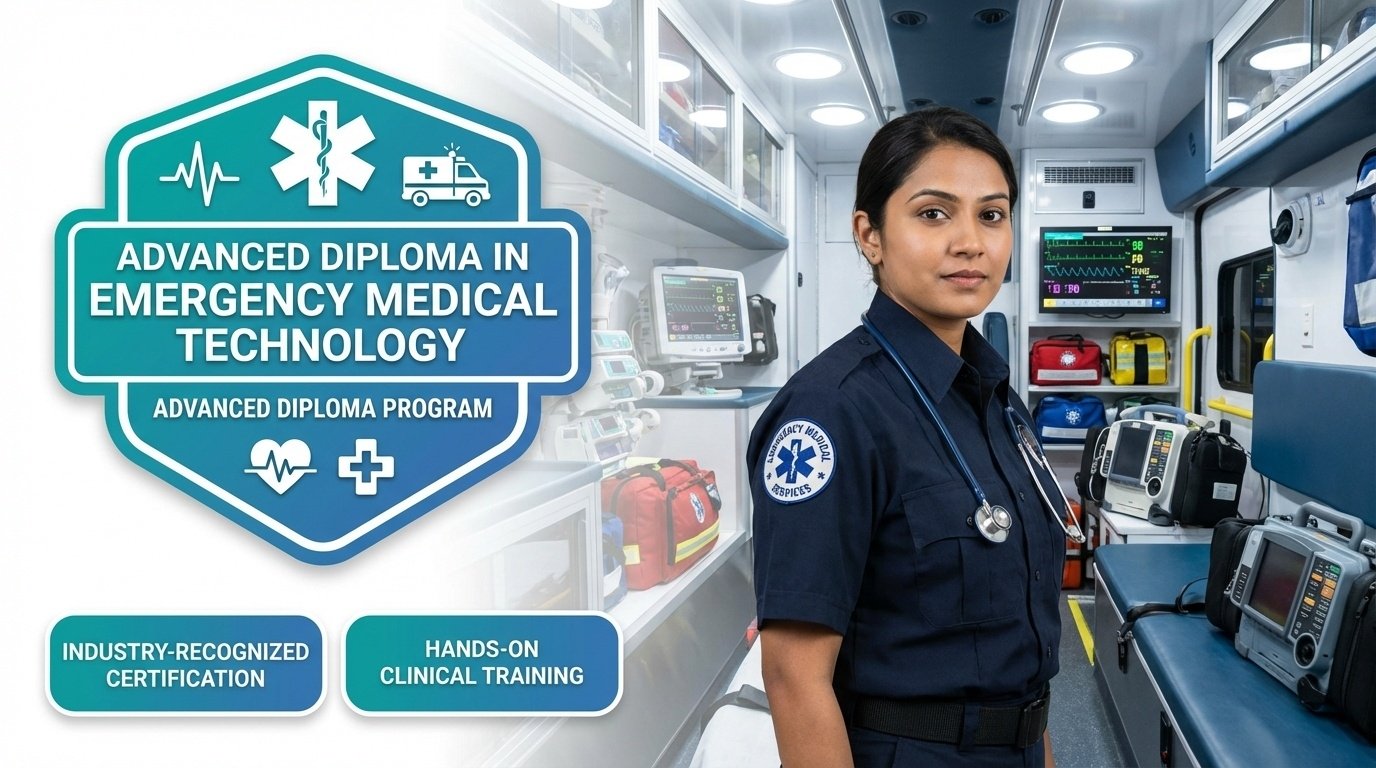
Advanced Diploma in Emergency Medical Technology
Overview
The Advanced Diploma in Emergency Medical Technology is a specialized paramedic program designed to create frontline healthcare warriors who save lives in critical situations. This intensive one-year course provides comprehensive training in emergency care, trauma management, pre-hospital care, and critical care support. Emergency Medical Technicians (EMTs) are the first responders in medical emergencies, making split-second decisions that can mean the difference between life and death. This program prepares you to be a confident, skilled, and compassionate emergency healthcare provider.
Course Details
About the Program
Emergency Medical Technology represents the cutting edge of pre-hospital and acute care medicine. In the crucial "Golden Hour" following trauma or medical emergency, EMTs provide life-saving interventions that dramatically improve patient outcomes. This advanced diploma program delivers:
- Comprehensive emergency care training across all types of medical emergencies
- Advanced life support skills including CPR, defibrillation, and airway management
- Trauma management expertise for accidents, injuries, and disasters
- Pre-hospital care competencies for ambulance and emergency response
- Critical thinking abilities for rapid assessment and decision-making
- Disaster management skills for mass casualty incidents
- Patient stabilization techniques before hospital transfer
- Emergency equipment proficiency with modern life-saving devices
Key Subjects Covered
Core Modules:
-
Fundamentals of Emergency Medical Services
- History and evolution of EMS
- EMS system components and operations
- Roles and responsibilities of EMTs
- Emergency medical dispatch
- Legal and ethical considerations
- Documentation and reporting
- Communication systems
-
Human Anatomy & Physiology
- Musculoskeletal system
- Cardiovascular system
- Respiratory system
- Nervous system
- Digestive and urinary systems
- Endocrine system
- Applied anatomy for emergency care
-
Patient Assessment & Management
- Scene safety and assessment
- Primary survey (ABCDE approach)
- Secondary survey
- Vital signs assessment and monitoring
- Focused physical examination
- Patient history taking
- Critical vs. non-critical patient differentiation
- SAMPLE history technique
-
Basic Life Support (BLS)
- Adult, child, and infant CPR
- Automated External Defibrillator (AED) operation
- Foreign body airway obstruction management
- Recovery position
- Two-rescuer CPR techniques
- BLS certification standards
-
Advanced Life Support (ALS) - Basic
- Advanced airway management
- Endotracheal intubation assistance
- Manual defibrillation
- Cardiac monitoring basics
- IV access and fluid therapy
- Medication administration routes
- Emergency drug calculations
-
Cardiovascular Emergencies
- Acute coronary syndrome
- Myocardial infarction
- Heart failure
- Cardiac arrhythmias recognition
- Cardiac arrest management
- ECG basics and interpretation
- Chest pain assessment
- Stroke and TIA management
-
Respiratory Emergencies
- Airway management techniques
- Oxygen therapy
- Bag-valve-mask ventilation
- Mechanical ventilation basics
- Asthma management
- COPD emergencies
- Pneumothorax
- Pulmonary embolism
- Respiratory distress and failure
-
Trauma Management
- Mechanism of injury assessment
- Head and spinal injuries
- Chest trauma
- Abdominal trauma
- Musculoskeletal trauma
- Burns and scalds
- Hemorrhage control
- Shock management
- Spinal immobilization
- Splinting and bandaging
- Extraction techniques
-
Medical Emergencies
- Altered mental status
- Seizures and epilepsy
- Diabetic emergencies
- Allergic reactions and anaphylaxis
- Poisoning and overdose
- Environmental emergencies (heat stroke, hypothermia)
- Infectious disease precautions
- Gastrointestinal emergencies
- Renal emergencies
-
Obstetric & Gynecological Emergencies
- Normal childbirth assistance
- Complicated deliveries
- Postpartum hemorrhage
- Eclampsia and pre-eclampsia
- Ectopic pregnancy
- Gynecological emergencies
- Neonatal resuscitation
-
Pediatric Emergency Care
- Pediatric assessment triangle
- Common pediatric emergencies
- Pediatric airway management
- Pediatric CPR and AED
- Pediatric trauma
- Child abuse recognition
- Communicating with children and families
- Pediatric medication dosing
-
Geriatric Emergency Care
- Age-related physiological changes
- Common geriatric emergencies
- Falls and mobility issues
- Polypharmacy considerations
- Elder abuse recognition
- End-of-life care considerations
-
Pharmacology for Emergency Care
- Drug classifications
- Emergency medications
- Routes of administration
- Dosage calculations
- Drug interactions
- Adverse effects management
- Controlled substances handling
-
Emergency Equipment & Technology
- Ambulance equipment and supplies
- Cardiac monitors/defibrillators
- Ventilators and oxygen delivery systems
- Spine boards and immobilization devices
- Stretchers and patient moving equipment
- Communication devices
- Equipment maintenance and troubleshooting
-
Disaster Management & Mass Casualty
- Disaster preparedness and response
- Triage systems (START, JumpSTART)
- Mass casualty incident management
- Hazardous materials awareness
- Natural disaster response
- Terrorism and bioterrorism
- Incident command systems
- Search and rescue basics
-
Ambulance Operations
- Ambulance driving and safety
- Emergency vehicle operations
- Scene management
- Patient packaging and transport
- Air medical transport coordination
- Inter-facility transfers
- Radio communication protocols
-
Infection Control & Safety
- Standard precautions
- Personal protective equipment (PPE)
- Bloodborne pathogens
- Communicable disease prevention
- Decontamination procedures
- Sharps safety
- Biomedical waste management
-
Professional Development
- Stress management and resilience
- Critical incident stress debriefing
- Physical fitness for emergency responders
- Team dynamics and leadership
- Continuing education requirements
- Career advancement pathways
Practical Training Components
Students receive extensive hands-on training including:
✓ CPR & ALS Skills - Mannequin-based practice and certification
✓ Airway Management - Intubation, ventilation, and oxygen therapy
✓ Patient Assessment Scenarios - Simulated emergency situations
✓ Trauma Care Drills - Hemorrhage control, splinting, immobilization
✓ Cardiac Emergencies - Defibrillator and ECG monitor operation
✓ Medical Emergency Simulations - Stroke, diabetic, allergic reactions
✓ Ambulance Operations - Vehicle familiarization and equipment use
✓ Disaster Response Exercises - Mass casualty triage and management
✓ Clinical Rotations - Hospital emergency departments
✓ Ambulance Ride-Alongs - Real emergency response experience
✓ Communication Training - Radio protocols and coordination
✓ Equipment Maintenance - Cleaning, stocking, and troubleshooting
✓ Physical Fitness Training - Strength and endurance building
✓ Team Coordination Drills - Multi-rescuer scenarios
Career Opportunities
Graduates can pursue exciting and meaningful careers including:
✅ Emergency Medical Technician (EMT) in ambulance services
✅ Paramedic with advanced certification pathway
✅ Emergency Department Technician in hospitals
✅ Critical Care Transport Specialist
✅ Trauma Technician in trauma centers
✅ Emergency Room Assistant supporting ER physicians
✅ Disaster Response Team Member for government/NGO agencies
✅ Industrial Emergency Responder in factories and plants
✅ Event Medical Services for sports, concerts, and gatherings
✅ Air Ambulance Crew Member for medical flight services
✅ Fire Department Medical Officer combining fire and EMS
✅ Emergency Communications Dispatcher in call centers
✅ Patient Transport Coordinator in healthcare facilities
✅ EMS Instructor training future emergency responders
✅ Corporate Health & Safety Officer with emergency response focus
✅ Armed Forces Medical Assistant in military medical services
✅ Search & Rescue Team Member in disaster operations
✅ Cruise Ship Medical Technician for maritime services
✅ Mining/Construction Site Medic in remote locations
✅ Emergency Services Entrepreneur establishing ambulance services
Why Choose Emergency Medical Technology?
✓ Heroes in Action
Be the first responder who saves lives and makes an immediate, visible difference in emergencies.
✓ High Adrenaline, High Reward
Experience the satisfaction of critical decision-making and life-saving interventions every day.
✓ Universal Eligibility
Open to students from any stream (Science/Commerce/Arts) - inclusive opportunity for all.
✓ Rapid Career Launch
One-year intensive program prepares you for immediate employment in the emergency services sector.
✓ Growing Demand
Expanding emergency services, improved ambulance networks, and healthcare infrastructure create constant demand.
✓ Job Security
Emergencies never stop - ensuring stable, recession-proof employment opportunities.
✓ Affordable Investment
At ₹80,000, gain specialized life-saving skills with excellent return on investment.
✓ Diverse Work Settings
Work in ambulances, hospitals, disaster zones, events, industries, or remote locations.
✓ Physical & Mental Challenge
Perfect for those seeking dynamic, non-routine work that tests skills and builds character.
Earn respect and admiration as a trusted first responder in your community.
✓ Global Opportunities
Emergency medical skills are universally needed, opening doors worldwide.
✓ Foundation for Advancement
Pathway to advanced paramedic, nursing, or other healthcare professions.
Skills You'll Master
Life-Saving Technical Skills:
- CPR and advanced cardiac life support
- Airway management and ventilation
- Defibrillation and cardiac monitoring
- Hemorrhage control and wound care
- Spinal immobilization techniques
- Splinting and fracture management
- IV access and medication administration
- Patient assessment and vital signs
- Emergency childbirth assistance
- Extrication and patient movement
Critical Competencies:
- Rapid situation assessment
- Priority-based decision making
- Stress management under pressure
- Multi-tasking in chaotic environments
- Equipment troubleshooting
- Scene safety evaluation
- Resource coordination
Professional Attributes:
- Clear communication with patients and teams
- Compassionate patient care
- Emotional resilience
- Physical stamina and strength
- Leadership in emergencies
- Cultural sensitivity
- Ethical judgment
- Documentation accuracy
- Teamwork and collaboration
Industry Demand & Statistics
???? Market Growth:
- Emergency services expanding rapidly across India
- Government initiatives like National Ambulance Service (108/102)
- Private ambulance services growing in urban and rural areas
- Corporate and industrial facilities mandated to have emergency medical personnel
- Event management requiring medical standby services
???? Employment Statistics:
- Near 100% placement for certified EMTs
- Acute shortage of trained emergency medical personnel
- Government and private sector opportunities abundant
- Increasing international placements
???? Service Expansion:
- Every district establishing emergency response systems
- Air ambulance services multiplying
- Dedicated trauma care networks developing
- Public-private partnerships in emergency care
Admission Requirements
Eligibility Criteria:
- Successful completion of 10+2 (Higher Secondary) from a recognized board
- Any stream accepted - Science, Commerce, or Arts
- Minimum aggregate marks as per institute norms
- Age typically between 17-35 years
- Physical fitness and medical clearance
- Good physical stamina and endurance
- Valid academic certificates and documents
Ideal Candidate Qualities:
- Strong desire to help others
- Ability to remain calm under pressure
- Good physical fitness and strength
- Quick thinking and decision-making ability
- Effective communication skills
- Emotional stability and resilience
- Team player mentality
- Willingness to work irregular hours
- Adaptability to various situations
Admission Process:
- Application: Complete online form with accurate information
- Document Submission: Upload/submit all required certificates
- Entrance Assessment: Aptitude test/interview (if applicable)
- Physical Fitness Test: Basic fitness and stamina evaluation
- Medical Examination: Health clearance and fitness certificate
- Fee Payment: Admission fee payment upon selection
- Orientation: Pre-course briefing and preparation
- Course Commencement: Begin your emergency care training
Course Structure & Learning Methodology
Integrated Learning Approach:
Theory Component (30%):
- Classroom lectures by emergency medicine specialists
- Interactive multimedia presentations
- Case study analysis
- Guest lectures from experienced paramedics
- Online learning modules
Practical Training (50%):
- Skills lab practice with mannequins and simulators
- Scenario-based emergency simulations
- Equipment operation and maintenance
- Physical fitness training sessions
- Ambulance operations and familiarization
Clinical Experience (20%):
- Hospital emergency department rotations
- Ambulance ride-along programs
- Trauma center exposure
- Community health outreach
- Disaster response drills
Assessment Methods:
- Written theory examinations
- Practical skill demonstrations
- Scenario-based assessments
- CPR and ALS certification tests
- Physical fitness evaluations
- Clinical performance reviews
- Final comprehensive examination
- Portfolio of emergency response experiences
Certification & Licensing
Upon successful completion, students receive:
???? Advanced Diploma Certificate from Mahatma Gandhi Ayurvigyan Vidyapeeth
???? BLS Provider Certification (if applicable)
???? Emergency Medical Technician Credential
???? Clinical Competency Certificate
Additional Certifications Available:
- Advanced Cardiac Life Support (ACLS)
- Pediatric Advanced Life Support (PALS)
- Pre-Hospital Trauma Life Support (PHTLS)
- International Trauma Life Support (ITLS)
- Hazardous Materials Awareness
Salary Prospects
Entry-Level EMT (0-1 year): ₹15,000 - ₹25,000 per month
Experienced EMT (1-3 years): ₹25,000 - ₹40,000 per month
Senior EMT (3-5 years): ₹40,000 - ₹55,000 per month
Paramedic/Team Leader (5+ years): ₹55,000 - ₹80,000+ per month
EMS Supervisor/Manager: ₹80,000 - ₹1,20,000+ per month
Additional Earning Opportunities:
- Shift Allowances: Night shifts command 20-30% premium
- Emergency Bonuses: Performance-based incentives
- Event Standbys: Additional income from event medical services
- Training Income: Extra earnings as certified instructor
- Overtime Pay: Time-and-a-half for extra hours
International Opportunities:
- Middle East: $1,500 - $3,500 per month (₹1.2 - 2.9 lakhs)
- USA: $35,000 - $60,000 per year (₹29 - 50 lakhs) with advanced certification
- UK/Europe: £22,000 - £35,000 per year (₹23 - 36 lakhs)
- Australia: AUD 45,000 - 65,000 per year (₹25 - 36 lakhs)
Compensation varies based on location, employer type, experience, certifications, and shift patterns.
Career Advancement Pathways
- Government ambulance services (108, 102)
- Private ambulance companies
- Hospital emergency departments
- Industrial medical services
- Event medical coverage
Specialization Options:
- Advanced Paramedic: Pursue advanced paramedic certification
- Critical Care Transport: Specialize in ICU-level transport
- Flight Paramedic: Air ambulance services
- Tactical/Wilderness EMS: Special operations medicine
- Pediatric Emergency: Focus on children's emergency care
- Trauma Specialist: Advanced trauma management
Higher Education:
- B.Sc. in Emergency Medical Services
- B.Sc. in Paramedic Science
- General Nursing and Midwifery (GNM)
- B.Sc. Nursing (lateral entry in some programs)
- Diploma/Degree in Critical Care Technology
- MBA in Healthcare Management
Career Progression:
EMT → Senior EMT → Paramedic → Shift Supervisor → EMS Coordinator → Operations Manager → EMS Director
Alternative Careers:
- Emergency medical dispatcher/call center
- EMS training and education
- Emergency preparedness planning
- Medical equipment sales (emergency division)
- Healthcare consulting
- Occupational safety and health
- Disaster management coordination
Entrepreneurship:
- Start private ambulance service
- Establish EMS training academy
- Event medical services company
- Corporate health and safety consultancy
- Medical transport coordination business
Why Mahatma Gandhi Ayurvigyan Vidyapeeth?
Excellence in Emergency Medical Education:
???? Advanced Training Facilities
- Modern simulation laboratory
- High-fidelity training mannequins (adult, child, infant)
- Real ambulance for practical training
- Emergency equipment and supplies
- CPR and ALS training stations
- Communication systems lab
????⚕️ Expert Faculty
- Emergency medicine physicians
- Experienced paramedics and EMTs
- Trauma specialists
- Guest instructors from ambulance services
- Disaster management experts
???? Strong Industry Partnerships
- Tie-ups with government ambulance services (108/102)
- Collaborations with leading hospitals
- Partnerships with private ambulance companies
- Emergency department clinical rotations
- Disaster response organization connections
???? Excellent Placement Support
- Dedicated placement cell
- Campus recruitment drives
- Job placement assistance nationwide
- Career guidance and counseling
- Resume building and interview preparation
- Alumni network opportunities
???? Recognized Credentials
- Industry-accepted diploma certification
- Pathway to advanced certifications
- Valued by employers across sectors
- Foundation for international qualifications
???? Holistic Development
- Physical fitness training programs
- Mental resilience building
- Leadership development
- Communication skills enhancement
- Stress management workshops
- Professional ethics training
Student Life & Support
✓ Mentorship Programs: Personal guidance from experienced EMTs
✓ Skills Practice: Extended lab hours for perfecting techniques
✓ Study Resources: Library, online materials, and journals
✓ Fitness Facilities: Gym and physical training areas
✓ Peer Learning: Study groups and collaborative learning
✓ Industry Exposure: Regular visits to ambulance services and trauma centers
✓ Guest Lectures: Insights from emergency service veterans
✓ Workshops: Regular skill enhancement sessions
✓ Student Support: Counseling and welfare services