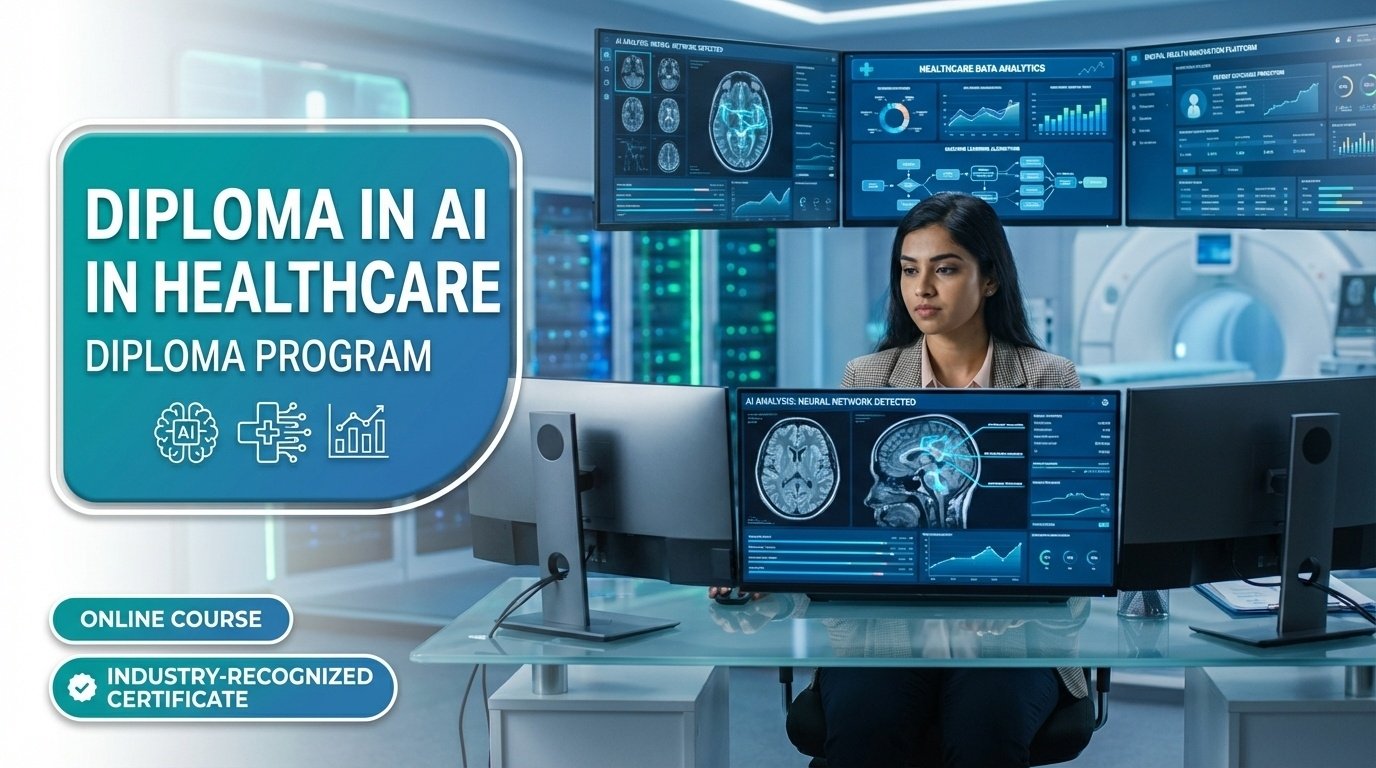
The Diploma in Artificial Intelligence (AI) in Healthcare is a cutting-edge, industry-focused program designed to prepare professionals for the rapidly evolving intersection of artificial intelligence and healthcare. This intensive 1-year diploma offered by Mahatma Gandhi Ayurvigyan Vidyapeeth equips graduates with the technical skills, healthcare domain knowledge, and practical experience needed to implement AI solutions in medical settings, transform patient care, and drive innovation in the healthcare industry.
Program Highlights
Why AI in Healthcare is the Future
Explosive Industry Growth
The global AI in healthcare market is projected to reach $188 billion by 2030, growing at a CAGR of 37%. India is emerging as a major hub for healthcare AI innovation and implementation.
Revolutionary Impact
AI is transforming every aspect of healthcare:
- Diagnostic Accuracy: AI achieves up to 95% accuracy in detecting diseases from medical images
- Early Detection: Identifying diseases years before symptoms appear
- Personalized Medicine: Tailoring treatments to individual genetic profiles
- Drug Discovery: Reducing drug development time from 10+ years to 2-3 years
- Hospital Efficiency: Optimizing operations and reducing costs by 30-40%
High-Demand Career Path
- Massive Talent Shortage: Over 1 million AI healthcare professionals needed globally by 2027
- Premium Salaries: Starting salaries of ₹6-12 LPA, rising to ₹20-50 LPA with experience
- Job Security: AI healthcare roles projected to grow by 40% annually
- Diverse Opportunities: Work with hospitals, tech giants, startups, research institutions, and government
Who Should Enroll?
This program is ideal for:
✓ IT/Computer Science Graduates wanting to specialize in healthcare technology
✓ Healthcare Professionals (doctors, nurses, technicians) seeking tech upskilling
✓ Life Sciences Graduates interested in computational healthcare
✓ Data Analysts looking to specialize in medical data science
✓ Software Developers aspiring to build healthcare AI applications
✓ Entrepreneurs planning healthcare tech startups
✓ Recent Graduates seeking high-growth career opportunities
✓ Career Changers transitioning into healthcare technology
Comprehensive Curriculum
SEMESTER 1: Foundations & Core Technologies
Module 1: Introduction to AI & Healthcare Fundamentals
- Overview of Artificial Intelligence and Machine Learning
- History and evolution of AI in healthcare
- Medical terminology and healthcare systems
- Electronic Health Records (EHR) and Health Information Systems
- Healthcare data types and sources
- Regulatory frameworks: HIPAA, FDA guidelines, ethical considerations
- Introduction to medical imaging modalities (X-Ray, CT, MRI, Ultrasound)
Module 2: Python Programming & Data Analytics
- Python fundamentals for healthcare applications
- NumPy, Pandas for medical data manipulation
- Data visualization with Matplotlib, Seaborn
- Statistical analysis for healthcare data
- Working with healthcare datasets (MIMIC-III, NIH datasets)
- Data preprocessing and cleaning techniques
- Feature engineering for medical data
Module 3: Machine Learning for Healthcare
- Supervised Learning: Classification and Regression
- Disease prediction models
- Patient outcome prediction
- Risk stratification algorithms
- Unsupervised Learning: Clustering and Dimensionality Reduction
- Patient segmentation
- Anomaly detection in medical data
- Model evaluation metrics specific to healthcare
- Cross-validation and overfitting prevention
Module 4: Medical Imaging & Computer Vision
- Fundamentals of computer vision
- Image preprocessing and enhancement
- Convolutional Neural Networks (CNNs)
- Medical image analysis:
- Tumor detection and segmentation
- Disease classification from radiology images
- Retinal image analysis
- Pathology slide analysis
- Transfer learning with pre-trained models
- Image segmentation techniques (U-Net, Mask R-CNN)
- Working with DICOM format
Module 5: Natural Language Processing (NLP) in Healthcare
- Text mining from clinical notes
- Named Entity Recognition (NER) for medical terms
- Clinical documentation automation
- Sentiment analysis for patient feedback
- Medical literature analysis
- Chatbots for patient interaction
- Clinical decision support through NLP
SEMESTER 2: Advanced Applications & Industry Projects
Module 6: Deep Learning for Healthcare
- Deep Neural Networks architecture
- Recurrent Neural Networks (RNNs) for time-series medical data
- LSTM networks for patient monitoring
- Generative Adversarial Networks (GANs) for medical image synthesis
- Attention mechanisms and Transformers
- AI models for genomics and precision medicine
- Explainable AI (XAI) in healthcare
Module 7: Clinical AI Applications
-
Diagnostic AI Systems:
- Cancer detection (lung, breast, skin, colon)
- Cardiovascular disease prediction
- Diabetic retinopathy screening
- Pneumonia detection from chest X-rays
-
Predictive Analytics:
- Hospital readmission prediction
- ICU mortality prediction
- Sepsis early warning systems
- Disease progression modeling
-
Treatment Optimization:
- Clinical decision support systems
- Treatment recommendation engines
- Drug interaction prediction
- Personalized treatment planning
Module 8: Healthcare Data Management & Security
- Healthcare database management
- Big Data in healthcare (Hadoop, Spark)
- Cloud computing for healthcare (AWS, Azure, Google Cloud)
- Data privacy and security protocols
- HIPAA compliance and data anonymization
- Blockchain in healthcare
- Federated learning for privacy-preserving AI
Module 9: AI in Drug Discovery & Genomics
- AI-driven drug discovery pipelines
- Molecular property prediction
- Virtual screening and docking
- Genomic data analysis
- Precision medicine and pharmacogenomics
- CRISPR and gene editing technologies
- Bioinformatics tools and databases
Module 10: Healthcare AI Deployment & MLOps
- Model deployment strategies
- Creating REST APIs for AI models
- Containerization with Docker
- Model monitoring and maintenance
- A/B testing in healthcare applications
- Continuous integration/continuous deployment (CI/CD)
- FDA approval process for AI medical devices
- Real-world implementation challenges
Module 11: Capstone Project & Industry Training
- Real-world healthcare AI project
- Industry mentorship and guidance
- End-to-end ML pipeline development
- Project presentation and documentation
- Portfolio development
- Industry internship opportunities
- Collaboration with hospitals/healthcare organizations
Key Skills You Will Master
Technical Skills:
✓ Programming: Python, R, SQL
✓ Machine Learning: Scikit-learn, XGBoost, Random Forests
✓ Deep Learning: TensorFlow, Keras, PyTorch
✓ Computer Vision: OpenCV, medical imaging libraries
✓ NLP: NLTK, SpaCy, Hugging Face Transformers
✓ Data Tools: Pandas, NumPy, Matplotlib, Seaborn
✓ Big Data: Spark, Hadoop basics
✓ Cloud Platforms: AWS, Azure, Google Cloud
✓ Version Control: Git, GitHub
Healthcare Domain Skills:
✓ Medical terminology and anatomy basics
✓ Understanding of clinical workflows
✓ Healthcare data standards (HL7, FHIR)
✓ Regulatory compliance (HIPAA, FDA, GDPR)
✓ Clinical decision-making processes
✓ Patient safety and quality metrics
Professional Skills:
✓ Problem-solving in healthcare contexts
✓ Cross-functional team collaboration
✓ Technical communication to non-technical stakeholders
✓ Project management and agile methodologies
✓ Ethical AI decision-making
✓ Research and continuous learning
Career Opportunities & Roles
Healthcare AI Specialist Roles:
1. AI Healthcare Engineer ₹6-15 LPA
- Develop and deploy AI solutions for hospitals and clinics
- Build predictive models for patient outcomes
- Implement computer vision systems for medical imaging
2. Medical Imaging AI Specialist ₹8-20 LPA
- Develop AI algorithms for radiology and pathology
- Work on tumor detection and disease classification
- Collaborate with radiologists and pathologists
3. Healthcare Data Scientist ₹7-18 LPA
- Analyze large-scale healthcare datasets
- Build predictive analytics models
- Generate insights for clinical and business decisions
4. Clinical AI Consultant ₹10-25 LPA
- Advise healthcare organizations on AI adoption
- Design AI strategies for hospitals
- Conduct feasibility studies and ROI analysis
5. AI Drug Discovery Scientist ₹8-22 LPA
- Apply AI to pharmaceutical research
- Molecular modeling and virtual screening
- Work with biotech and pharma companies
6. Healthcare NLP Engineer ₹7-16 LPA
- Process clinical notes and medical records
- Build chatbots and virtual health assistants
- Automate medical documentation
7. Telemedicine AI Developer ₹6-14 LPA
- Develop AI-powered telemedicine platforms
- Remote patient monitoring systems
- Virtual diagnostic assistants
8. Healthcare Research Scientist ₹8-20 LPA
- Conduct research at academic/medical institutions
- Publish papers in top-tier journals
- Advance state-of-the-art in healthcare AI
Employment Sectors
Healthcare Providers:
- Hospitals and hospital chains
- Diagnostic centers and laboratories
- Specialty clinics (oncology, cardiology, radiology)
- Telemedicine companies
Technology Companies:
- Google Health, Microsoft Healthcare, IBM Watson Health
- Healthcare AI startups (Qure.ai, Niramai, SigTuple)
- Health tech product companies
- Medical device manufacturers
Pharmaceutical & Biotech:
- Drug discovery companies
- Clinical research organizations (CROs)
- Genomics companies
- Precision medicine startups
Government & Research:
- AIIMS, NIH, ICMR research projects
- Government health tech initiatives
- Academic research institutions
- Public health organizations
Entrepreneurship:
- Start your own healthcare AI company
- Build AI-powered diagnostic tools
- Develop health tech SaaS products
- Healthcare consulting services
Salary Potential
Freshers (0-2 years):
- Entry-level AI Healthcare Developer: ₹6-12 LPA
- Junior Data Scientist (Healthcare): ₹7-14 LPA
- Medical Imaging Analyst: ₹8-15 LPA
Mid-Level (3-5 years):
- Senior AI Engineer: ₹15-30 LPA
- Healthcare Data Science Lead: ₹18-35 LPA
- AI Product Manager (Healthcare): ₹20-40 LPA
Experienced (5+ years):
- Principal AI Scientist: ₹30-50 LPA
- Healthcare AI Architect: ₹35-60 LPA
- AI Research Director: ₹40-80 LPA
Freelance/Consulting:
- Project-based earnings: ₹50,000 - ₹5,00,000+ per project
- Hourly rates: ₹2,000 - ₹10,000+ per hour
Industry-Relevant Tools & Technologies
Programming & Development:
- Python, R, Java, C++
- Jupyter Notebooks, Google Colab
- Visual Studio Code, PyCharm
Machine Learning Frameworks:
- TensorFlow, Keras, PyTorch
- Scikit-learn, XGBoost, LightGBM
- Fast.ai, Hugging Face
Medical Imaging:
- 3D Slicer, ITK-SNAP
- PyDICOM, SimpleITK, Nibabel
- MedPy, TorchIO
Data Processing:
- Apache Spark, Hadoop
- MongoDB, PostgreSQL
- ElasticSearch
Cloud & Deployment:
- AWS (SageMaker, EC2, S3)
- Google Cloud (Vertex AI, Cloud Healthcare API)
- Microsoft Azure (Azure ML, FHIR Service)
- Docker, Kubernetes
- MIMIC-III database
- CheXpert dataset
- NIH ChestX-ray8
- BraTS (Brain Tumor Segmentation)
- ISIC (Skin Lesion Analysis)
Unique Program Features
Industry-Aligned Curriculum
Designed in consultation with leading healthcare AI companies and medical institutions to ensure industry relevance.
Hands-On Project-Based Learning
Work on real healthcare datasets and build portfolio-worthy projects that demonstrate your skills to employers.
Hospital Collaboration
Access to anonymized medical data and collaboration opportunities with partner hospitals for practical exposure.
Expert Faculty
Learn from professionals with experience in both AI/ML and healthcare domains, including guest lectures from industry leaders.
Research Opportunities
Contribute to cutting-edge research papers and participate in healthcare AI competitions.
Placement Assistance
Dedicated placement support with connections to healthcare AI companies, startups, and hospitals.
Industry Certification Preparation
Prepare for certifications like Google Cloud Healthcare Data Engineer, AWS Machine Learning Specialty.
Global Perspective
Learn about international healthcare systems, regulations, and best practices in AI implementation.
Eligibility Criteria
Educational Qualification:
- Required: Bachelor's degree (B.Tech/B.E./B.Sc./BCA/Any Graduate)
- Preferred Streams:
- IT/Computer Science/Software Engineering
- Electronics/Electrical Engineering
- Life Sciences/Biotechnology/Bioinformatics
- Physics/Mathematics/Statistics
- Healthcare professionals (MBBS/BDS/BAMS/BHMS/Nursing)
Prerequisites (Preferred but not mandatory):
- Basic programming knowledge (any language)
- Basic understanding of statistics
- Familiarity with data analysis concepts
- Interest in healthcare and medicine
Skills to Bring:
- Analytical thinking and problem-solving
- Passion for technology and healthcare
- Willingness to learn new technologies
- Strong work ethic and dedication
About Mahatma Gandhi Ayurvigyan Vidyapeeth
Mahatma Gandhi Ayurvigyan Vidyapeeth is a progressive, government-approved private university in Nagpur, Maharashtra, committed to bridging traditional healthcare wisdom with modern technology. The institution is pioneering healthcare education by introducing cutting-edge programs like AI in Healthcare.
Why Choose MGAV for AI in Healthcare?
✓ Technology-Forward Approach: Modern computer labs with high-performance GPUs for AI training
✓ Healthcare Expertise: Deep understanding of medical systems and clinical workflows
✓ Industry Partnerships: Collaborations with hospitals, tech companies, and research institutions
✓ Practical Training: Access to real medical datasets (anonymized and ethics-compliant)
✓ Affordable Excellence: World-class education at a fraction of international program costs
✓ Strategic Location: Nagpur's growing tech ecosystem with emerging healthcare AI startups
✓ Holistic Development: Technical skills + healthcare domain knowledge + soft skills
Program Structure
Learning Methodology:
- 40% Theory: Conceptual foundations and theoretical knowledge
- 40% Practical: Hands-on coding, projects, and labs
- 20% Projects: Real-world applications and capstone project
Evaluation System:
- Internal assessments and quizzes
- Mid-term and end-term examinations
- Project submissions and presentations
- Capstone project evaluation
- Industry internship assessment (if applicable)
Class Schedule:
- Weekday Batch: Monday to Friday (Morning/Evening slots)
- Weekend Batch: Saturday and Sunday (For working professionals)
- Flexible Learning: Recorded lectures and online resources
Admission Process
Step 1: Online Application
Submit your application through the official website with required documents.
Step 2: Document Verification
Upload degree certificates, mark sheets, ID proof, and photographs.
Step 3: Entrance Assessment (Optional)
Basic aptitude test covering logical reasoning, quantitative ability, and basic computer knowledge.
Step 4: Interview/Counseling
Discussion about career goals, program expectations, and course suitability.
Step 5: Fee Payment & Enrollment
Complete fee payment and receive enrollment confirmation.
Step 6: Orientation
Attend orientation program and receive course materials, lab access credentials.
Required Documents:
- Bachelor's degree certificate and mark sheets
- 10th and 12th mark sheets
- Transfer/Migration certificate (if applicable)
- ID proof (Aadhar/PAN/Passport)
- 4 passport-size photographs
- Category certificate (if applicable for reservations)
Future Learning Pathways
After completing this diploma, you can pursue:
Advanced Certifications:
- Google Cloud Healthcare Data Engineer
- AWS Certified Machine Learning Specialty
- Microsoft Azure AI Engineer Associate
- TensorFlow Developer Certificate
Master's Programs:
- M.Tech in Artificial Intelligence
- M.Sc. in Data Science & AI
- Master's in Health Informatics
- MBA in Healthcare Management
PhD & Research:
- Doctoral programs in Healthcare AI
- Research positions at top institutions
- Industry research labs (Google, Microsoft, IBM)
Frequently Asked Questions
Q: Do I need programming experience to enroll?
A: Basic programming knowledge is helpful but not mandatory. We start with Python fundamentals.
Q: Can healthcare professionals without IT background join?
A: Absolutely! We have a specialized track for healthcare professionals transitioning into AI.
Q: Will I get placement assistance?
A: Yes, dedicated placement cell with connections to 100+ healthcare and tech companies.
Q: Is the course updated with latest AI technologies?
A: Curriculum is reviewed quarterly to include latest developments in healthcare AI.
Q: Can I pursue this while working full-time?
A: Yes, weekend batch option available for working professionals.
Q: What if I don't have a science background?
A: Any graduate can apply. We cover necessary fundamentals during the program.
Investment in Your Future
Program Fee: ₹1,00,000
(Complete 1-year diploma program)
What's Included:
✓ Comprehensive course materials and e-resources
✓ Access to cloud computing platforms (AWS/GCP credits)
✓ Medical datasets and databases
✓ Project mentorship and guidance
✓ Industry expert guest lectures
✓ Placement assistance and career counseling
✓ Certificate of completion
✓ Alumni network access
✓ Lifetime learning resource access
Payment Options:
- One-time payment with discount
- Semester-wise installments
- Education loan assistance
- Scholarship opportunities for meritorious students
Limited Seats - Enroll Now!