
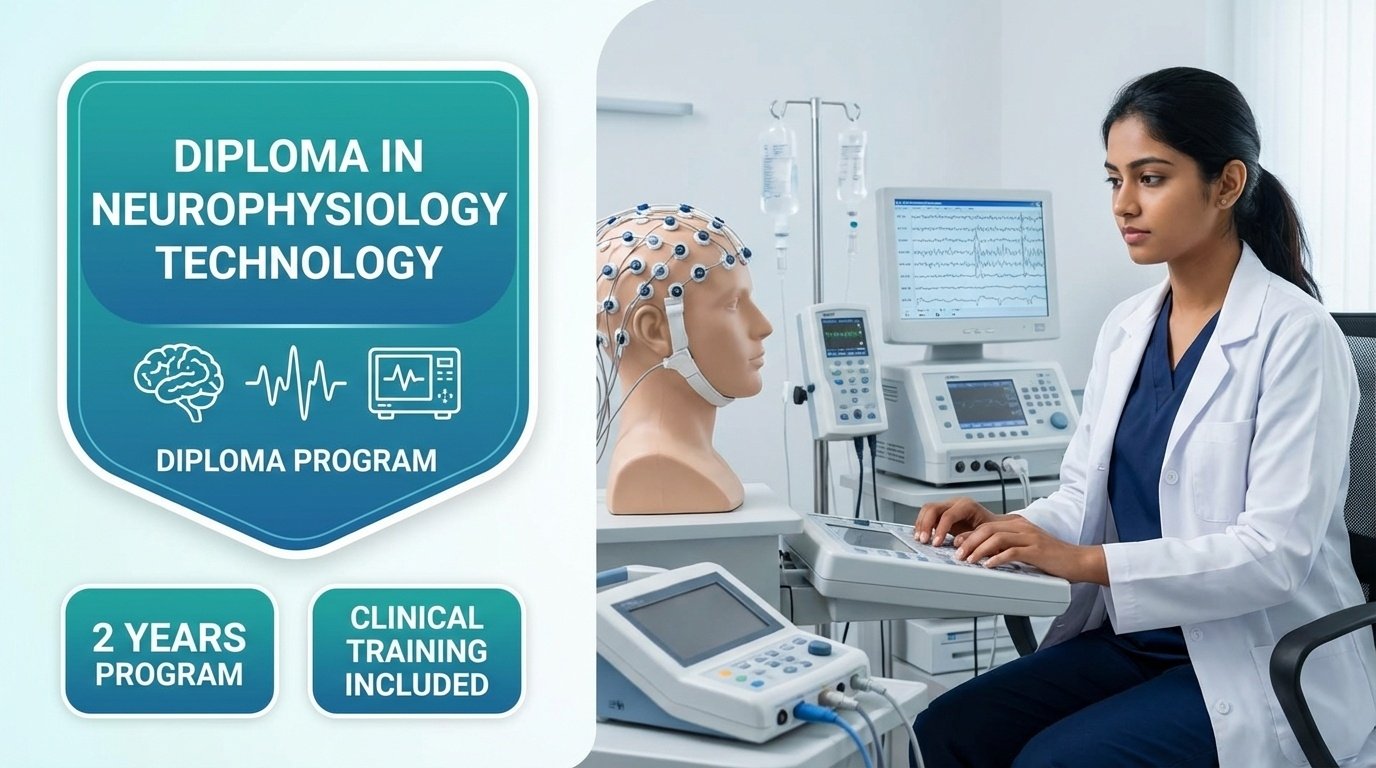
Diploma in Neurophysiology Technology
Program Overview
The Diploma in Neurophysiology Technology is an elite, specialized paramedical program designed to train skilled technologists in the fascinating field of brain and nervous system diagnostics. This comprehensive 2-year diploma combines neuroscience, medical technology, and patient care to prepare competent professionals who operate sophisticated neurodiagnostic equipment, perform crucial diagnostic tests, and assist neurologists in diagnosing and monitoring neurological disorders. As neurological conditions become increasingly prevalent and advanced neurodiagnostic technologies emerge, neurophysiology technologists are becoming indispensable members of modern neurology and neurosurgery teams.
Program Highlights
- Category: Paramedical - Neurodiagnostic Sciences
- Duration: 2 Years (Full-time with Intensive Clinical Training)
- Eligibility: 10+2 with Science stream (PCB/PCM)
- Total Fee: ₹90,000
- Institute: Mahatma Gandhi Ayurvigyan Vidyapeeth
- Mode: Regular/On-Campus with Hospital-Based Practical Training
- Career Focus: Brain & Nervous System Diagnostics
- Entry Advantage: Start specialized neuro-career directly after 12th!
- Technology-Driven: Work with cutting-edge neurological equipment
What is Neurophysiology Technology? Understanding the Specialty
The Science of Brain & Nerve Function:
Neurophysiology Technology is the specialized field focused on recording and analyzing the electrical activity of the brain, spinal cord, and peripheral nerves to diagnose neurological disorders. Neurophysiology technologists are skilled professionals who operate complex neurodiagnostic equipment, conduct various neurological tests, and provide critical data that helps physicians diagnose conditions ranging from epilepsy and stroke to sleep disorders and nerve damage.
Core Neurodiagnostic Procedures:
1. Electroencephalography (EEG):
- Recording brain's electrical activity
- Diagnosing epilepsy and seizure disorders
- Assessing brain function in coma patients
- Monitoring during brain surgery
- Sleep disorder evaluation
- Brain death determination
2. Electromyography (EMG):
- Testing muscle electrical activity
- Diagnosing muscle diseases
- Assessing nerve-muscle communication
- Detecting neuromuscular disorders
3. Nerve Conduction Studies (NCS):
- Measuring nerve signal speed and strength
- Diagnosing peripheral neuropathy
- Carpal tunnel syndrome testing
- Diabetic neuropathy assessment
- Nerve injury evaluation
4. Evoked Potentials (EP):
- Visual Evoked Potential (VEP): Testing optic nerve function
- Brainstem Auditory Evoked Response (BAER): Hearing pathway testing
- Somatosensory Evoked Potential (SSEP): Sensory pathway evaluation
- Monitoring during spinal surgery
5. Polysomnography (Sleep Studies):
- Diagnosing sleep disorders
- Sleep apnea detection
- Narcolepsy assessment
- REM sleep behavior disorder
- Overnight sleep monitoring
6. Intraoperative Neuromonitoring (IONM):
- Real-time monitoring during neurosurgery
- Preventing nerve damage during surgery
- Spinal cord monitoring
- Brain mapping during tumor removal
7. Transcranial Doppler (TCD):
- Measuring blood flow in brain arteries
- Stroke risk assessment
- Monitoring after brain injury
8. Video EEG Monitoring:
- Long-term seizure monitoring (24-72 hours)
- Epilepsy surgery evaluation
- Differentiating seizure types
The Neurophysiology Technologist's Role:
Pre-Test Responsibilities:
- Patient preparation and education
- Electrode placement (proper anatomical positioning)
- Equipment calibration and setup
- Verifying physician orders
- Ensuring patient safety and comfort
During Testing:
- Operating sophisticated neurodiagnostic equipment
- Recording high-quality tracings
- Monitoring patient condition
- Performing activation procedures (hyperventilation, photic stimulation)
- Troubleshooting technical issues
- Recognizing abnormal patterns requiring immediate attention
Post-Test Duties:
- Data analysis and preliminary review
- Report generation
- Equipment cleaning and maintenance
- Documentation and record-keeping
- Communication with neurologists
- Quality assurance activities
Why Choose Neurophysiology Technology? The Compelling Case
???? Rapidly Growing Specialty:
Market Dynamics:
- Neurological disorders in India: 30+ million people affected
- Epilepsy prevalence: 10-12 million patients (highest globally)
- Stroke incidence: 1.8 million annually (increasing 15% yearly)
- Sleep disorder epidemic: 150+ million Indians with sleep problems
- Diabetes neuropathy: Rising with 77 million diabetics
- Aging population: Dementia, Parkinson's cases increasing
- Road accidents: Traumatic brain injuries requiring neurodiagnostics
Industry Growth:
- Neurodiagnostic equipment market: $9.2 billion globally (2023)
- Expected growth: 7.5% CAGR through 2030
- Every major hospital establishing neurology departments
- Standalone neurology clinics and sleep centers proliferating
- Telemedicine-enabled remote EEG monitoring emerging
Critical Shortage:
- Less than 3,000 trained neurophysiology technologists in India
- 500+ neurology centers desperately seeking skilled staff
- Patient-to-technologist ratio: Severely imbalanced
- Multiple job offers common for graduates
- Near-zero unemployment in this specialty
???? Lucrative Career Earnings:
Salary Progression:
| Experience Level | Hospital/Clinical | Specialized Centers | International |
|---|---|---|---|
| Fresher (0-2 years) | ₹2.5 - 4.0 LPA | ₹3.0 - 4.5 LPA | ₹6 - 10 LPA (Middle East) |
| Junior (2-4 years) | ₹4.0 - 6.5 LPA | ₹5.0 - 7.5 LPA | ₹8 - 14 LPA |
| Senior (4-8 years) | ₹6.5 - 11.0 LPA | ₹8.0 - 13.0 LPA | ₹12 - 20 LPA |
| Chief/Manager (8+ years) | ₹10.0 - 18.0 LPA | ₹12.0 - 20.0 LPA | ₹18 - 30 LPA |
Additional Income Streams:
- On-call duties: ₹1,500 - 3,000 per emergency call
- Weekend/night shifts: Premium rates (1.5x - 2x base pay)
- Private clinic consultations: ₹1,000 - 2,500 per test
- Training workshops: ₹5,000 - 15,000 per session
- Equipment company consulting: Additional revenue
- Freelance services: Multiple hospital affiliations possible
Benefits Package:
- Medical insurance (₹3-5 lakhs coverage)
- Annual performance bonuses (10-20%)
- Conference and CME sponsorships
- Professional development allowances
- Housing/transport benefits (larger institutions)
- Shift allowances and meal subsidies
???? Early Career Entry Advantage:
Why Start After 12th:
- Begin earning at 20 years old (vs 22-24 for degree students)
- 2-3 years career head start
- Specialized skill development from day one
- Lower education investment than B.Sc. programs
- Can upgrade while working - pursue B.Sc. through lateral entry
- Build expertise early in high-demand specialty
Career Timeline Comparison:
| Educational Path | Age Start Working | Experience at 25 | Typical Position at 25 |
|---|---|---|---|
| Diploma (12th+2yr) | 20 years | 5 years | Senior Technologist |
| B.Sc. Neuro Tech (12th+3yr) | 21 years | 4 years | Junior-Mid Level |
| After Any Graduation (15+3+2) | 23 years | 2 years | Entry Level |
???? Diverse Work Environments:
Employment Settings:
1. Multi-Specialty Hospitals:
- Neurology departments
- Neurosurgery units
- Critical care and ICU
- Emergency departments
- Sleep centers
- Comprehensive neurodiagnostic labs
2. Specialized Neuro Centers:
- Dedicated neurology hospitals
- Epilepsy monitoring units
- Sleep disorder clinics
- Stroke centers
- Headache and pain clinics
- Movement disorder centers
3. Diagnostic Centers:
- Standalone EEG/EMG clinics
- Imaging centers with neurophysiology
- Mobile EEG services
- Home-based neurodiagnostics
4. Academic & Research:
- Medical colleges with neurology
- Neuroscience research institutes
- Clinical trial centers
- Teaching hospitals
5. Equipment Companies:
- Clinical application specialists
- Product trainers and demonstrators
- Technical support teams
- Sales and marketing (clinical side)
6. Telemedicine:
- Remote EEG monitoring services
- Tele-neurology platforms
- Cloud-based neurodiagnostic centers
???? International Opportunities:
Global Demand:
Middle East (Excellent Opportunities):
- UAE, Saudi Arabia, Qatar, Kuwait, Oman
- Tax-free salaries: ₹6 - 20 LPA
- Modern facilities with latest equipment
- Accommodation and benefits included
- Strong demand for Indian technologists
- Work visa sponsorship provided
Western Countries:
- USA: After R.EEG.T or CNIM certification
- Salary: $45,000 - 75,000 annually
- High demand in hospitals and clinics
- UK, Ireland: NHS jobs available
- Canada: After CBNC certification
- Australia, New Zealand: Growing demand
Certification Pathways for International Work:
- R.EEG.T (Registered EEG Technologist) - ABRET, USA
- CNIM (Certified Neurophysiologic Intraoperative Monitoring)
- RPSGT (Registered Polysomnographic Technologist)
- R.EP.T (Registered Evoked Potentials Technologist)
???? Advanced Technology Exposure:
Work with Cutting-Edge Equipment:
- High-density EEG systems (128-256 channels)
- Digital EMG/NCS machines
- Polysomnography systems with full video
- Intraoperative monitoring systems
- Transcranial Doppler ultrasound
- Evoked potential equipment
- Brain mapping systems
- Seizure detection algorithms and AI
- Wireless ambulatory EEG
- Cloud-based neurodiagnostic platforms
Constantly Evolving Field:
- New diagnostic techniques emerging
- AI-assisted interpretation tools
- Wearable EEG devices
- Remote monitoring technologies
- Never stagnant or boring!
???? Job Security & Stability:
Why Neurophysiology Tech is Recession-Proof:
- Highly specialized skills - cannot be easily replaced
- Cannot be automated - requires human expertise and judgment
- Essential medical service - neurological testing always needed
- Growing patient population - neurological disorders increasing
- Critical for diagnosis - no alternative to these tests
- Multi-department demand - neurology, neurosurgery, ICU, sleep medicine
Professional Respect:
- Recognized as skilled specialist
- Work alongside neurologists and neurosurgeons
- Critical role in patient diagnosis and care
- Valued member of neuroscience team
- Professional certification enhances credibility
⚖️ Excellent Work-Life Balance:
Reasonable Working Conditions:
- Regular day shifts in most settings (8-10 hours)
- Scheduled procedures - not constant emergencies
- Clean, air-conditioned lab environment
- Limited physical strain - mostly sitting work
- On-call manageable with compensation
- Weekends often free except scheduled on-calls
- Professional work environment
- Intellectual stimulation without extreme stress
Compared to Other Medical Fields:
- Less stressful than ICU/emergency nursing
- Better hours than radiology technologists (less 24/7 coverage)
- More predictable than operation theater work
- Cleaner environment than laboratory work
Comprehensive Curriculum Structure
Year 1: Foundation & Basic Neurodiagnostic Techniques
Semester 1: Fundamental Sciences & Neuroanatomy
Human Anatomy & Physiology:
Nervous System Anatomy (Detailed):
-
Central Nervous System:
- Brain anatomy (cerebrum, cerebellum, brainstem)
- Cerebral cortex - lobes and functional areas
- Motor cortex and sensory cortex
- Basal ganglia and thalamus
- Limbic system
- Ventricles and CSF circulation
- Meninges and protective layers
- Spinal cord anatomy (segments, tracts)
- Gray matter and white matter organization
-
Peripheral Nervous System:
- Cranial nerves (12 pairs) - anatomy and function
- Spinal nerves - dermatome and myotome distribution
- Nerve plexuses (cervical, brachial, lumbar, sacral)
- Autonomic nervous system (sympathetic, parasympathetic)
- Sensory and motor pathways
-
Muscular System:
- Skeletal muscle anatomy
- Muscle fiber types
- Neuromuscular junction
- Major muscle groups and innervation
- Reflex arcs
Neurophysiology:
-
Cellular Neurophysiology:
- Neuron structure and types
- Resting membrane potential
- Action potential generation and propagation
- Saltatory conduction
- Synaptic transmission (chemical and electrical)
- Neurotransmitters and receptors
-
Brain Function:
- Consciousness and arousal
- Sleep-wake cycle physiology
- Memory formation and consolidation
- Sensory processing
- Motor control mechanisms
- Brain plasticity
-
Nerve Function:
- Sensory nerve conduction
- Motor nerve conduction
- Nerve conduction velocity
- Neuromuscular transmission
- Reflex mechanisms
Medical Physics & Electronics:
-
Basic Physics:
- Electricity and magnetism
- Ohm's law and electrical circuits
- Impedance and resistance
- Signal processing basics
-
Biomedical Instrumentation:
- Electrodes and electrode types
- Amplifiers and filters
- Analog-to-digital conversion
- Signal acquisition systems
- Noise reduction techniques
- Electrical safety in medical equipment
Biochemistry & Pathophysiology:
- Brain metabolism
- Neurotransmitter biochemistry
- Electrolyte balance and nerve function
- Biochemical markers of neurological disease
- Basic pathological processes
- Inflammatory and degenerative processes
Medical Terminology:
- Neurological terminology
- Anatomical terms and directions
- Common abbreviations in neurology
- Medical report reading
- Understanding physician orders
Patient Care & Communication:
- Patient assessment basics
- Vital signs monitoring
- Patient positioning and comfort
- Infection control and universal precautions
- Medical ethics and professional conduct
- Communication with patients and families
- Handling anxious or difficult patients
- Pediatric and geriatric considerations
Semester 2: Electroencephalography (EEG) Fundamentals
Introduction to EEG:
- History and evolution of EEG
- Principles of electroencephalography
- Electrical activity of the brain
- EEG frequency bands (delta, theta, alpha, beta, gamma)
- Normal EEG patterns across age groups
- Sleep stages and EEG characteristics
- Artifacts vs. genuine brain activity
EEG Equipment & Technology:
-
EEG Machine Components:
- Amplifiers and their functions
- Digital EEG systems
- Electrode placement systems
- Recording parameters (sensitivity, filters, time constants)
- Montage design and selection
-
Electrode Systems:
- 10-20 International Electrode System
- Electrode types (cup, needle, subdermal)
- Electrode impedance checking
- Proper electrode application techniques
- Electrode care and maintenance
EEG Recording Techniques:
-
Patient Preparation:
- Pre-test instructions (medication, sleep deprivation)
- Scalp preparation and cleaning
- Electrode placement (precise anatomical positioning)
- Impedance testing and troubleshooting
- Patient positioning
-
Standard EEG Procedure:
- Routine EEG protocol
- Recording time and conditions
- Activation procedures:
- Hyperventilation
- Photic stimulation
- Sleep recording
- Eye opening/closing
- Behavioral monitoring during recording
- Notation and marking events
-
Special EEG Techniques:
- Sleep-deprived EEG
- Ambulatory EEG (24-hour monitoring)
- Video EEG monitoring
- Neonatal and pediatric EEG
- ICU/bedside EEG
Normal EEG Patterns:
-
Age-Related Patterns:
- Neonatal EEG
- Infant and childhood EEG
- Adolescent EEG
- Adult EEG
- Elderly EEG
-
State-Related Patterns:
- Awake - eyes open vs. eyes closed
- Drowsiness
- Sleep stages (N1, N2, N3, REM)
- Post-hyperventilation patterns
EEG Artifacts:
-
Physiological Artifacts:
- Eye movements (blinks, lateral eye movements)
- Muscle artifacts (EMG contamination)
- ECG artifact
- Glossokinetic artifact (tongue movements)
- Pulse artifact
- Breathing artifact
-
Technical Artifacts:
- Electrode artifacts (poor contact, pop-off)
- 50/60 Hz electrical interference
- Movement artifacts
- Cable artifacts
- Equipment malfunction
Introduction to Abnormal EEG:
- Epileptiform discharges (spikes, sharp waves)
- Focal vs. generalized abnormalities
- Slowing (focal and diffuse)
- Asymmetries
- Burst suppression
- Recognizing urgent patterns (status epilepticus)
Clinical Neurology Basics:
- Common neurological symptoms
- Neurological examination overview
- Classification of seizures and epilepsy
- Stroke and cerebrovascular disease
- Encephalopathy and metabolic disorders
- Neurodegenerative diseases
- Brain tumors and mass lesions
Practical Training (Semester 1 & 2):
- Neuroanatomy models and dissection study
- EEG machine operation practice
- Electrode placement training (on mannequins and peers)
- Impedance testing drills
- Artifact recognition exercises
- Montage creation and manipulation
- Simulated EEG recordings
- Hospital visits and observations
- Video analysis of EEG procedures
Year 2: Advanced Neurodiagnostics & Clinical Expertise
Semester 3: Advanced EEG & Electromyography
Advanced EEG Interpretation:
Epilepsy & Seizure Disorders:
-
Seizure Classification:
- Focal seizures (aware, impaired awareness)
- Generalized seizures (tonic-clonic, absence, myoclonic, atonic)
- Unknown onset seizures
-
Epileptiform Patterns:
- Interictal discharges (spikes, sharp waves, spike-wave complexes)
- Ictal patterns (seizure activity on EEG)
- Post-ictal patterns
- Specific epilepsy syndromes:
- Juvenile myoclonic epilepsy
- Childhood absence epilepsy
- Benign rolandic epilepsy
- West syndrome (infantile spasms)
- Lennox-Gastaut syndrome
Non-Epileptic EEG Abnormalities:
- Focal slowing (brain lesions, tumors, stroke)
- Diffuse slowing (encephalopathy, metabolic disorders)
- Triphasic waves (hepatic encephalopathy)
- Periodic patterns (CJD, SSPE)
- Alpha coma
- Spindle coma
- Brain death criteria on EEG
Long-Term EEG Monitoring:
- Video-EEG monitoring setup
- Seizure detection and analysis
- Pre-surgical epilepsy evaluation
- Psychogenic non-epileptic seizures (PNES) identification
- Medication adjustment monitoring
- Event button correlation
Intensive Care EEG:
- Continuous EEG monitoring in ICU
- Status epilepticus detection
- Burst suppression in induced coma
- Ischemia monitoring
- Prognostication in coma
- Bedside EEG challenges
Electromyography (EMG) & Nerve Conduction Studies:
EMG Fundamentals:
- Principles of electromyography
- Motor unit action potential (MUAP)
- Muscle fiber physiology
- Neuromuscular junction function
- EMG equipment and electrodes (needle and surface)
EMG Recording Technique:
-
Patient Preparation:
- Pre-test instructions (medications to avoid)
- Positioning for different muscles
- Skin preparation and antisepsis
- Pain management and patient comfort
-
Needle EMG Procedure:
- Needle insertion technique
- Insertional activity assessment
- Spontaneous activity observation (fibrillation, fasciculation)
- Voluntary activity recording
- MUAP analysis (amplitude, duration, phases)
- Recruitment pattern assessment
- Multiple muscle sampling
Nerve Conduction Studies (NCS):
-
Principles:
- Nerve stimulation and recording
- Latency, amplitude, conduction velocity
- Sensory vs. motor nerve testing
- Compound muscle action potential (CMAP)
- Sensory nerve action potential (SNAP)
-
Common NCS Procedures:
-
Upper Limb:
- Median nerve (motor and sensory)
- Ulnar nerve
- Radial nerve
- Musculocutaneous nerve
-
Lower Limb:
- Peroneal nerve
- Tibial nerve
- Sural nerve
- Femoral nerve
-
Special Studies:
- F-wave and H-reflex
- Repetitive nerve stimulation (RNS) - for myasthenia gravis
- Blink reflex
-
