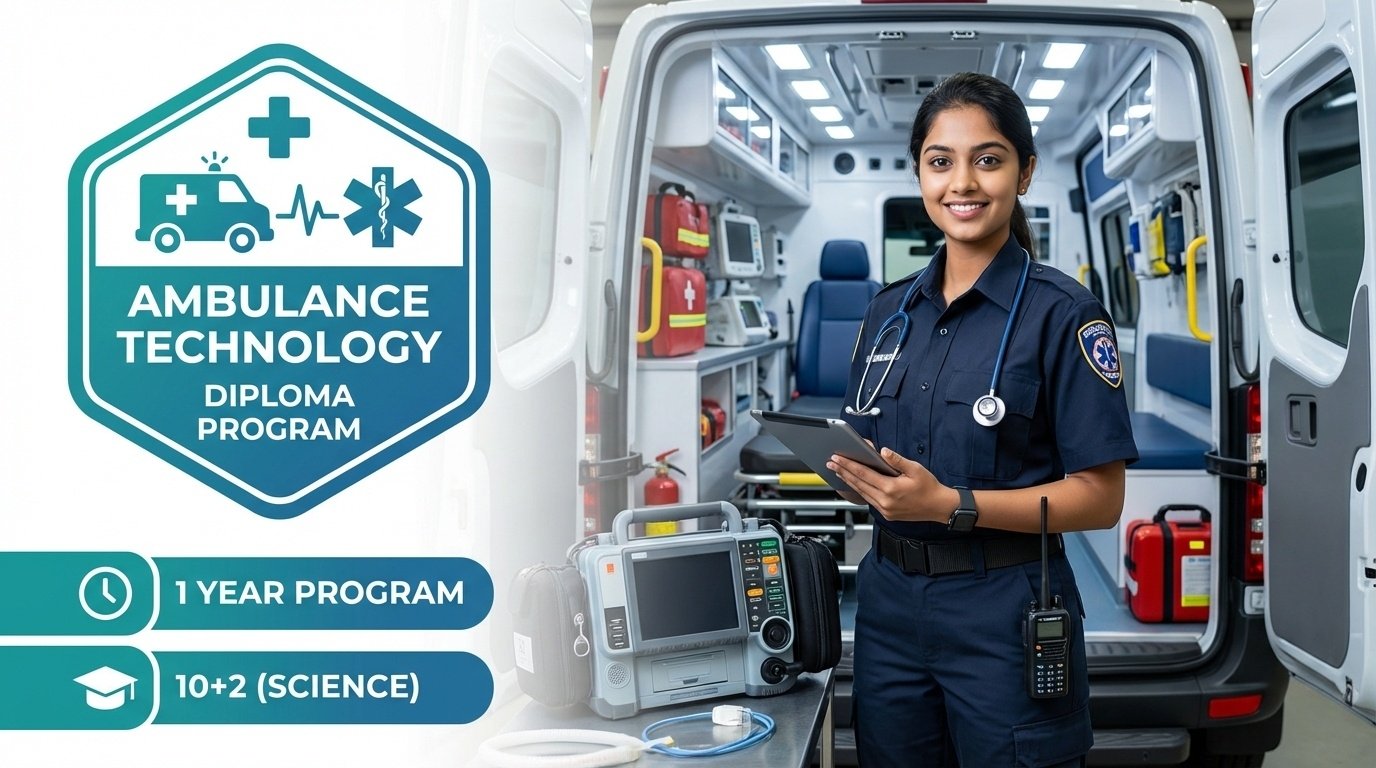
Diploma in Ambulance Technology
Complete Course Guide & Career Pathway
Course Overview
The Diploma in Ambulance Technology is a specialized paramedical program designed to train highly skilled professionals in emergency medical services, ambulance operations, and pre-hospital care. This comprehensive course combines medical knowledge with technical expertise to prepare students for critical roles in emergency response systems.
Ambulance Technologists are essential healthcare professionals who serve as the vital link between emergency scenes and hospital care. They are trained to operate advanced medical equipment, provide life-saving interventions, manage ambulance operations, and ensure safe patient transport during critical situations.
This program goes beyond basic emergency response, incorporating advanced medical technology, ambulance fleet management, communication systems, and modern emergency medical service protocols aligned with international standards.
Course at a Glance
Program Objectives
- Emergency Medical Expertise: Master pre-hospital emergency care and trauma management
- Technical Proficiency: Operate and maintain advanced ambulance medical equipment
- Life Support Skills: Provide Basic Life Support (BLS) and Advanced Cardiac Life Support (ACLS)
- Ambulance Operations: Understand fleet management, logistics, and emergency response coordination
- Patient Care Excellence: Deliver compassionate and efficient care during transport
- Safety Management: Implement infection control and safety protocols in mobile healthcare
- Communication Skills: Coordinate effectively with dispatch centers, hospitals, and emergency services
- Crisis Management: Handle mass casualty situations and disaster response operations
Detailed Curriculum Structure
YEAR 1 - Foundation & Core Modules
Semester 1: Medical Foundations
-
Human Anatomy & Physiology
- Cardiovascular, respiratory, and nervous systems
- Musculoskeletal structure and function
- Body systems relevant to emergency care
-
Medical Biochemistry & Nutrition
- Metabolic processes
- Nutritional requirements in critical care
- Fluid and electrolyte balance
-
Microbiology & Infection Control
- Pathogenic microorganisms
- Sterilization and disinfection techniques
- Biosafety in ambulance settings
-
Pharmacology for Emergency Care
- Emergency medications and their uses
- Drug administration routes
- Medication safety and adverse reactions
-
Medical Terminology
- Healthcare vocabulary
- Medical abbreviations and documentation
- Professional communication standards
-
Basic Life Support (BLS)
- CPR techniques (adult, child, infant)
- AED operation
- Choking management
Semester 2: Emergency Care Basics
-
First Aid & Emergency Response
- Initial assessment and triage
- Wound care and hemorrhage control
- Bandaging and splinting techniques
-
Patient Assessment & Vital Signs
- Primary and secondary survey
- Vital signs monitoring and interpretation
- Documentation and reporting
-
Airway Management
- Oxygen therapy
- Suction techniques
- Basic airway adjuncts
-
Introduction to Ambulance Technology
- Types of ambulances and their equipment
- Ambulance design and specifications
- Vehicle safety standards
-
Medical Equipment Operation
- Stretchers and lifting devices
- Spine boards and cervical collars
- Diagnostic equipment basics
-
Communication Systems
- Radio communication protocols
- Emergency dispatch systems
- Hospital handover procedures
YEAR 2 - Advanced Training & Specialization
Semester 3: Advanced Emergency Care
-
Advanced Trauma Life Support (ATLS)
- Multiple trauma management
- Head, chest, and abdominal injuries
- Burn care and management
- Fracture stabilization
-
Cardiac Emergency Management
- Acute coronary syndromes
- ECG interpretation basics
- Defibrillation and cardioversion
- Stroke recognition and care
-
Respiratory Emergencies
- Asthma and COPD management
- Ventilation support
- Pneumothorax and tension pneumothorax
-
Medical Emergencies
- Diabetic emergencies
- Seizures and altered consciousness
- Allergic reactions and anaphylaxis
- Poisoning and overdose management
-
Special Populations
- Pediatric emergency care
- Geriatric considerations
- Obstetric emergencies and childbirth
- Psychiatric emergencies
-
Advanced Ambulance Equipment
- Defibrillators and cardiac monitors
- Ventilators and CPAP devices
- IV therapy and infusion pumps
- Portable ultrasound and diagnostic tools
Semester 4: Operations & Clinical Practice
-
Ambulance Fleet Management
- Vehicle maintenance and inspection
- Equipment inventory management
- Quality assurance protocols
- Cost management and budgeting
-
Emergency Medical Services (EMS) Systems
- EMS structure and organization (108, 102 services)
- Dispatch and resource allocation
- Response time optimization
- Performance metrics and KPIs
-
Disaster Management & Mass Casualty
- Triage systems (START, JumpSTART)
- Incident command systems
- Multi-casualty incident management
- Natural disaster response
-
Rescue Operations
- Vehicle extrication techniques
- Confined space rescue
- Water and fire scene safety
- Hazardous materials awareness
-
Medical-Legal & Ethical Aspects
- Consent and refusal of care
- Documentation for legal purposes
- Patient confidentiality (HIPAA principles)
- Professional liability
-
Healthcare Quality & Safety
- Patient safety protocols
- Error prevention and reporting
- Clinical audit and improvement
- Evidence-based practice
-
Clinical Internship (6-12 weeks)
- Hospital emergency departments
- Ambulance services (field rotations)
- Trauma centers
- ICU and critical care units
-
Field Training (6-12 weeks)
- 108/102 ambulance operations
- Real emergency response experience
- Supervised patient care
- Professional portfolio development
Practical Training Components
Simulation Lab Training:
- High-fidelity mannequin simulations
- Scenario-based emergency drills
- Equipment operation practice
- Team coordination exercises
Clinical Rotations:
- Emergency department attachments
- ICU/CCU observations
- Operation theater exposure
- Ambulance ride-alongs
Hands-on Workshops:
- Ambulance equipment maintenance
- Radio communication practice
- Map reading and navigation
- Physical fitness training
Project Work:
- Emergency response case studies
- Ambulance service improvement proposals
- Research on EMS systems
- Community health education programs
Career Opportunities & Job Profiles
Emergency Medical Services
-
Ambulance Technologist
- Primary role in ambulance operations
- Patient care during transport
- Salary: ₹18,000 - ₹35,000/month
-
Emergency Medical Technician (EMT)
- 108/102 emergency services
- Private ambulance operators
- Salary: ₹15,000 - ₹30,000/month
-
Advanced EMT/Paramedic
- Advanced life support procedures
- Team leadership roles
- Salary: ₹25,000 - ₹45,000/month
-
Flight Paramedic/Air Ambulance Technician
- Air medical transport operations
- Critical care transport
- Salary: ₹40,000 - ₹70,000/month (with additional certification)
Healthcare Facilities
-
Emergency Department Technician
- Hospital casualty support
- Trauma team member
- Salary: ₹20,000 - ₹40,000/month
-
Critical Care Technician
- ICU/CCU support staff
- Ventilator and monitoring equipment operation
- Salary: ₹22,000 - ₹45,000/month
-
Operation Theater Technician
- Surgical equipment management
- Patient preparation and transfer
- Salary: ₹20,000 - ₹38,000/month
Corporate & Industrial Sector
-
Occupational Health & Safety Officer
- Industrial medical services
- Workplace emergency response
- Salary: ₹25,000 - ₹50,000/month
-
Medical Coordinator - Corporate
- Employee health management
- Emergency preparedness planning
- Salary: ₹30,000 - ₹55,000/month
-
Oil & Gas/Mining Medical Technician
- Remote site medical support
- High-risk environment response
- Salary: ₹35,000 - ₹65,000/month
Specialized Services
-
Event Medical Services Coordinator
- Sports events, concerts, festivals
- On-site medical management
- Salary: ₹20,000 - ₹40,000/month (+ event fees)
-
Disaster Response Specialist
- NGOs and civil defense
- Mass casualty management
- Salary: ₹25,000 - ₹45,000/month
-
Medical Equipment Sales & Support
- Technical sales representative
- Equipment training specialist
- Salary: ₹25,000 - ₹60,000/month (+ incentives)
Education & Training
-
EMS Trainer/Instructor
- BLS/ACLS training programs
- Medical institute faculty
- Salary: ₹30,000 - ₹50,000/month
-
Simulation Lab Coordinator
- Medical education technology
- Skill training programs
- Salary: ₹25,000 - ₹45,000/month
Government Sector
-
State Ambulance Services (108/102)
- Government emergency response
- Job security and benefits
- Salary: ₹20,000 - ₹40,000/month
-
Armed Forces Medical Corps
- Defense medical services
- Field ambulance units
- As per defense pay scales
-
Railway/Airport Medical Services
- Transport hub emergency care
- Steady employment
- Salary: ₹25,000 - ₹45,000/month
Entrepreneurial Opportunities
-
Private Ambulance Service Owner
- Start your own ambulance business
- Contract with hospitals and events
- Income varies by scale
-
Medical Transport Consultancy
- EMS system planning and setup
- Training and quality improvement services
- Consulting fees vary
Salary Progression
Note: Salaries vary by location, employer type (government/private), specialization, and additional certifications
Skills & Competencies Developed
Clinical Skills:
- ✅ Advanced cardiopulmonary resuscitation (CPR)
- ✅ Defibrillation and cardiac monitoring
- ✅ Advanced airway management (intubation, LMA)
- ✅ IV cannulation and fluid therapy
- ✅ Emergency medication administration
- ✅ Trauma assessment and stabilization
- ✅ Spinal immobilization techniques
- ✅ Wound management and hemorrhage control
- ✅ Fracture splinting and immobilization
- ✅ Obstetric emergency management
- ✅ Pediatric and neonatal care
Technical Skills:
- ✅ Medical equipment operation and troubleshooting
- ✅ Ambulance systems management
- ✅ ECG monitoring and interpretation
- ✅ Ventilator operation
- ✅ Defibrillator/AED use
- ✅ Suction devices and oxygen systems
- ✅ Patient lifting and transfer equipment
- ✅ Radio communication systems
- ✅ GPS navigation and route planning
- ✅ Vehicle safety inspection
Management Skills:
- ✅ Fleet and inventory management
- ✅ Quality assurance protocols
- ✅ Resource allocation and logistics
- ✅ Emergency dispatch coordination
- ✅ Data management and reporting
- ✅ Budget and cost control
- ✅ Staff supervision and training
- ✅ Performance monitoring
Soft Skills:
- ✅ Crisis decision-making
- ✅ Stress and emotional resilience
- ✅ Team leadership and coordination
- ✅ Effective communication (verbal/written)
- ✅ Patient and family counseling
- ✅ Cultural sensitivity
- ✅ Professional ethics and integrity
- ✅ Time management under pressure
- ✅ Conflict resolution
- ✅ Continuous learning mindset
⭐ Why Choose Diploma in Ambulance Technology?
Comprehensive Training
- Combines medical expertise with technical skills
- More advanced than basic EMT training
- Includes management and operational aspects
Excellent ROI
- Moderate course fees with good salary potential
- Quick entry into workforce (2 years)
- Multiple career pathways and growth opportunities
High Demand Sector
- India needs 3+ lakh trained ambulance technicians
- Government expanding emergency services (National Ambulance Code)
- Private healthcare sector rapid growth
- Medical tourism driving demand for quality emergency services
Respectable Profession
- Recognized as essential healthcare workers
- Public respect and appreciation
- Professional recognition with uniform and identity
- Part of critical healthcare infrastructure
Job Security
- Essential service - recession-proof
- Increasing demand year after year
- Government and private sector opportunities
- International opportunities with additional certification
Diverse Work Environments
- Not desk-bound - dynamic field work
- Every day brings new challenges
- Work in ambulances, hospitals, events, industries
- Option for specialized areas (air ambulance, disaster response)
Career Advancement
- Clear progression path to supervisory roles
- Specialize in critical care transport, flight paramedicine
- Move into EMS management and training
- Pursue higher education (B.Sc., M.Sc. in Emergency Medicine)
Personal Development
- Build physical and mental resilience
- Develop leadership qualities
- Gain confidence in high-pressure situations
- Satisfaction of saving lives daily
International Opportunities
- With NREMT or similar certifications, work abroad
- Gulf countries, UK, Australia have demand
- Medical evacuation and repatriation services globally
- International NGO emergency response teams
Eligibility Criteria
Academic Qualifications:
- ✓ Passed 10+2 examination with Science stream
- ✓ Subjects: Physics, Chemistry, Biology (PCB) or Mathematics (PCM)
- ✓ Minimum 50% aggregate marks (45% for reserved categories)
- ✓ From a recognized Board (CBSE, State Boards, ICSE, NIOS)
Age Requirements:
- ✓ Minimum age: 17 years at time of admission
- ✓ Maximum age: 35 years (relaxation for reserved categories as per norms)
Physical & Medical Fitness:
- ✓ Medically fit to perform emergency medical duties
- ✓ Good physical stamina (lifting patients, equipment)
- ✓ No chronic conditions that impair emergency response
- ✓ Good vision (corrected vision acceptable)
- ✓ Clear communication ability
Other Requirements:
- ✓ Basic English language proficiency
- ✓ Local language communication skills
- ✓ Valid identification (Aadhar card)
- ✓ Character certificate from previous institution
Preferred Attributes:
- Compassionate and empathetic nature
- Ability to work under pressure
- Team player with good interpersonal skills
- Interest in healthcare and emergency services
- Physical fitness and endurance
Admission Process
Step 1: Research & Selection
- Identify accredited institutes offering the program
- Compare curriculum, fees, placement records
- Check faculty credentials and infrastructure
Step 2: Application Submission
- Fill online/offline application form
- Upload/submit required documents:
- 10th & 12th mark sheets and certificates
- Transfer certificate
- Character certificate
- Caste certificate (if applicable)
- ID proof (Aadhar card)
- Passport-size photographs
- Medical fitness certificate
Step 3: Selection Process
- Merit-based admission: Based on 10+2 marks
- Entrance examination: Some institutes conduct aptitude tests
- Personal interview: Assessment of communication and aptitude
- Physical fitness test: Basic fitness evaluation
Step 4: Document Verification
- Verification of original certificates
- Background check (if required)
- Medical examination
Step 5: Fee Payment & Enrollment
- Pay admission fee and first installment
- Complete enrollment formalities
- Receive student ID and course materials
Financial Aid Options:
- Scholarships: Merit-based and need-based scholarships
- Government Schemes: SC/ST/OBC scholarships, minority scholarships
- Education Loans: Available from banks and NBFCs
- Installment Plans: Many institutes offer semester-wise payment
- Work-Study Programs: Part-time opportunities in some institutes
Additional Certifications (Career Boosters)
During or After Diploma:
- Basic Life Support (BLS) - American Heart Association
- Advanced Cardiac Life Support (ACLS) - AHA
- Pediatric Advanced Life Support (PALS) - AHA
- Pre-Hospital Trauma Life Support (PHTLS) - NAEMT
- International Trauma Life Support (ITLS) - ITLS
- Neonatal Resuscitation Program (NRP)
- Advanced Medical Life Support (AMLS)
- Emergency Medical Responder (EMR) - NREMT
- Certified Flight Paramedic (FP-C) - For air ambulance
- Hazardous Materials Awareness
- Confined Space Rescue Operations
- Basic Vehicle Extrication
These certifications:
- Enhance employability
- Increase salary potential (₹5,000 - ₹15,000 extra per month)
- Open international opportunities
- Required for specialized roles
Further Education Pathways
After Diploma, You Can Pursue:
Bachelor's Degree:
- B.Sc. in Emergency Medicine
- B.Sc. in Paramedical Sciences
- B.Sc. in Critical Care Technology
- B.Sc. in Anesthesia Technology
- Bachelor in Emergency Medical Services (BEMS)
Postgraduate Options:
- M.Sc. in Emergency Medicine
- M.Sc. in Critical Care
- MBA in Hospital/Healthcare Management
- PG Diploma in Disaster Management
Professional Courses:
- Critical Care Paramedic Certification
- Flight Paramedic Training
- EMS Management Programs
- Healthcare Quality & Safety Certifications
Top Recruiters
Government Sector:
- State Emergency Medical Services (108 Services)
- National Health Mission Ambulance Services (102)
- Armed Forces Medical Services
- State Health Departments
- Civil Defense & Disaster Management
Private Ambulance Operators:
- GVK Emergency Management & Research Institute (EMRI)
- Ziqitza Healthcare Limited (ZHL)
- BVG India Limited
- Medulance Healthcare
- Red Cross Society Ambulance Services
Hospitals & Healthcare Groups:
- Apollo Hospitals
- Fortis Healthcare
- Max Healthcare
- Medanta - The Medicity
- Manipal Hospitals
- Narayana Health
- AIIMS and government medical colleges
Corporate & Industrial:
- Reliance Industries
- Tata Group
- Larsen & Toubro (L&T)
- ONGC
- Coal India Limited
- Airport Authority of India
- Indian Railways
International Organizations:
- International Committee of Red Cross (ICRC)
- Médecins Sans Frontières (MSF)
- World Health Organization (WHO)
- United Nations agencies
- International medical evacuation companies
Success Tips for Students
During the Course:
- Focus on practical skills - practice regularly
- Maintain physical fitness - strength and stamina crucial
- Build strong relationships with clinical supervisors
- Maintain detailed learning portfolios
- Volunteer for extra shifts during internship
- Stay updated with latest EMS protocols
- Work on communication skills
- Network with ambulance services and hospitals
For Career Success:
- Pursue additional certifications (BLS, ACLS)
- Join professional associations (NAEMT India, EMS groups)
- Learn basic data management and reporting
- Obtain driving license (advantage for ambulance roles)
- Consider learning additional languages
- Build professional resume with all clinical experiences
- Seek mentorship from experienced paramedics
- ? Plan for continuous professional development
Frequently Asked Questions
Q1: Is Diploma in Ambulance Technology the same as EMT course? A: Ambulance Technology is more comprehensive, covering not just emergency medical care but also ambulance operations, fleet management, and advanced equipment. EMT is often a shorter, more basic certification.
Q2: Can I work internationally after this diploma? A: With additional certifications like NREMT (National Registry of Emergency Medical Technicians) and relevant work experience, you can explore opportunities in countries like UAE, Saudi Arabia, UK, Australia, and Canada.
Q3: Is this course physically demanding? A: Yes, the job involves lifting patients, working in challenging environments, long shifts, and quick responses. Basic physical fitness is essential.
Q4: What are the working hours like? A: Emergency services operate 24/7. You'll work in shifts (typically 8-12 hours), including nights, weekends, and holidays. Shift work often comes with premium pay.
Q5: Can I pursue B.Sc. after this diploma? A: Absolutely! Many students pursue B.Sc. in Emergency Medicine or related fields through lateral entry (direct admission to 2nd year) or regular admission.
Q6: Is there scope for females in this field? A: Yes! Female ambulance technicians are in demand, especially for women's emergency services, pediatric and obstetric emergencies, and in hospitals.
Q7: What's the difference between this and nursing? A: Nursing focuses on comprehensive patient care in hospital settings. Ambulance Technology specializes in pre-hospital emergency care, transport, and ambulance operations.
Q8: Do I need to know driving for ambulance jobs? A: Not mandatory. Ambulances have dedicated drivers. However, having a driving license is an added advantage and may be required for some roles.
Q9: Are jobs available in small cities/towns? A: Yes! With 108/102 services and private ambulances expanding nationwide, opportunities exist in tier-2 and tier-3 cities too.
Q10: What if I'm uncomfortable with blood and injuries? A: This field involves trauma, blood, and medical emergencies. If you have severe anxiety around these, consider whether this is the right career path. However, training and exposure help most students overcome initial discomfort.
Industry Trends & Future Outlook
Growth Drivers:
- Government initiatives: National Ambulance Code implementation
- Urbanization and increased road accidents
- Aging population requiring more medical transport
- Medical tourism growth needing quality emergency services
- Technology integration: Telemedicine-enabled ambulances
- Air ambulance services expansion
- Healthcare infrastructure development in rural areas
Emerging Opportunities:
- Smart Ambulances: IoT-enabled vehicles with real-time data transmission
- Telemedicine Integration: Remote consultation during transport
- Specialized Transport: Neonatal, cardiac, bariatric ambulances
- Medical Tourism Support: International patient evacuation
- Event Medical Services: Growing sports and entertainment industry
- Drone Delivery: Medical supplies and AED delivery systems
- Community Paramedicine: Extended care beyond traditional emergency response
Future Skills in Demand:
- Digital health record management
- Telemedicine equipment operation
- Data analytics for EMS improvement
- Drone technology awareness
- Advanced diagnostic equipment use
- Mental health first aid
- Infection control (post-COVID emphasis)
Take the Next Step
Is This Course Right for You?
✅ Yes, if you:
- Want to save lives and help people
- Thrive in fast-paced, challenging environments
- Have good physical stamina and mental resilience
- Enjoy working with medical technology
- Want a career that's never boring
- Are comfortable with shift work
- Seek quick entry into healthcare sector
❌ Reconsider if you:
- Faint at the sight of blood
- Prefer desk jobs with fixed hours
- Have chronic health issues that limit physical activity
- Dislike high-stress situations
- Cannot work nights/weekends/holidays
- Prefer academic over practical learning
Ready to Start Your Journey?
Your Career in Emergency Healthcare Awaits!
The Diploma in Ambulance Technology is more than just a course - it's a calling to serve humanity at its most vulnerable moments. Every day, you'll make a real difference, using your skills and compassion to save lives and provide comfort.
Next Steps:
- Research accredited institutes in your area
- Check admission timelines and requirements
- Prepare for entrance exams if required
- Arrange necessary documents
- Apply and start your journey
Final Thoughts
The field of ambulance technology and emergency medical services is evolving rapidly with technology integration, improved protocols, and professional recognition. This diploma provides a solid foundation for a meaningful, dynamic career where every shift brings new challenges and the satisfaction of knowing you've made a difference.
Whether you see yourself responding to emergencies in an ambulance, managing EMS operations, training the next generation of technicians, or even starting your own medical transport service, this diploma opens multiple pathways.
The golden hour waits for no one. Your skills could be the difference between life and death. Are you ready to answer the call?
Embark on Your Emergency Healthcare Career Today!