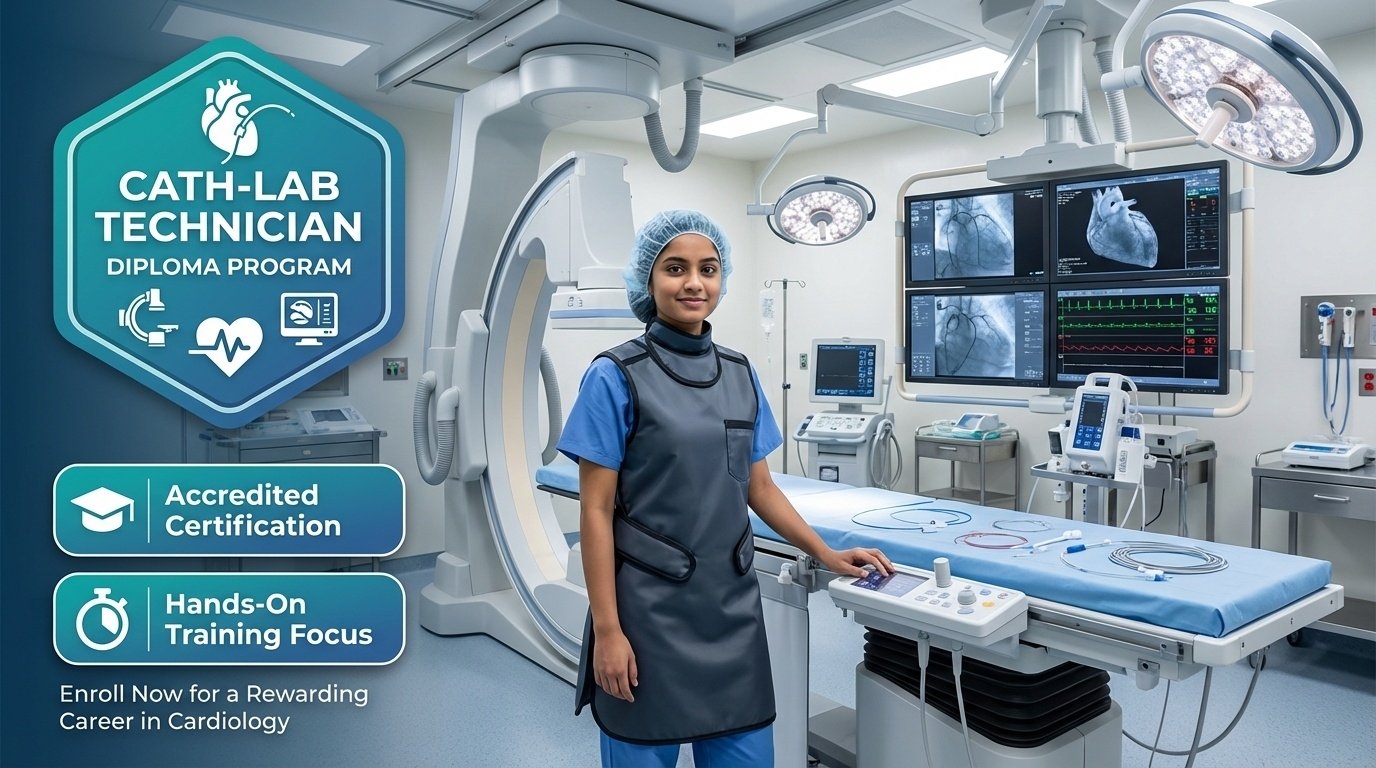
Diploma in Cath-Lab Technician - Complete Course Description
Course Overview
The Diploma in Catheterization Laboratory (Cath-Lab) Technology is a specialized healthcare diploma program designed to train students in assisting cardiologists and healthcare professionals during diagnostic and therapeutic cardiovascular procedures. The course equips graduates with the technical skills and knowledge required to operate advanced medical equipment in catheterization laboratories.
Course Duration & Type
- Duration: 2 years (Full-time integrated diploma program)
- Course Type: Full-time
- Course Level: Diploma/UG Diploma
Eligibility Criteria
Educational Qualification:
- Candidates must have completed Class 12 (Intermediate) with a Science stream (Physics, Chemistry, and Biology) from a recognized board
- Minimum Marks: Generally 50% aggregate in Class 12 (may vary by institution)
Age Requirement:
- Candidates should be at least 17-18 years old at the time of admission
Medical Requirements:
- Good physical health and stamina to handle long working hours
- Good vision and hearing capabilities
- Ability to work in high-pressure medical environments
Admission Process
UG Diploma Admission:
- Primarily merit-based admission based on Class 12 marks
- Direct admission through college/university applications
- Some institutions may conduct their own entrance examinations
PG Diploma Admission:
- Entrance-based: NEET PG scores are accepted at certain institutions
- Counseling sessions for seat allocation
- Document verification and fee payment
Application Process:
- Apply online/offline through institution websites
- Fill required details carefully
- Merit list publication or entrance exam results
- Counseling and seat allocation
- Document verification
- Fee payment to confirm admission
Course Fees
- Fee Range: ₹37,000 - ₹1,00,000 (varies by institution)
- Government institutions typically charge lower fees compared to private colleges
Course Curriculum & Subjects
FIRST YEAR (Diploma Part-I)
Theory Subjects:
1. Anatomy (150 marks total)
- Cell structure, tissues, and glands
- Musculoskeletal system (bones, joints, muscles)
- Cardiovascular System (detailed study of heart, blood vessels, circulation)
- Lymphatic, gastrointestinal, respiratory, urinary, and reproductive systems
- Endocrine glands and nervous system
2. Physiology (150 marks total)
- Blood physiology (RBCs, WBCs, hemoglobin, blood groups)
- Cardiovascular physiology (cardiac cycle, ECG, blood pressure)
- Gastrointestinal, respiratory, and endocrine system functions
- Central nervous system and special senses
- Nerve-muscle physiology
3. Biochemistry (150 marks total)
- Biomolecules and cell structure
- Carbohydrates, proteins, lipids, nucleic acids
- Enzymes, vitamins, and minerals
- Hormones and acid-base balance
4. Medical Electronics & Biophysics (150 marks total)
- Medical physics applications (CT, MRI, PET, SPECT scans)
- Radiation physics and safety
- Electrocardiography and ionic currents
- Pressure transducers and defibrillators
- Cathode ray tubes and impedance plethysmography
- Pulse oximetry and medical ultrasound/Doppler
5. Basics of Computer (College-level examination)
- Computer fundamentals, MS Office (Word, Excel, PowerPoint)
- Internet usage and healthcare information systems
SECOND YEAR (Diploma Part-II)
Theory Subjects:
1. Pathology and Microbiology (150 marks total)
Pathology:
- Valvular heart diseases (rheumatic heart disease, aortic/mitral stenosis)
- Coronary artery disease (angina, myocardial infarction, interventions)
- Hypertension and heart failure
- Myocardial diseases (cardiomyopathies)
- Pericardial diseases
- Arrhythmias and conduction disturbances
- Pulmonary hypertension and peripheral vascular disease
- Congenital heart diseases (cyanotic and acyanotic)
Microbiology:
- Gram-positive and gram-negative bacteria
- Sterilization techniques (dry heat, moist heat, chemical disinfectants)
- Hospital-acquired infections and bloodstream infections
- Subacute bacterial endocarditis
- Biomedical waste management
2. Pharmacology (150 marks total)
- Anti-anginal agents (beta-blockers, nitrates, calcium channel blockers)
- Anti-failure agents (diuretics, ACE inhibitors, digitalis)
- Anti-hypertensive drugs
- Anti-arrhythmic agents
- Antithrombotic agents (aspirin, clopidogrel, anticoagulants)
- Lipid-lowering drugs (statins)
- Miscellaneous drugs (narcotics, sedatives, antibiotics, anesthetics)
3. Basic Electrocardiography (ECG) and Echocardiography (150 marks total)
ECG:
- Fundamental principles of electrocardiography
- Lead systems (limb leads, precordial leads, augmented leads)
- Normal ECG and rhythm analysis
- Chamber enlargement and bundle branch blocks
- Exercise stress testing (protocols, indications, techniques)
- ECG in myocardial infarction and valvular diseases
Echocardiography:
- M-mode and 2D transthoracic echocardiography
- Doppler echocardiography (pulsed, continuous wave, color)
- Cardiac measurements and function evaluation
- Echocardiography in valvular heart disease
- Assessment of cardiomyopathies and congenital heart diseases
4. Basic Cardiac Catheterization and Treadmill Exercise Stress Testing (150 marks total)
- Types of catheters and sterilization techniques
- Setting up the cath lab for diagnostic studies
- Intracardiac pressure measurements
- Cardiac output determination methods
- Coronary angiography (catheters, views, laboratory preparation)
- Left and right heart catheterization
- Treadmill exercise stress testing (protocols, indications, contraindications)
- Holter monitoring and ambulatory ECG
- Cardiac arrhythmia recognition and management
- Defibrillator use and cardiac arrest management (ACLS, BLS)
Practical Training
First Year Practicals:
- Demonstration of bones and organs
- Histology studies
- Hemoglobin estimation, bleeding/clotting time
- Blood group determination
- Blood pressure recording
- Vital capacity measurement
- Biochemical tests (carbohydrates, proteins, lipids)
Second Year Practicals:
- Microbiology lab techniques (microscopy, sterilization, culture media)
- ECG recording and interpretation
- Exercise stress testing
- Echocardiography views and measurements
- Cardiac monitoring and ICCU setup
- Defibrillator operation
- Holter monitoring procedures
Clinical Internship:
- Mandatory practical training in hospitals, cath labs, and diagnostic centers
- Hands-on experience with cardiovascular procedures
- Patient care and safety protocol implementation
- Real-world exposure to angiography, angioplasty, and stent placement procedures
Examination Pattern
Theory Examination:
- Each paper: 75 marks (External) + 25 marks (Internal Assessment) = 100 marks
- Questions cover entire syllabus
- Annual examinations in May/June with supplementary exams within 6 months
Practical Examination:
- Each practical: 35 marks (External) + 15 marks (Internal Assessment) = 50 marks
- Internal and external examiners conduct practical assessments
Attendance Requirements:
- Minimum 75% attendance in theory and practical classes
- 5% attendance shortage can be condoned by the Director/Principal
Passing Criteria:
- Minimum 50% marks in theory, practical, and internal assessment combined
- Minimum 35% marks in internal assessment (theory and practical separately)
- Must pass each subject separately
Grading System:
- 81-100: A+ (Distinction: 75%+ in first attempt)
- 76-80: A
- 71-75: B+
- 61-70: B (First Division: 60%+)
- 51-60: C+ (Second Division: 50-59%)
- 41-50: C
- 31-40: D
- 0-30: E (Fail)
Promotion Rules
- Students failing all subjects in Year 1 cannot be promoted to Year 2
- Students passing at least one subject can attend Year 2 classes but must clear Year 1 before the final examination
- Maximum 4 attempts (including first attempt) + 1 mercy chance (at Vice-Chancellor's discretion)
- All attempts must be completed within 4 years of admission
Career Opportunities
Job Roles:
- Cath Lab Technician - Assisting in cardiac catheterization procedures
- Cardiology Technician - Conducting diagnostic tests (ECGs, stress tests)
- Clinical Associate - Patient care and clinical support
- Lab Assistant - Laboratory operational tasks
- Medical Equipment Operator - Managing cath lab machinery
- ECG/Echo Technician - Electrocardiography and echocardiography specialists
Work Settings:
- Hospitals (Apollo, Fortis, Max Healthcare)
- Cardiac care units and specialized heart hospitals
- Diagnostic centers (Metropolis, SRL Diagnostics)
- Medical equipment companies (GE Healthcare, Siemens Healthineers)
- Research institutions
Salary Range:
- Starting Salary: ₹15,000 - ₹30,000 per month (₹2.3 - 3.4 LPA)
- Average Salary: ₹3.4 LPA
- Experienced Professionals: ₹5 - 8 LPA
- Salary varies based on location, experience, and institution type
Top Institutions Offering the Course
Government Institutions:
- Sri Guru Ram Das University of Health Sciences, Amritsar
- Various government medical colleges and paramedical institutes
Private Institutions:
- Krishna Vishwa Vidyapeeth
- NIMS University
- Various private medical and paramedical colleges across India
Higher Education Opportunities
After completing the Diploma, graduates can pursue:
- Bachelor's degrees in Cardiovascular Technology, Medical Imaging Technology, or Radiology
- PG Diploma in specialized areas of cardiovascular technology
- Advanced certifications in Cardiac Imaging or Electrophysiology
- Master's programs in Medical Technology or Healthcare Management
- Teaching and research positions with further qualifications
Skills Developed
Technical Skills:
- Operation of catheterization laboratory equipment
- ECG and echocardiography interpretation
- Cardiac monitoring and life support (BLS/ACLS)
- Sterile technique and infection control
- Medical imaging and diagnostic procedures
Soft Skills:
- Patient communication and care
- Teamwork in high-pressure environments
- Attention to detail and precision
- Problem-solving and critical thinking
- Time management and stress management
Key Highlights
✅ Specialized training in cardiovascular technology
✅ High demand in healthcare sector
✅ Practical hands-on training in hospitals
✅ Career opportunities in prestigious hospitals
✅ Pathway to higher education and specialization
✅ Growing field with advancing medical technology
✅ Essential role in cardiac care and life-saving procedures
Recommended Textbooks
- Ross and Wilson - Anatomy and Physiology
- B.D. Chaurasia's Human Anatomy (Volumes 1, 2, 3)
- Grossmann - Textbook of Heart Disease
- Braunwald - Textbook of Heart Disease
- Feigenbaum - Echocardiography
- Dr. C.P. Baveja - Textbook on Microbiology
- Various nursing and paramedical textbooks