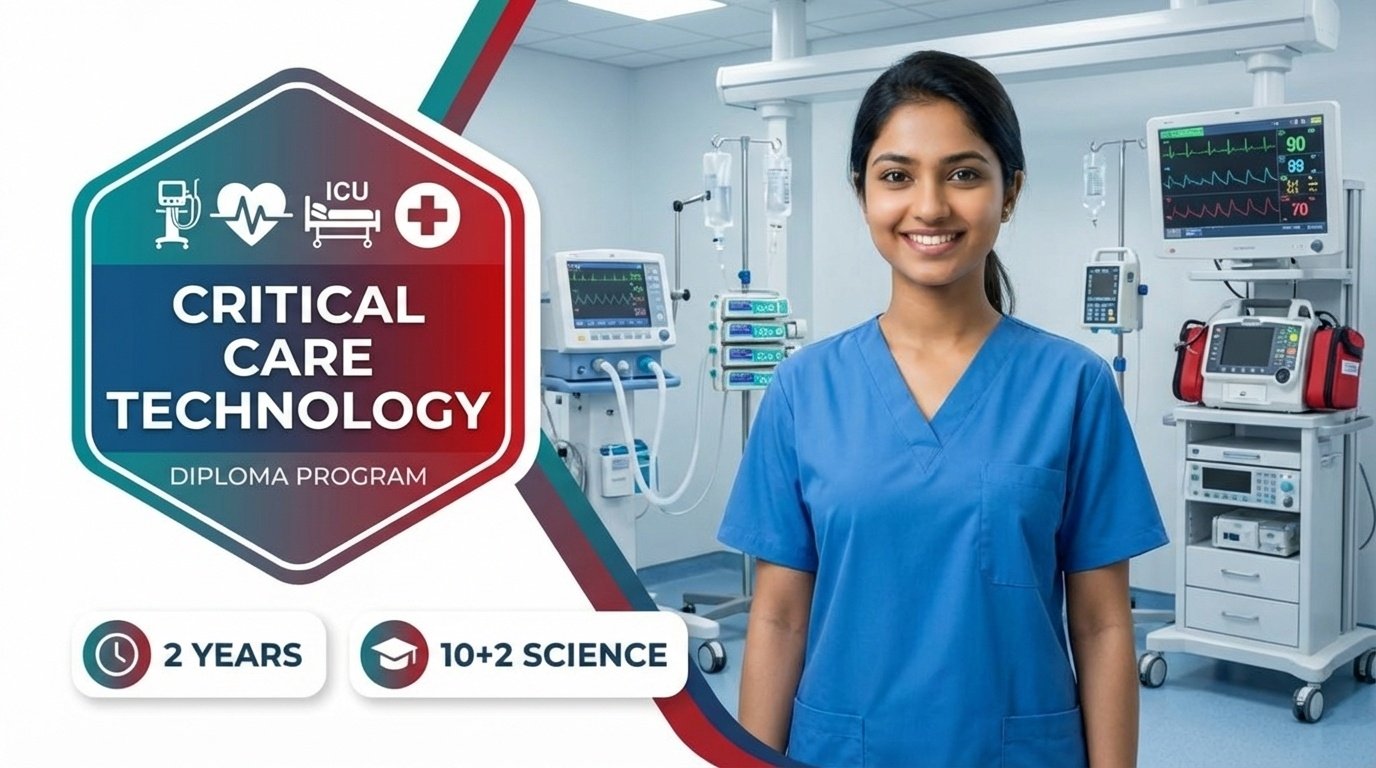
Diploma in Critical Care Technology
Mahatma Gandhi Ayurvigyan Vidyapeeth
Course Overview
The Diploma in Critical Care Technology is an advanced 2-year paramedical program designed to train highly skilled professionals who provide specialized care to critically ill patients in Intensive Care Units (ICU), Critical Care Units (CCU), and emergency settings. This comprehensive course equips students with expertise in managing life-threatening conditions, operating sophisticated medical equipment, and supporting physicians in delivering life-saving interventions.
Critical care represents the pinnacle of acute medical care, where every decision matters and every second counts. ICU technologists are essential members of the critical care team, monitoring vital parameters, operating ventilators and cardiac monitors, and providing round-the-clock support to patients fighting for their lives.
With the exponential growth of multi-specialty hospitals, trauma centers, and critical care facilities across India, qualified critical care technologists are in high demand and command premium salaries due to their specialized expertise and critical role in patient survival.
Course Information
✅ Eligibility Criteria
- Educational Qualification: 10+2 (Science Stream) from a recognized board
- Mandatory Subjects: Physics, Chemistry, and Biology
- Minimum Percentage: 50% aggregate (45% for reserved categories)
- Age Limit: Generally 17-35 years at the time of admission
- Physical & Mental Fitness: Good health status (medical certificate required)
- Personal Attributes:
- High attention to detail and accuracy
- Emotional stability and stress management
- Ability to work in high-pressure environments
- Team coordination and communication skills
- Compassion and patient care orientation
- Comprehensive Course Curriculum
Year 1: Foundation Sciences & Basic Critical Care
Semester 1: Fundamentals
- Human Anatomy & Physiology (Advanced - Cardiopulmonary & Neurological Systems)
- Medical Biochemistry and Clinical Chemistry
- Medical Microbiology and Infection Control
- Introduction to Critical Care - History, Scope, and Ethics
- Basic Life Support (BLS) - Theory and Certification
- Medical Terminology and Documentation
- Healthcare Communication - Patient, Family, and Team
- Pharmacology Basics - Critical Care Medications
- Medical Ethics and Legal Aspects
- Biomedical Waste Management
Semester 2: Essential Critical Care Skills
- Applied Anatomy for Critical Care
- Pathophysiology of Critical Illnesses
- ICU Equipment - Introduction and Basic Operation
- Patient Assessment in Critical Care
- Vital Signs Monitoring - Advanced Techniques
- Airway Management - Basic and Advanced
- Oxygen Therapy and Respiratory Support
- ECG (Electrocardiography) - Recording and Interpretation
- IV Access and Fluid Management
- Infection Prevention in ICU Settings
- Nutrition Support in Critical Care
Year 2: Advanced Critical Care & Specialization
Semester 3: Advanced Critical Care Technology
- Mechanical Ventilation - Modes, Settings, and Management
- Hemodynamic Monitoring - Invasive and Non-invasive
- Cardiac Life Support - ACLS Basics
- Arterial Blood Gas (ABG) Analysis and Interpretation
- Critical Care Pharmacology - Inotropes, Sedatives, Analgesics
- Renal Replacement Therapy (Dialysis Basics)
- Neurological Monitoring - ICP, EEG, Neuro Assessment
- Cardiac Monitoring - Arrhythmia Recognition and Management
- Chest Physiotherapy and Pulmonary Rehabilitation
- Central Line Management - CVP, Arterial Lines
- Blood Products and Transfusion in ICU
- Laboratory Investigations - Interpretation for ICU
Semester 4: Specialized Units & Clinical Mastery
- Coronary Care Unit (CCU) Management
- Neonatal ICU (NICU) - Pediatric Critical Care
- Surgical ICU (SICU) Operations
- Trauma ICU and Emergency Critical Care
- Neuro ICU Specialization
- Post-Operative Care in ICU
- Sepsis and Shock Management
- Multi-Organ Dysfunction Syndrome (MODS)
- End-of-Life Care and Palliative Support
- Quality Assurance in Critical Care
- ICU Protocols and Clinical Guidelines
- Disaster Management in Critical Care Settings
- Hospital ICU Clinical Rotations (12-16 weeks)
- Comprehensive Practical Training
- Research Project and Case Studies
- Final Examination and Skill Assessment
Key Learning Outcomes
Upon successful completion, graduates will master:
Technical Competencies:
- ✅ Ventilator Management: Operate and troubleshoot mechanical ventilators, adjust settings, manage patients on respiratory support
- ✅ Hemodynamic Monitoring: Monitor and interpret CVP, arterial lines, cardiac output, and other vital parameters
- ✅ Advanced Monitoring: Use multi-parameter monitors, interpret ECG rhythms, recognize arrhythmias
- ✅ ABG Analysis: Collect arterial blood samples, interpret gas values, manage acid-base disorders
- ✅ Cardiac Support: Assist in managing patients with cardiac conditions, understand inotropic support
- ✅ Renal Support: Assist with dialysis procedures, monitor fluid balance
- ✅ Equipment Operation: Operate defibrillators, infusion pumps, syringe pumps, IABP, ECMO (exposure)
- ✅ Critical Procedures: Assist with intubation, central line insertion, chest tube management
- ✅ Emergency Response: Perform CPR, recognize and respond to code blue situations
Clinical Skills:
- ✅ Patient Assessment: Conduct comprehensive critical patient evaluations
- ✅ Airway Management: Secure airways, manage ventilation, perform suctioning
- ✅ Medication Administration: Prepare and administer critical care medications
- ✅ Specimen Collection: Obtain blood, urine, and other samples for lab analysis
- ✅ Wound Care: Manage surgical wounds, pressure ulcers, drains
- ✅ Neurological Assessment: Use Glasgow Coma Scale, pupillary assessment
- ✅ Infection Control: Implement strict aseptic techniques and isolation protocols
- ✅ Documentation: Maintain accurate ICU charts and monitoring records
Professional Attributes:
- ✅ Critical Thinking: Analyze complex patient data and recognize deterioration
- ✅ Team Collaboration: Work with intensivists, nurses, and multidisciplinary teams
- ✅ Time Management: Prioritize multiple critical patients simultaneously
- ✅ Stress Management: Maintain composure in life-threatening situations
- ✅ Ethical Practice: Handle end-of-life decisions and family communications sensitively
- ✅ Continuous Learning: Stay updated with latest critical care advancement Career Opportunities
Critical Care Technology graduates enjoy premium employment opportunities:
Primary Job Roles:
- ICU Technologist/Technician
- Critical Care Technologist
- Intensive Care Unit Specialist
- Coronary Care Unit (CCU) Technician
- Neonatal ICU (NICU) Technologist
- Surgical ICU (SICU) Technician
- Trauma ICU Specialist
- Neuro ICU Technologist
- Cardiac ICU Technician
- Pediatric ICU (PICU) Specialist
- Medical ICU Technologist
- Post-Anesthesia Care Unit (PACU) Technician
- Emergency Critical Care Technician
- Respiratory Care Practitioner
- Perfusion Technology Assistant
- ICU Quality Control Officer
- Critical Care Equipment Specialist
- Clinical Research Coordinator (Critical Care)
Employment Sectors:
Government Healthcare:
- AIIMS and Government Medical Colleges (ICUs)
- State Government Multi-Specialty Hospitals
- District Hospitals Critical Care Units
- Government Trauma Centers
- Armed Forces Medical Services (Army, Navy, Air Force)
- Railway Hospitals ICU Departments
- ESIC Hospitals
Private Healthcare:
- Multi-Specialty Corporate Hospitals (Apollo, Fortis, Max, Manipal, Narayana, etc.)
- Super Specialty Hospitals
- Cardiac Care Hospitals
- Cancer Treatment Centers
- Transplant Units
- Trauma and Emergency Centers
- Standalone Critical Care Facilities
- Chain Hospitals ICU Networks
Specialized Settings:
- Organ Transplant Units
- Cardiac Surgery ICUs
- Neurosurgery ICUs
- Burn Units
- Pediatric Intensive Care
- Neonatal Intensive Care
- High-Dependency Units (HDU)
- Step-Down Units
Additional Opportunities:
- Medical Equipment Companies (Technical Support, Training)
- ICU Equipment Manufacturers (Product Specialists)
- Healthcare Training Institutes (Faculty)
- Telemedicine ICU Services
- Medical Tourism Hospitals
- International Hospital Placements
- Cruise Ship Medical Centers
- Offshore Medical Facilities
???? Salary Expectations (2026)
ICU/Critical Care Technologist Compensation:
Location-Wise Salary Variations:
Specialized Unit Compensation (Additional Premium):
Corporate Hospital Packages (Top Employers):
Additional Benefits & Perks:
- Night Shift Allowance: ₹3,000-7,000/month
- Overtime Pay: 1.5x to 2x regular hourly rate
- Medical Insurance: Self and family coverage
- Food Allowance: ₹2,000-4,000/month
- Accommodation: Provided by some hospitals
- Annual Bonuses: 10-30% of annual salary
- Performance Incentives: ₹20,000-1,00,000 annually
- Festival Bonuses: Diwali, year-end bonuses
- Continuing Education: Sponsored training and certifications
International Opportunities (Gulf Countries):
- UAE: AED 8,000-15,000/month (₹1.8-3.4 Lakhs/month)
- Saudi Arabia: SAR 6,000-12,000/month (₹1.4-2.8 Lakhs/month)
- Qatar: QAR 8,000-14,000/month (₹1.9-3.2 Lakhs/month)
???? Why Choose Critical Care Technology?
1. ???? Premium Specialization
Critical care is among the highest-paying paramedical specializations due to advanced skills, sophisticated equipment handling, and 24/7 critical patient management.
2. ???? High Demand, Low Supply
Severe shortage of qualified ICU technologists across India. Every multi-specialty hospital with ICU facilities needs critical care technologists—demand far exceeds supply.
3. ???? Fast Career Growth
Rapid progression from junior to senior positions. Specialized units (cardiac, neuro, trauma ICU) offer additional premiums and faster advancement.
4. ???? Premium Employment
Work in prestigious multi-specialty hospitals, super-specialty centers, and corporate healthcare chains that offer excellent compensation and benefits.
5. ???? Global Opportunities
Critical care skills are universally recognized. With additional certifications, work in Gulf countries, USA, UK, Australia, and other developed nations at international salaries.
6. ???? Essential Healthcare Role
ICU technologists are indispensable members of critical care teams. Hospitals cannot operate ICUs without qualified technologists.
7. ???? Continuous Learning
Exposure to cutting-edge medical technology, latest treatment protocols, and advanced life-support systems. Continuous skill enhancement and learning opportunities.
8. ???? Job Security
Critical care services are essential hospital functions. ICU technologists enjoy extremely high job security regardless of economic conditions.
9. ???? Professional Recognition
Respected as specialized healthcare professionals. Work alongside intensivists, surgeons, and senior medical staff.
10. ???? Life-Saving Impact
Directly contribute to saving critically ill patients. Witness recovery miracles and experience immense professional satisfaction.
???? Unique Course Features
Advanced Training Infrastructure:
- Fully Equipped ICU Simulation Lab - Ventilators, monitors, infusion pumps
- Ventilator Training - Multiple ventilator models and modes
- Cardiac Monitoring Systems - ECG, arrhythmia recognition
- High-Fidelity Mannequins - Realistic patient simulation
- Critical Care Equipment - Defibrillators, IABP, dialysis machines
Comprehensive Clinical Exposure:
- Hospital ICU Rotations - 16+ weeks in active intensive care units
- Multiple Specialty Units - Medical ICU, Surgical ICU, CCU, NICU, Neuro ICU
- 24/7 Shift Experience - Day, evening, and night shift training
- Emergency Response - Code blue participation and management
- Multidisciplinary Rounds - Learning with intensivists and consultants
Certification & Advanced Training:
- BLS (Basic Life Support) Certification included
- ACLS (Advanced Cardiac Life Support) preparation
- Ventilator Management Certification
- ECG Interpretation Workshop
- ABG Analysis Training
- Infection Control Certification
Industry Partnerships:
- Direct recruitment drives by corporate hospital chains
- Campus placement by Apollo, Fortis, Max, Manipal, Narayana
- Internship-to-employment conversion opportunities
- Guest lectures by senior intensivists and ICU specialists
- Equipment training by manufacturer representatives
Skill Development Beyond Clinical:
- Communication in crisis situations
- Family counseling and support
- Team coordination and leadership
- Stress and fatigue management
- Ethical decision-making in critical care
- Electronic medical record systems
???? Further Education & Career Advancement
Higher Education Pathways:
- B.Sc. in Critical Care Technology (Lateral Entry)
- B.Sc. in Emergency & Critical Care
- B.Sc. in Cardiac Care Technology
- B.Sc. in Respiratory Care
- Post-Graduate Diploma in Critical Care
- M.Sc. in Critical Care Technology
- MBA in Healthcare Management
- B.Sc. in Nursing (Bridge Course)
Advanced Certifications:
- ACLS (Advanced Cardiac Life Support) - AHA/IHA Certified
- PALS (Pediatric Advanced Life Support)
- NRP (Neonatal Resuscitation Program)
- ECMO Specialist Training
- Perfusion Technology Certification
- Respiratory Therapist Certification
- Critical Care Paramedic Advanced Training
- Clinical Research Certification
Career Progression Ladder:
Junior ICU Technologist (0-2 years) → ICU Technologist (2-4 years) → Senior ICU Technologist (4-7 years) → ICU In-Charge/Supervisor (7-10 years) → ICU Manager/Coordinator (10+ years) → Director of Critical Care Services
Specialization Options:
- Cardiac Intensive Care Specialist
- Neuro Critical Care Specialist
- Neonatal Intensive Care Specialist
- Trauma ICU Specialist
- Transplant ICU Coordinator
- ECMO Specialist
- Perfusionist
- Respiratory Care Practitioner
- Critical Care Quality Officer
- ICU Infection Control Specialist
???? Why Choose Mahatma Gandhi Ayurvigyan Vidyapeeth?
- ✅ Specialized Faculty: Learn from experienced intensivists, critical care nurses, and ICU specialists
- ✅ State-of-the-Art ICU Lab: Fully equipped with modern ventilators, monitors, and critical care equipment
- ✅ Hospital ICU Partnerships: Clinical rotations in multi-specialty hospital ICUs
- ✅ Comprehensive Training: Exposure to Medical, Surgical, Cardiac, Neuro, and Neonatal ICUs
- ✅ Ventilator Mastery: Hands-on training on multiple ventilator models
- ✅ BLS & ACLS Training: Certification courses integrated into curriculum
- ✅ Premium Placements: Direct recruitment by top hospital chains
- ✅ High Success Rate: 95%+ employment within 6 months
- ✅ Industry Recognition: Diploma recognized by healthcare institutions
- ✅ Expert Guest Faculty: Sessions by senior intensivists and ICU consultants
- ✅ Modern Pedagogy: Simulation-based learning, case discussions, practical focus
- ✅ Career Support: Lifetime placement assistance and career guidance
???? Admission Process
Step-by-Step Enrollment:
Step 1: Online Application ⏰ (15 minutes)
Step 2: Document Submission ????
- Submit all required documents (detailed list below)
- Ensure certificates are clear, attested copies
- Academic transcripts must show 50% aggregate in 10+2 Science
Step 3: Eligibility Assessment ✅
- Institute verifies academic qualifications
- Review of marks and subject requirements
- Background check and document validation
- Response typically within 3-5 working days
Step 4: Entrance/Merit-Based Selection ????
- Merit-based selection based on 10+2 marks
- Or entrance examination (if conducted)
- Personal interview (may be required)
Step 5: Admission Counseling ????
- One-on-one counseling session
- Detailed course overview and career prospects
- Campus and ICU lab tour
- Interaction with faculty and current students
- Fee structure and payment options discussion
Step 6: Fee Payment & Enrollment ????
- Pay admission and first semester fees
- ₹1,00,000 total course fee (₹50,000/year)
- Installment options available
- Receive official admission letter
Step 7: Commence Training ????
- Attend orientation program
- Receive student ID, course materials, uniform
- Begin your journey to becoming an ICU specialist!
???? Required Documents
Academic Credentials:
- ☑️ 10th Standard Mark Sheet & Certificate
- ☑️ 12th Standard Mark Sheet & Certificate (Science - PCB mandatory)
- ☑️ Transfer Certificate from previous institution
- ☑️ Migration Certificate (if from different state/board)
- ☑️ Character Certificate from school/college principal
- ☑️ Equivalency Certificate (for non-CBSE/state board, if required)
Identity & Medical Documents:
- ☑️ Aadhar Card (mandatory)
- ☑️ PAN Card (if available)
- ☑️ Medical Fitness Certificate from registered medical practitioner
- ☑️ COVID-19 Vaccination Certificate
- ☑️ Blood Group Certificate
- ☑️ Passport Size Photographs (10 copies - recent, colored)
Additional Documents (if applicable):
- ☑️ Caste Certificate (for SC/ST/OBC reservation)
- ☑️ Domicile Certificate
- ☑️ Income Certificate (for fee concession/scholarship)
- ☑️ GAP Certificate (if gap between 10+2 and admission)
- ☑️ EWS Certificate (Economically Weaker Section)
???? Course Delivery & Assessment
Teaching Methodology:
Theory Classes (25%):
- Interactive lectures with audio-visual aids
- Case-based learning and clinical scenario discussions
- Guest lectures by senior intensivists
- Journal club and research paper discussions
- Evidence-based critical care protocols
Laboratory Training (30%):
- ICU simulation lab sessions
- Ventilator operation and troubleshooting
- Cardiac monitor interpretation
- Equipment handling and maintenance
- Emergency scenario simulations
- Code blue drills
Clinical Training (40%):
- Hospital ICU rotations (16+ weeks)
- Multiple specialty ICU exposure
- Hands-on patient care under supervision
- 24/7 shift experience
- Multidisciplinary team rounds
- Real-time emergency response
Skill Development (5%):
- Communication workshops
- Stress management sessions
- Team building activities
- Ethical decision-making seminars
- Leadership development
Assessment & Evaluation:
- Continuous Assessment: Monthly skill evaluations and quizzes
- Theory Examinations: Semester-end written exams
- Practical Exams: OSCE (Objective Structured Clinical Examination)
- Clinical Logbook: Documented case studies and procedures
- Project Work: Research-based critical care project
- Final Comprehensive Exam: Theory + Practical + Viva
⚡ A Day in ICU: What to Expect
Morning Shift (7 AM - 3 PM):
- 7:00 AM: Handover from night shift, patient status review
- 7:30 AM: Equipment check, ventilator parameter verification
- 8:00 AM: Doctor rounds, update patient charts
- 9:00 AM: ABG collection and analysis
- 10:00 AM: Medication administration, IV management
- 11:00 AM: Patient positioning, chest physiotherapy
- 12:00 PM: Lunch break (in batches)
- 1:00 PM: Monitor vital parameters, document changes
- 2:30 PM: Shift handover preparation
- 3:00 PM: Detailed handover to evening shift
Critical Situations You'll Handle:
- Ventilator Alarms: Troubleshoot and manage
- Cardiac Arrest: Participate in code blue response
- Respiratory Distress: Adjust oxygen therapy
- Hemodynamic Instability: Monitor and alert physician
- Equipment Malfunction: Quick problem-solving
Skills Used Daily:
- ECG monitoring and arrhythmia recognition
- Ventilator parameter adjustment
- IV infusion management
- Central line care
- Arterial line monitoring
- Suctioning and airway care
- Medication preparation
- Documentation and charting
???? Launch Your Critical Care Career!
Join the Diploma in Critical Care Technology program at Mahatma Gandhi Ayurvigyan Vidyapeeth and become a highly sought-after ICU specialist. Master advanced medical technology, save critically ill patients, and build a premium career in one of healthcare's most rewarding specializations!
???? Ready to Join the ICU Elite?
Contact Information:
- Institute: Mahatma Gandhi Ayurvigyan Vidyapeeth
- Application Portal: https://mgavidyapeeth.com/addmission-form
- Course Duration: 2 Years (Full-time with Clinical Training)
- Total Investment: ₹1,00,000
- Expected ROI: Recover investment in 6-12 months of employment
❓ Frequently Asked Questions (FAQs)
Q1: What is the difference between ICU Nurse and ICU Technologist? A: ICU Nurses provide direct patient care including medication administration, wound care, and nursing interventions. ICU Technologists specialize in operating and managing critical care equipment like ventilators, monitors, dialysis machines, and assist physicians with technical procedures. Both are essential ICU team members with complementary roles.
Q2: Is this course recognized for government hospital jobs? A: Yes, this diploma qualifies you for ICU technologist positions in government hospitals, medical colleges, and public healthcare institutions that recruit paramedical staff for critical care units.
Q3: What are the working hours in ICU? A: ICUs operate 24/7, so technologists work in rotational shifts (usually 8-12 hours). Shifts include day, evening, and night duties, with weekly offs as per hospital policy. Most positions follow 2-3 shift rotation systems.
Q4: Is the fee of ₹1,00,000 inclusive of all charges? A: The ₹1,00,000 covers tuition fees for the 2-year program. Additional charges may apply for: uniform, books, examination fees, certification courses (BLS/ACLS), and hostel accommodation (if required). Please confirm complete fee breakdown with the institute.
Q5: Can I specialize in a specific ICU type (Cardiac, Neuro, etc.)? A: The diploma provides comprehensive training across all ICU types. After graduation and gaining general ICU experience (1-2 years), you can specialize by working exclusively in Cardiac ICU, Neuro ICU, NICU, or other specialized units. Additional certifications enhance specialization prospects.
Q6: What is the job guarantee after completing this course? A: While the institute provides strong placement support and corporate hospitals actively recruit ICU technologists, employment depends on individual performance, interview skills, and market conditions. The current demand-supply gap strongly favors qualified candidates, with 90-95% employment within 6 months.
Q7: Is BLS/ACLS certification included in the course fee? A: BLS (Basic Life Support) training is typically included. ACLS (Advanced Cardiac Life Support) may be offered as a separate certification program. Please confirm specific inclusions with the institute during admission counseling.
Q8: Can females pursue this course? Is night shift mandatory? A: Absolutely! Female ICU technologists are highly valued and many women excel in critical care. Night shifts are part of ICU operations, but hospitals provide proper security, transportation, and safety measures for female staff. Many facilities offer women-only night shift teams.
Q9: What are the physical demands of ICU work? A: ICU work requires moderate physical fitness for: patient repositioning, equipment handling, long standing hours, and quick response to emergencies. It's not extremely physically demanding like emergency services, but requires stamina for 8-12 hour shifts.
Q10: Can I work abroad with this diploma? A: Yes, with additional country-specific certifications or equivalency assessments. Gulf countries (UAE, Saudi Arabia, Qatar) actively recruit Indian ICU technologists. For USA/UK/Australia, you may need to complete equivalency exams and additional qualifications.
Q11: What happens if I cannot handle the stress of ICU work? A: The course includes gradual exposure, starting with simulations before real patient care. You'll develop stress management skills and emotional resilience. If ICU work doesn't suit you, your skills are transferable to other hospital departments, emergency services, or equipment companies.
Q12: Are there scholarship or financial aid options? A: Please inquire with the institute about:
- Merit-based scholarships
- SC/ST/OBC fee concessions
- EWS (Economically Weaker Section) benefits
- Installment payment plans
- Educational loans (banks offer education loans for recognized diploma courses)
Q13: What equipment will I learn to operate? A: You'll be trained on:
- Mechanical Ventilators (multiple modes and models)
- Multi-parameter Patient Monitors
- Cardiac Monitors and ECG machines
- Defibrillators and AED
- Infusion Pumps and Syringe Pumps
- ABG Analyzers
- Suction Machines
- Central Line and Arterial Line equipment
- Dialysis machines (basics)
- IABP, ECMO (exposure in advanced centers)
Q14: Can I pursue B.Sc. Nursing after this diploma? A: Yes, some universities offer bridge courses for diploma holders to enter B.Sc. Nursing programs. This pathway allows you to become a Registered Nurse while leveraging your critical care expertise.
Q15: What is the difference between this and Emergency Medical Technician (EMT) course? A: EMT focuses on pre-hospital emergency care and ambulance services. Critical Care Technology specializes in in-hospital intensive care unit management, advanced equipment operation, and care of critically ill patients on life support. Critical Care typically commands higher salaries due to advanced specialization.
???? Success Stories & Career Impact
Real-World Impact:
ICU Technologists Make a Difference In:
- ???? Post-Cardiac Surgery: Managing patients on mechanical ventilation and cardiac support
- ???? Neurological Emergencies: Monitoring ICP, managing ventilation in brain injury patients
- ???? Neonatal Care: Supporting premature babies on respiratory support
- ???? Trauma Management: Stabilizing multi-trauma patients in Trauma ICU
- ???? Respiratory Failure: Managing complex ventilator modes for ARDS patients
- ???? Septic Shock: Monitoring hemodynamics and assisting with aggressive resuscitation
- ???? Organ Transplants: Post-operative ICU care for transplant recipients
Career Success Statistics:
- 95% placement rate within 6 months
- Average starting salary 40% higher than general lab technicians
- 70% of graduates receive job offers during final semester internships
- 85% achieve senior positions within 5 years
- Top 10% earn ₹10+ Lakhs annually within 7-8 years
???? Key Differentiators of This Course
Why This Diploma is Worth ₹1,00,000:
- Advanced Specialization - Not basic paramedical, but critical care expertise
- Premium Salary Range - 30-50% higher than general technician roles
- Multi-Specialty Training - Exposure to 5-6 different ICU types
- Equipment Mastery - Hands-on training on lakhs worth of medical equipment
- Corporate Hospital Demand - Direct recruitment by top hospital chains
- Career Longevity - Skills remain relevant and in-demand for decades
- Global Mobility - International career opportunities with certifications
- Rapid ROI - Recover investment in 6-12 months of employment
???? Take the Next Step
- ✅ Visit application portal: mgavidyapeeth.com/addmission-form
- ✅ Fill application form (15 minutes)
- ✅ Prepare required documents
- ✅ Schedule campus visit or virtual tour
- ✅ Connect with admission counselor for fee negotiation/installments
- ✅ Secure your seat - Limited intake for quality training
⏰ Don't Delay - Critical Care Needs You!
Limited Seats Available:
- Small batch sizes ensure individual attention and adequate clinical rotation
- ICU labs have capacity constraints for hands-on training
- Hospital partnerships limit the number of students per semester
- Early admission secures priority in ICU placement assignments
???? Join the Critical Care Elite
Critical Care Technologists are among the most respected paramedical professionals, working at the cutting edge of medical technology and patient care. Every day, they contribute to saving lives, managing complex medical equipment, and supporting physicians in delivering world-class intensive care.
Your Patients Need You. ICUs Need You. Healthcare Needs You.