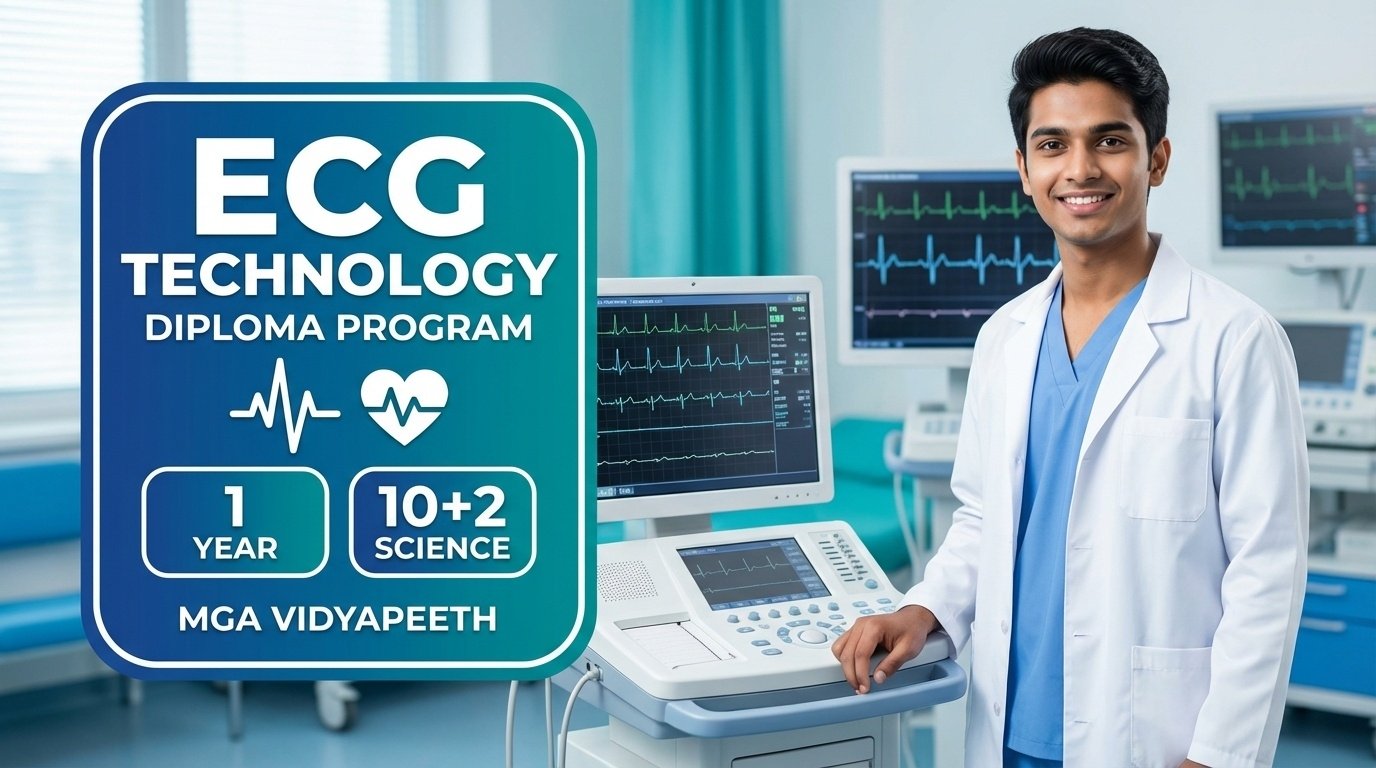
Course Details at a Glance
✅ Eligibility Criteria
- Academic Qualification: Candidates must have completed 10+2 (Higher Secondary) with Science stream
- Minimum Percentage: 50% aggregate marks (may vary)
- Subjects: Physics, Chemistry, and Biology/Mathematics
- Age Limit: Generally between 17-35 years
Course Curriculum & Syllabus
The Diploma in ECG Technology curriculum is carefully designed to provide both theoretical knowledge and hands-on practical training:
Semester 1 - Foundation Subjects
-
Anatomy & Physiology of the Cardiovascular System
- Structure and function of the heart
- Blood circulation and vascular system
- Cardiac cycle and heart sounds
-
Medical Terminology & Healthcare Communication
- Medical abbreviations and terminology
- Professional communication skills
- Patient interaction and documentation
-
Fundamentals of Electrocardiography
- Introduction to ECG technology
- Electrical conduction system of the heart
- ECG machine components and functioning
-
Basics of Cardiology
- Common cardiac conditions
- Risk factors for heart diseases
- Prevention and management approaches
Semester 2 - Advanced & Practical Subjects
-
ECG Interpretation & Analysis
- Normal ECG patterns and waveforms
- Recognition of cardiac arrhythmias
- Identification of ischemia and infarction
- Conduction abnormalities and heart blocks
-
Advanced Cardiac Diagnostic Procedures
- 12-lead ECG recording techniques
- Holter monitoring (24-hour ECG)
- Stress testing (TMT - Treadmill Test)
- Ambulatory blood pressure monitoring
-
Patient Care & Safety Protocols
- Infection control measures
- Patient positioning and preparation
- Emergency response procedures
- Biomedical waste management
-
Medical Ethics & Professional Practice
- Healthcare ethics and patient rights
- Legal aspects in healthcare
- Professional conduct and responsibility
-
Clinical Internship/Practical Training
- Hands-on training in hospitals/diagnostic centers
- Real-world patient interaction
- Equipment handling and maintenance
Learning Outcomes
Upon successful completion of this diploma, students will be able to:
✓ Operate and maintain ECG equipment with precision
✓ Perform various types of cardiac diagnostic tests
✓ Record accurate ECG tracings and rhythm strips
✓ Recognize normal and abnormal cardiac rhythms
✓ Assist cardiologists in diagnostic procedures
✓ Provide quality patient care with professionalism
✓ Follow safety protocols and infection control measures
✓ Maintain accurate medical records and documentation
✓ Handle emergency cardiac situations effectively
Career Opportunities & Job Roles
ECG Technology graduates have diverse career opportunities in both private and government healthcare sectors:
Job Positions
- ECG Technician - Primary role in hospitals and clinics
- Cardiac Technician - Specialized cardiac care units
- Cardiovascular Technologist - Advanced diagnostic centers
- Holter Monitor Technician - Ambulatory ECG monitoring
- Stress Test Technician - Cardiac rehabilitation centers
- Diagnostic Center Operator - Private diagnostic labs
- Medical Equipment Technician - Equipment maintenance and calibration
Employment Sectors
- Multi-specialty Hospitals
- Cardiology Clinics and Centers
- Diagnostic Laboratories
- Primary Health Centers (PHCs)
- Community Health Centers
- Cardiac Rehabilitation Centers
- Research Institutions
- Medical Equipment Companies
- Emergency Medical Services
- Corporate Healthcare Facilities
- Government Hospitals
- Medical Colleges
Salary Prospects
The ECG Technology field offers competitive remuneration with growth potential:
Salaries vary based on location, institution type, skills, and experience level
Career Growth & Advancement
The Diploma in ECG Technology opens doors to various career progression opportunities:
- Specialization: Pursue advanced courses in cardiology technology, cardiac catheterization, or echocardiography
- Higher Education: Enroll in B.Sc. in Cardiac Technology or related bachelor's programs
- Certification: Obtain international certifications to enhance career prospects
- Leadership Roles: Progress to supervisory or managerial positions in diagnostic departments
- Entrepreneurship: Establish diagnostic centers or equipment servicing businesses
- Teaching: Join paramedical institutes as faculty after gaining experience
Why Choose This Course?
High Demand
- Growing cardiovascular disease prevalence in India
- Expanding healthcare infrastructure
- Shortage of trained paramedical professionals
Quick Entry into Healthcare
- Only 1-year duration for job-ready skills
- Practical, hands-on training approach
- Immediate employment opportunities
Stable Career
- Essential healthcare service
- Recession-proof profession
- Consistent demand across all locations
Affordable Education
- Cost-effective compared to degree programs
- Quick return on investment
- Scholarships and financial aid options available
Work-Life Balance
- Regular working hours in most settings
- Professional healthcare environment
- Respect and recognition in medical teams
About Mahatma Gandhi Ayurvigyan Vidyapeeth
Mahatma Gandhi Ayurvigyan Vidyapeeth is a recognized institution dedicated to providing quality paramedical and healthcare education. The institute focuses on:
- Experienced Faculty: Qualified instructors with clinical experience
- Modern Infrastructure: Well-equipped labs and training facilities
- Clinical Training: Partnerships with hospitals for practical exposure
- Placement Support: Career guidance and job placement assistance
- Industry Connections: Strong network with healthcare providers
Admission Process
Step 1: Check Eligibility
Ensure you meet the 10+2 (Science) qualification requirement
Step 2: Online Application
Complete the admission form with accurate details
Step 3: Document Submission
Submit required documents:
- 10th & 12th mark sheets
- Transfer certificate
- Identity proof (Aadhar/PAN)
- Passport-size photographs
- Category certificate (if applicable)
Step 4: Fee Payment
Pay the course fee of ₹50,000 as per payment schedule
Step 5: Admission Confirmation
Receive admission confirmation and course commencement details
Skills You Will Develop
Technical Skills
- ECG machine operation and troubleshooting
- Cardiac rhythm interpretation
- Medical equipment maintenance
- Computer-based ECG software proficiency
Soft Skills
- Patient communication and empathy
- Attention to detail and accuracy
- Time management and multitasking
- Teamwork and collaboration
- Problem-solving abilities
- Professional ethics and responsibility
Future Scope & Industry Trends
The ECG Technology field is evolving with:
- Digital Health Integration: Telemedicine and remote ECG monitoring
- AI-Assisted Diagnostics: Advanced interpretation software
- Portable ECG Devices: Wearable cardiac monitors
- Growing Healthcare Market: Expansion of diagnostic services
- International Opportunities: Global demand for skilled technicians
❓ Frequently Asked Questions
Q: Can I pursue this course after 10+2 Commerce?
A: No, science stream with PCB/PCM is mandatory.
Q: Is there placement assistance provided?
A: Yes, the institute provides placement support and career guidance.
Q: What is the difference between ECG and EEG?
A: ECG records heart electrical activity, while EEG records brain electrical activity.
Q: Can I work abroad after this diploma?
A: Yes, with additional certifications and country-specific licensing requirements.
Q: Is the course recognized?
A: Yes, the diploma is recognized within India. Check specific recognition details with the institute.
Contact & Admission Inquiry
Institute: Mahatma Gandhi Ayurvigyan Vidyapeeth
Course Duration: 1 Year
Course Fee: ₹50,000
Eligibility: 10+2 (Science)
Important Notes:
- Seats are limited - Early application is recommended
- Fee structure may be subject to revision
- Documents must be original and verified
- Age relaxation may apply for reserved categories
- Contact the admission office for detailed information