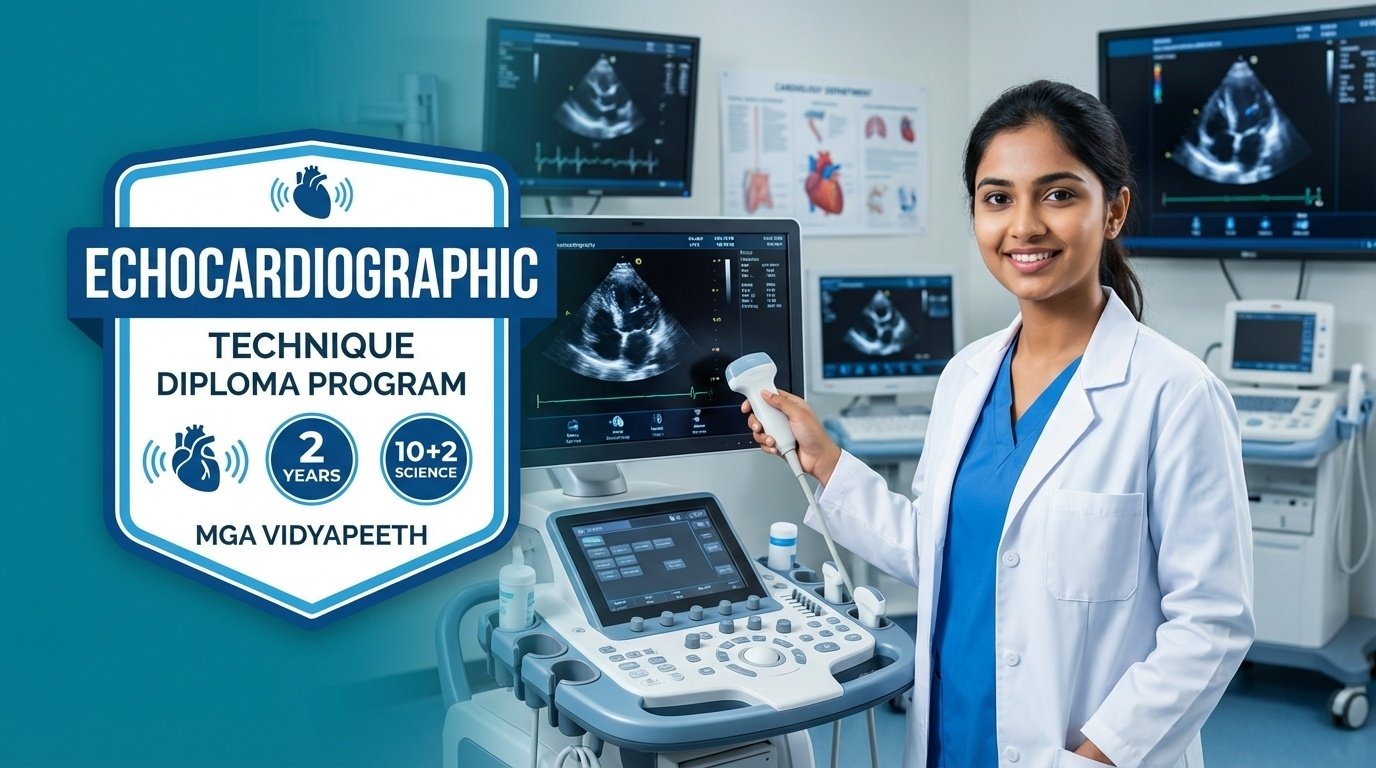
Course Details at a Glance
✅ Eligibility Criteria
Academic Qualifications
- Minimum Education: 10+2 (Higher Secondary) with Science stream
- Required Subjects: Physics, Chemistry, and Biology
- Minimum Percentage: 50% aggregate marks (45% for reserved categories)
- Age Limit: Generally between 17-35 years
- Additional Preference: Students with prior medical background or paramedical courses
Desirable Skills
- Interest in medical sciences and cardiac care
- Good hand-eye coordination for equipment operation
- Attention to detail and precision
- Patient interaction and communication skills
- Basic computer literacy
Comprehensive Course Curriculum & Syllabus
The Diploma in Echocardiographic Technique curriculum is meticulously designed to provide progressive learning from basic concepts to advanced techniques:
YEAR 1 - Foundation & Core Subjects
Semester 1 - Basic Sciences & Introduction
1. Human Anatomy & Physiology
- Detailed cardiovascular system anatomy
- Structure of heart chambers, valves, and vessels
- Blood circulation: systemic and pulmonary
- Cardiac cycle and hemodynamics
- Coronary artery anatomy
2. Pathophysiology of Cardiovascular Diseases
- Common cardiac conditions and disorders
- Congenital heart diseases
- Acquired heart diseases
- Valvular heart diseases
- Coronary artery disease and heart failure
3. Physics of Ultrasound
- Fundamentals of ultrasound technology
- Sound waves and acoustic properties
- Ultrasound transducers and their types
- Image formation and resolution
- Artifacts in ultrasound imaging
4. Medical Terminology & Healthcare Communication
- Medical abbreviations and cardiac terminology
- Patient documentation and reporting
- Professional communication skills
- Medical ethics and patient confidentiality
5. Introduction to Echocardiography
- History and evolution of echocardiography
- Role of echo in cardiac diagnosis
- Types of echocardiographic examinations
- Equipment overview and safety protocols
Semester 2 - Basic Echocardiographic Techniques
1. 2D Echocardiography (Basic)
- Standard echocardiographic views
- Parasternal views (long and short axis)
- Apical views (2-chamber, 4-chamber, 5-chamber)
- Subcostal and suprasternal views
- Image optimization techniques
2. M-Mode Echocardiography
- Principles of M-mode imaging
- Measurements and calculations
- Assessment of chamber dimensions
- Wall motion analysis
3. Doppler Echocardiography (Introduction)
- Principles of Doppler effect
- Continuous wave (CW) Doppler
- Pulsed wave (PW) Doppler
- Color flow Doppler basics
4. Basic Cardiac Measurements
- Left ventricular dimensions and function
- Ejection fraction calculation
- Wall thickness measurements
- Chamber volume calculations
5. Patient Care & Positioning
- Patient preparation for echo procedures
- Positioning techniques for optimal imaging
- Infection control measures
- Emergency response protocols
6. Practical Training - Phase I
- Hands-on training with echo machines
- Practice on simulators and volunteers
- Image acquisition techniques
- Equipment handling and maintenance
YEAR 2 - Advanced Techniques & Specialization
Semester 3 - Advanced Echocardiography
1. Advanced 2D & 3D Echocardiography
- Complex cardiac anatomy visualization
- 3D echo principles and applications
- Real-time 3D imaging
- Multiplanar reconstruction
2. Advanced Doppler Studies
- Tissue Doppler imaging (TDI)
- Strain and strain rate imaging
- Diastolic function assessment
- Hemodynamic calculations
3. Valvular Heart Disease Assessment
- Evaluation of mitral valve disorders
- Aortic valve assessment
- Tricuspid and pulmonary valve evaluation
- Prosthetic valve assessment
- Severity grading of valvular lesions
4. Stress Echocardiography
- Exercise stress echo protocols
- Pharmacological stress echo (Dobutamine)
- Indications and contraindications
- Safety monitoring during stress tests
- Interpretation of stress echo results
5. Contrast Echocardiography
- Contrast agents and their applications
- Left ventricular opacification
- Enhancement techniques
- Safety considerations
6. Echocardiographic Assessment of Cardiac Function
- Systolic function evaluation
- Diastolic function assessment
- Regional wall motion abnormalities
- Quantitative analysis methods
Semester 4 - Specialized Procedures & Clinical Application
1. Transesophageal Echocardiography (TEE)
- Principles and indications of TEE
- Patient preparation and sedation
- Probe handling and manipulation
- Standard TEE views and planes
- Safety protocols and complications
2. Congenital Heart Disease Evaluation
- Echo in pediatric patients
- Common congenital defects (ASD, VSD, PDA)
- Complex congenital anomalies
- Shunt calculations
- Fetal echocardiography basics
3. Cardiomyopathies & Advanced Cardiac Conditions
- Dilated cardiomyopathy
- Hypertrophic cardiomyopathy
- Restrictive cardiomyopathy
- Cardiac masses and tumors
- Pericardial diseases
4. Interventional Echocardiography
- Echo guidance for cardiac procedures
- Pericardiocentesis guidance
- Valve intervention monitoring
- Device closure procedures
5. Quality Assurance & Reporting
- Quality control in echocardiography
- Standard reporting formats
- Documentation and image archiving
- Legal and ethical considerations
- Accreditation standards
6. Research Methodology & Biostatistics
- Basics of medical research
- Data collection and analysis
- Evidence-based practice
- Case study presentations
7. Clinical Internship & Practical Training - Phase II
- Extensive hospital-based training (Minimum 500 hours)
- Real patient interactions under supervision
- Independent examination performance
- Report writing and interpretation
- Case presentations and discussions
- Exposure to various cardiac conditions
Learning Outcomes
Upon successful completion of this diploma, graduates will be able to:
✓ Technical Proficiency: Independently perform comprehensive echocardiographic examinations using all modalities
✓ Image Acquisition: Obtain high-quality cardiac images in all standard views
✓ Measurements & Calculations: Accurately measure cardiac parameters and perform hemodynamic calculations
✓ Pathology Recognition: Identify normal and abnormal cardiac structures and functions
✓ Advanced Techniques: Perform stress echocardiography and assist in TEE procedures
✓ Equipment Management: Operate, troubleshoot, and maintain echocardiography equipment
✓ Report Generation: Create comprehensive, accurate echocardiography reports
✓ Patient Care: Provide professional patient care with empathy and safety
✓ Quality Standards: Follow quality assurance protocols and maintain professional standards
✓ Collaborative Work: Work effectively with cardiologists and healthcare teams
✓ Continuing Education: Stay updated with latest advancements in cardiac imaging
Career Opportunities & Job Roles
Echocardiography graduates have excellent career prospects in diverse healthcare settings:
Primary Job Positions
1. Echocardiography Technician
- Performing routine and advanced echo studies
- Primary role in cardiology departments
2. Cardiovascular Sonographer
- Specialized cardiac ultrasound imaging
- Multi-modality cardiac diagnostics
3. Cardiac Imaging Specialist
- Advanced imaging techniques
- Quality control and protocol development
4. Stress Echo Technician
- Conducting exercise and pharmacological stress tests
- Monitoring and safety management
5. TEE Technician/Assistant
- Assisting in transesophageal echocardiography
- Specialized procedures support
6. Echocardiography Laboratory Supervisor
- Managing echo labs and staff
- Quality assurance and training
7. Clinical Application Specialist
- Training and product demonstrations
- Medical equipment companies
8. Cardiac Research Assistant
- Clinical trials and research projects
- Data collection and analysis
9. Medical Equipment Sales & Support
- Technical sales representation
- Product training and support
10. Echocardiography Faculty/Trainer
- Teaching in paramedical institutes
- Conducting workshops and training programs
Employment Sectors
Healthcare Facilities
- Super-specialty and Multi-specialty Hospitals
- Cardiology Centers and Clinics
- Cardiac Catheterization Laboratories
- Intensive Care Units (ICU/CCU)
- Emergency Departments
Diagnostic & Research Centers
- Advanced Diagnostic Laboratories
- Cardiac Research Institutions
- Clinical Trial Centers
- Medical Colleges and Teaching Hospitals
Corporate & Private Sector
- Medical Equipment Manufacturing Companies
- Healthcare Technology Firms
- Telemedicine and Remote Diagnostic Services
- Corporate Hospitals and Health Centers
Government & Public Health
- Government Hospitals and Medical Colleges
- Primary and Community Health Centers
- Public Health Programs
- Armed Forces Medical Services
International Opportunities
- Middle East (UAE, Saudi Arabia, Qatar)
- North America (USA, Canada)
- Europe (UK, Germany, Australia)
- Singapore and Other Asian Countries
Salary Prospects & Earning Potential
The Echocardiography field offers attractive remuneration with excellent growth potential:
Indian Market - Annual Salary Range
International Market - Annual Salary
Additional Income Sources
- Freelance Consulting: ₹2,000 - ₹5,000 per case
- Workshop Training: ₹10,000 - ₹50,000 per session
- Private Practice: Additional ₹3-8 Lakhs annually
- Research Projects: Project-based compensation
Note: Salaries vary based on location, institution type, skills, certifications, and market demand
Career Growth & Advancement Pathways
Vertical Growth
- Junior Echocardiography Technician → Entry-level position
- Senior Echocardiography Technician → 3-5 years experience
- Lead Echocardiography Technician → 5-7 years experience
- Echo Lab Supervisor/Manager → 7-10 years experience
- Chief Cardiac Sonographer → 10+ years experience
- Department Head/Director → 12+ years experience
Horizontal Growth & Specializations
Advanced Certifications
- TEE Certification: Specialized transesophageal echo
- 3D Echo Certification: Advanced imaging techniques
- Pediatric Echo Certification: Congenital heart disease expertise
- Stress Echo Certification: Advanced stress testing
- Fetal Echo Certification: Prenatal cardiac imaging
Higher Education Options
- B.Sc. in Cardiovascular Technology: Bachelor's degree programs
- M.Sc. in Cardiac Imaging: Master's specialization
- Post-Graduate Diploma in Cardiac Care: Advanced training
- MBA in Healthcare Management: Administrative roles
- PhD in Cardiac Sciences: Research and academia
International Certifications
- ARDMS (USA): American Registry for Diagnostic Medical Sonography
- CCI (USA): Cardiovascular Credentialing International
- EACVI (Europe): European Association of Cardiovascular Imaging
- BSE (UK): British Society of Echocardiography
Alternative Career Paths
- Healthcare Administration: Managing cardiac care facilities
- Medical Technology Sales: Representing ultrasound equipment companies
- Clinical Research: Participating in cardiac research studies
- Healthcare Education: Teaching in medical/paramedical institutions
- Entrepreneurship: Establishing diagnostic centers
- Telemedicine: Remote cardiac diagnostic services
- Healthcare IT: Developing cardiac imaging software solutions
Why Choose This Course?
High Demand Specialty
- Critical shortage of qualified echocardiography professionals
- Expanding cardiovascular care infrastructure in India
- Growing elderly population with cardiac conditions
- Increasing awareness of preventive cardiac health
Advanced Technical Skills
- Master cutting-edge ultrasound technology
- Hands-on training with sophisticated equipment
- Multi-modality expertise (2D, 3D, Doppler, TEE)
- Industry-relevant practical exposure
Excellent Career Prospects
- Higher starting salaries compared to basic paramedical courses
- Rapid career progression opportunities
- Diverse employment options across sectors
- Strong demand in international markets
Global Opportunities
- High demand in Middle East countries (tax-free salaries)
- Migration pathways to USA, Canada, Australia
- International certification recognition
- Competitive global remuneration
⚕️ Meaningful Work
- Direct contribution to life-saving cardiac diagnoses
- Working with advanced medical technology
- Collaborative work with cardiologists
- Intellectual stimulation and continuous learning
⏱️ Work-Life Balance
- Standard working hours in most settings
- Professional healthcare environment
- Respect and recognition as specialized technicians
- Limited on-call duties compared to nursing
Return on Investment
- Affordable two-year program (₹80,000)
- Quick entry into specialized field
- High salary potential within 3-5 years
- Multiple income streams possible
Future-Proof Career
- Continuous technological advancements
- Essential diagnostic service
- Cannot be automated or replaced
- Growing importance in preventive healthcare
About Mahatma Gandhi Ayurvigyan Vidyapeeth
Mahatma Gandhi Ayurvigyan Vidyapeeth is a premier institution committed to excellence in paramedical and healthcare education. The institute provides:
Infrastructure & Facilities
- State-of-the-Art Echo Lab: Equipped with latest echocardiography machines
- Simulation Training Center: Advanced cardiac imaging simulators
- Digital Classroom: Modern teaching aids and multimedia learning
- Research Library: Comprehensive medical and technical resources
- Clinical Training Facilities: Partnerships with leading hospitals
Academic Excellence
- Experienced Faculty: Qualified cardiologists and senior echocardiography specialists
- Curriculum Updates: Regularly revised to match industry standards
- Practical Focus: 60% hands-on training component
- Guest Lectures: Industry experts and visiting faculty
- Research Opportunities: Participation in clinical studies
Clinical Training Network
- Tie-ups with multi-specialty hospitals
- Exposure to diverse cardiac conditions
- Supervised patient interactions
- Real-world procedural experience
- Minimum 500 hours clinical training
Placement Support
- Dedicated Placement Cell: Active job placement assistance
- Industry Connections: Network with hospitals and diagnostic centers
- Campus Recruitment: Leading healthcare institutions visit for hiring
- Career Counseling: Resume building and interview preparation
- Alumni Network: Strong professional connections
Student Support Services
- Scholarship programs for meritorious students
- Flexible payment options
- Hostel facilities (for outstation students)
- Library and study resources
- Mentorship programs
Admission Process - Step by Step
Step 1: Eligibility Verification
- Ensure you meet 10+2 (Science) requirements
- Check minimum percentage criteria
- Prepare required documents
Step 2: Online Application
Step 3: Document Submission
Required documents include:
- 10th standard mark sheet and certificate
- 12th standard mark sheet and certificate
- Transfer Certificate (TC) from previous institution
- Character Certificate
- Migration Certificate (if applicable)
- Aadhar Card / Government ID proof
- Passport size photographs (6 copies)
- Category certificate (SC/ST/OBC - if applicable)
- Medical fitness certificate
- Income certificate (for scholarship eligibility)
Step 4: Selection Process
- Merit-Based Selection: Based on 12th standard marks
- Entrance Test: (If applicable - institute discretion)
- Personal Interview: Assessment of aptitude and interest
- Document Verification: Original document validation
Step 5: Fee Payment
- Total Course Fee: ₹80,000 (for 2 years)
- Payment Options:
- Lump sum payment with discount
- Semester-wise payment (₹20,000 per semester)
- Annual payment (₹40,000 per year)
- EMI options available (inquire with admission office)
Step 6: Admission Confirmation
- Receive admission confirmation letter
- Complete enrollment formalities
- Attend orientation program
- Receive student ID and course materials
- Begin classes as per academic calendar
Important Dates (Indicative)
- Application Start: March 2026
- Application Deadline: June 2026
- Admission Processing: April - July 2026
- Course Commencement: July/August 2026
Note: Exact dates will be announced on the official website
Skills You Will Master
Technical Skills
Imaging Expertise
- Advanced ultrasound machine operation
- Multi-probe handling techniques
- Image optimization and troubleshooting
- Artifact recognition and correction
- Quality assessment of cardiac images
Diagnostic Capabilities
- Comprehensive 2D/3D echocardiographic examination
- Doppler flow analysis and interpretation
- Stress echocardiography performance
- TEE assistance and support
- Contrast echocardiography techniques
Analytical Skills
- Cardiac measurement calculations
- Hemodynamic parameter assessment
- Valve function quantification
- Left ventricular function evaluation
- Report generation and documentation
Equipment Management
- Ultrasound machine calibration
- Transducer care and maintenance
- Software navigation and updates
- PACS (Picture Archiving System) management
- Equipment troubleshooting
Clinical Skills
Patient Care
- Professional patient interaction
- Patient positioning and preparation
- Comfort and safety management
- Emergency response readiness
- Infection control practices
Procedural Competence
- Standard protocol adherence
- Time-efficient examinations
- Stress test monitoring
- Sedation support (for TEE)
- Post-procedure patient care
Professional Skills
Communication
- Effective verbal and written communication
- Report writing and documentation
- Interprofessional collaboration
- Patient education and counseling
- Presentation skills
Critical Thinking
- Problem-solving during examinations
- Adaptive thinking for difficult cases
- Quality assessment
- Continuous improvement mindset
Leadership & Management
- Team coordination
- Workflow optimization
- Resource management
- Training and mentoring juniors
Technology Proficiency
- Medical software applications
- Electronic medical records (EMR)
- Digital image archiving
- Computer-based reporting
- Telemedicine platforms
Future Scope & Industry Trends
The field of echocardiography is rapidly evolving with technological advancements:
Emerging Technologies
Artificial Intelligence (AI) Integration
- Automated image acquisition and optimization
- AI-assisted measurement and calculations
- Machine learning for pattern recognition
- Automated report generation
- Predictive analytics for cardiac risk
Advanced Imaging Modalities
- 4D Echocardiography: Real-time volumetric imaging
- Contrast-Enhanced Echo: Improved endocardial visualization
- Fusion Imaging: Integration with CT/MRI
- Strain Imaging: Advanced myocardial deformation analysis
- Pocket-Sized Echo Devices: Point-of-care ultrasound
Telemedicine & Remote Diagnostics
- Remote echocardiography guidance
- Cloud-based image sharing and interpretation
- Mobile health (mHealth) applications
- Virtual consultations and tele-echo services
Portable & Handheld Devices
- Smartphone-connected echo devices
- Battery-operated portable machines
- Point-of-care cardiac ultrasound
- Emergency and rural healthcare applications
Market Growth Drivers
Increasing Disease Burden
- Rising cardiovascular disease prevalence
- Aging population demographics
- Lifestyle-related cardiac conditions
- Growing awareness of preventive health
Expanding Healthcare Infrastructure
- Government healthcare initiatives (Ayushman Bharat)
- Private hospital chain expansion
- Tier 2 and Tier 3 city healthcare growth
- Medical tourism development
Technological Advancements
- Continuous innovation in ultrasound technology
- Improved image quality and diagnostic accuracy
- Integration with other cardiac imaging modalities
- Software enhancements and automation
Global Opportunities
- International healthcare collaborations
- Medical outsourcing and telemedicine
- Migration of Indian healthcare professionals
- Growing demand in developing countries
❓ Frequently Asked Questions (FAQs)
About the Course
Q1: What is the difference between ECG and Echocardiography?
A: ECG records the electrical activity of the heart using electrodes, while Echocardiography uses ultrasound waves to create images of heart structure and function. Echo provides detailed visualization of heart chambers, valves, and blood flow.
Q2: Is this course only theoretical or includes practical training?
A: The course is highly practical-oriented with approximately 60% hands-on training, including clinical internship in hospitals with minimum 500 hours of patient interaction.
Q3: Can I pursue this course after completing a different stream in 12th (Commerce/Arts)?
A: No, Science stream with Physics, Chemistry, and Biology is mandatory for admission.
Q4: Is there any entrance exam for admission?
A: Admission is primarily merit-based on 12th standard marks. Some institutes may conduct interviews or aptitude tests. Check with the admission office for specific requirements.
Q5: What is the class schedule? Can working professionals join?
A: This is a full-time course with regular classes and clinical training. It is not suitable for working professionals unless they can commit full-time.
About Career & Employment
Q6: What is the job placement rate after completion?
A: Qualified echocardiography technicians have excellent placement opportunities. The institute provides placement assistance, and the demand for skilled professionals is high in the industry.
Q7: Can I work abroad after completing this diploma?
A: Yes, with additional international certifications (ARDMS, CCI) and country-specific licensing, you can work in countries like USA, Canada, UAE, Saudi Arabia, Australia, and UK.
Q8: Is there growth opportunity in this field?
A: Yes, significant growth potential exists. You can advance to senior technician, supervisor, department head positions, or specialize further with certifications.
Q9: Can I start my own diagnostic center?
A: Yes, with experience and necessary capital, you can establish your own cardiac diagnostic center or echo lab.
Q10: What is the starting salary after this course?
A: Fresher salaries typically range from ₹2.7 to ₹3.5 lakhs per annum in India, which increases significantly with experience.
About Fee & Financial Support
Q11: Is the ₹80,000 fee for the complete course or annual?
A: ₹80,000 is the total fee for the complete 2-year program.
Q12: Are there any hidden costs apart from the course fee?
A: The course fee typically covers tuition and basic materials. Additional costs may include examination fees, certification fees, books, uniform, and hostel charges (if applicable).
Q13: Are scholarships available?
A: Many institutes offer scholarships based on merit or for students from economically weaker sections. Check with the admission office for available schemes.
Q14: Can I pay the fee in installments?
A: Yes, most institutes offer semester-wise or annual payment options. EMI facilities may also be available.
About Technical Aspects
Q15: What equipment will I learn to operate?
A: You'll be trained on professional echocardiography machines from brands like GE, Philips, Siemens, including 2D, 3D, Doppler, and stress echo systems.
Q16: Is coding or computer programming required?
A: Basic computer skills are required for report generation and image archiving. No programming knowledge is necessary.
Q17: Will I be able to interpret echo reports independently?
A: While you'll learn to recognize normal and abnormal patterns, final interpretation is typically done by cardiologists. However, experienced technicians can provide preliminary assessments.
Q18: How is this different from a radiology/ultrasound technician course?
A: This course is specialized exclusively in cardiac ultrasound, providing deeper expertise in heart imaging compared to general ultrasound technician courses.
About Further Education
Q19: Can I pursue B.Sc. or M.Sc. after this diploma?
A: Yes, you can pursue B.Sc. in Cardiovascular Technology or related fields. Some universities offer lateral entry options for diploma holders.
Q20: What certifications should I pursue after the diploma?
A: Consider ARDMS (USA), CCI, or EACVI certifications for international recognition and better career prospects.
Professional Certifications & Credentials
Indian Certifications
- IAC Certification: Indian Association of Cardiovascular Certification
- Certified Echo Technician (CET): National certification programs
- Advanced TEE Certification: Specialized transesophageal echo credential
International Certifications
USA Certifications
- RDCS (Registered Diagnostic Cardiac Sonographer): ARDMS credential
- RCS (Registered Cardiac Sonographer): CCI credential
- RACS (Registered Adult Cardiac Sonographer): Specialized certification
European Certifications
- EACVI Certification: European cardiovascular imaging credential
- BSE Accreditation: British Society of Echocardiography
These certifications enhance:
- Global employment opportunities
- Higher salary packages
- Professional credibility
- Career advancement prospects
- International migration eligibility
Contact & Further Information
Mahatma Gandhi Ayurvigyan Vidyapeeth
For Admission Inquiries:
- Email: admissions@mgavidyapeeth.com
- Phone: [Contact Number]
- WhatsApp: [WhatsApp Number]
For Course Information:
- Email: info@mgavidyapeeth.com
Website:
Apply Now - Secure Your Future!
Why Apply Today?
✅ Limited seats available
✅ Early bird registration benefits
✅ Scholarship opportunities for early applicants
✅ Secure admission in a high-demand course
✅ Begin your journey to a rewarding healthcare career
Quick Application Link
APPLY ONLINE NOW
Course Comparison: Why Choose Echocardiography?
Your Success Starts Here
The Diploma in Echocardiographic Technique is more than just a course – it's your gateway to a prestigious, well-paying, and fulfilling career in cardiac healthcare. With advanced skills, cutting-edge technology training, and growing global demand, you'll be positioned at the forefront of modern cardiovascular diagnostics.
Take Action Now:
- Review the course details thoroughly
- Verify your eligibility criteria
- Prepare required documents
- Apply online immediately
- Secure your seat in this high-demand program