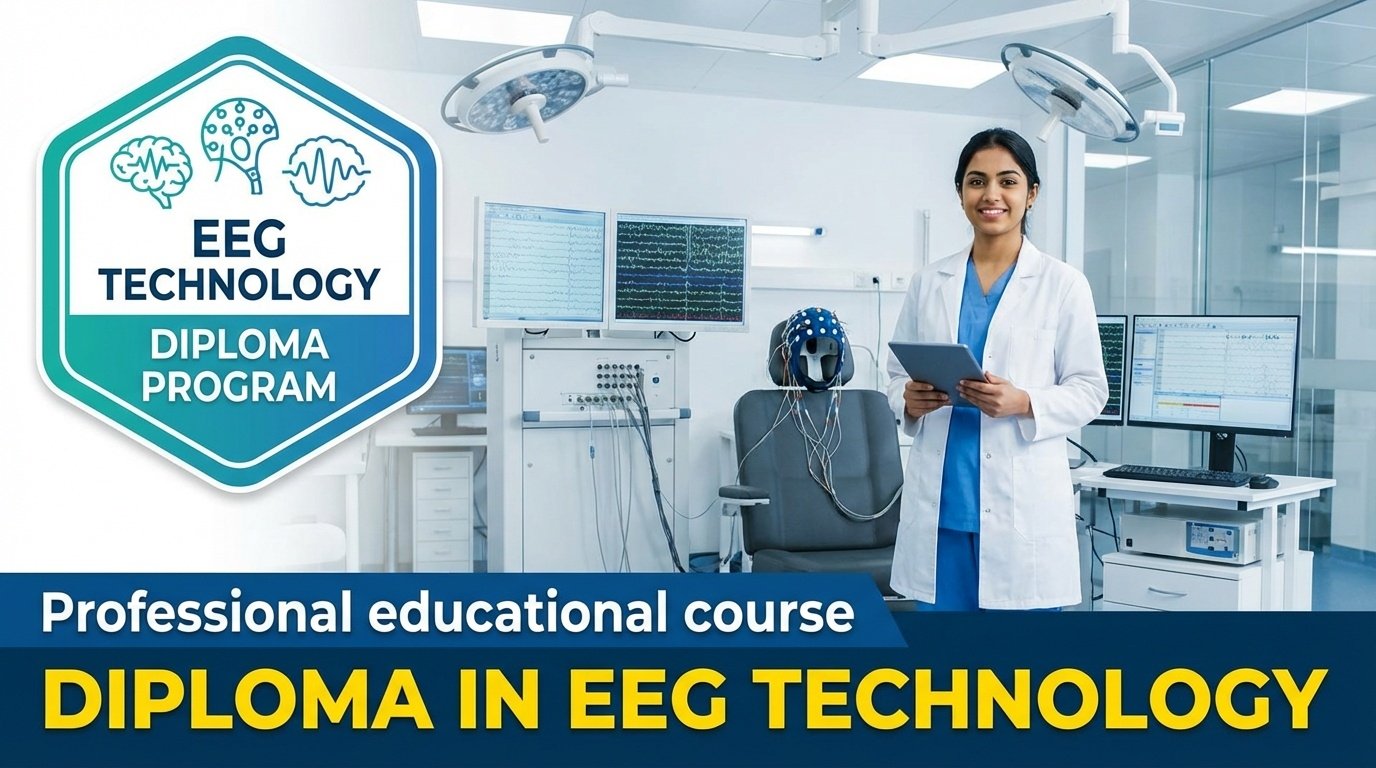
Diploma in EEG Technology
The Diploma in EEG Technology (Electroencephalography Technology), also known as Diploma in EEG & EMG Technology or Neurodiagnostic Technology, is a specialized paramedical program designed to train healthcare professionals in recording, monitoring, and interpreting electrical activity of the brain and muscles. This cutting-edge field plays a crucial role in diagnosing and managing neurological and neuromuscular disorders.
EEG (Electroencephalography) involves recording electrical activity of the brain to diagnose conditions like epilepsy, sleep disorders, brain injuries, and other neurological conditions. EMG (Electromyography) focuses on recording electrical activity of muscles to diagnose neuromuscular disorders.
EEG/EMG technicians work alongside neurologists, neurosurgeons, and sleep specialists to provide critical diagnostic information that guides treatment decisions and patient care.
What is EEG Technology?
Electroencephalography (EEG) is a non-invasive diagnostic technique that records electrical activity produced by the brain through electrodes placed on the scalp. The resulting patterns, called brain waves, provide valuable information about brain function and help diagnose various neurological conditions.
Key Applications:
- Epilepsy and seizure disorders
- Sleep disorders (including sleep apnea)
- Brain tumors and lesions
- Head injuries and trauma
- Stroke assessment
- Dementia and Alzheimer's disease
- Encephalitis and meningitis
- Brain death determination
- Monitoring during surgery (intraoperative monitoring)
What is EMG Technology?
Electromyography (EMG) is a diagnostic procedure that evaluates the health of muscles and the nerve cells (motor neurons) that control them. EMG measures the electrical activity produced by skeletal muscles.
Key Applications:
- Neuromuscular disorders (muscular dystrophy, myasthenia gravis)
- Peripheral nerve disorders (carpal tunnel syndrome, neuropathy)
- Motor neuron diseases (ALS, polio)
- Nerve root compression (herniated discs)
- Myopathies and muscle inflammation
What is an EEG/EMG Technician?
An EEG/EMG Technician (also called Neurodiagnostic Technologist) is a specialized healthcare professional who:
- Prepares patients for EEG and EMG procedures
- Applies electrodes according to the International 10-20 System
- Operates and maintains EEG and EMG equipment
- Records brain and muscle activity during various states (awake, asleep, stimulated)
- Performs activation procedures (hyperventilation, photic stimulation)
- Identifies artifacts and ensures quality recordings
- Assists in interpretation of results under physician supervision
- Conducts sleep studies (polysomnography)
- Performs nerve conduction studies (NCS)
- Maintains patient records and documentation
- Ensures patient safety and comfort during procedures
Course Duration & Type
- Duration:
- Certificate programs: 6 months - 1 year
- Diploma programs: 1-2 years (standard)
- Advanced Diploma: 2 years
- Course Type: Full-time, Part-time options available
- Course Level: Diploma/Certificate in Neurodiagnostic Technology
Course Objectives
The Diploma in EEG Technology aims to prepare technicians who can:
- Understand neuroanatomy and neurophysiology - Structure and function of the nervous system
- Master electrode placement - International 10-20 System of Electrode Placement
- Operate EEG and EMG equipment - Digital neurodiagnostic instruments
- Perform quality recordings - EEG, EMG, nerve conduction studies
- Recognize normal and abnormal patterns - Brain waves and muscle activity
- Identify and eliminate artifacts - Technical and physiological interference
- Conduct specialized procedures:
- Routine EEG
- Sleep-deprived EEG
- Ambulatory EEG monitoring
- Video EEG monitoring
- Polysomnography (sleep studies)
- Nerve conduction studies (NCS)
- Evoked potentials (EP)
- Intraoperative monitoring (IOM)
- Provide patient care - Safety, comfort, and communication
- Maintain professional standards - Ethics, documentation, quality assurance
- Stay updated with technological advances in neurodiagnostics
Eligibility Criteria
Educational Qualification:
Standard Requirements:
- High school diploma (10+2) or equivalent
- Science background preferred with subjects:
- Biology, Physics, Chemistry
- Minimum Marks: 45-50% aggregate
Alternative Pathways:
- Healthcare background: Nurses, medical technologists, lab technicians
- Associate degree in related healthcare field
Age Requirements:
- Minimum Age: 17 years
- Maximum Age: No strict upper limit (varies by institution)
Skills & Attributes:
- Manual dexterity and precision
- Good communication skills
- Patience and attention to detail
- Ability to work with diverse patients
- Computer literacy
- Physical ability to position patients and equipment
Other Requirements:
- Medical fitness certificate
- Basic English proficiency
- Background check (for clinical placements)
- Immunization records (Hepatitis B, TB, etc.)
Admission Process
Application Steps:
- Research accredited institutions offering EEG Technology programs
- Review admission requirements specific to each institution
- Prepare required documents:
- High school/secondary school transcripts
- Letters of recommendation (2-3)
- Personal statement/statement of purpose
- Resume/CV
- Medical fitness certificate
- Identity proof
- Passport size photographs
- Complete application form (online or offline)
- Pay application fee (₹500-1,500 or $25-100)
- Attend entrance exam/interview (if required)
- Await admission decision
- Accept offer and complete enrollment
- Attend orientation program
Selection Criteria:
- Academic performance in science subjects
- Entrance exam scores (if applicable)
- Interview performance
- Prior healthcare experience (advantageous)
Course Fees
India:
- Certificate programs: ₹30,000 - ₹80,000
- Diploma programs: ₹50,000 - ₹1,50,000 (2 years)
- Government institutions: Lower fees
- Private institutions: Higher fees
International (USA):
- Certificate programs: $3,000 - $8,000
- Associate degree: $10,000 - $25,000
Fee Components:
- Tuition fees
- Laboratory fees
- Clinical training fees
- Examination fees
- Equipment usage fees
- Books and materials
- Certification exam fees (separate)
Course Curriculum & Syllabus
SEMESTER 1: Foundation in Neurosciences
EEG 200: Fundamentals of Neuroanatomy
Topics:
- Introduction to Nervous System
- Basic anatomical terms (position, direction, regions, planes)
- Structure and function overview
- Skull and Bony Structure
- Cranial anatomy
- Protective structures
- Central Nervous System:
- Brain: Cerebrum, cerebellum, brainstem
- Spinal cord: Structure and function
- Meninges and cerebrospinal fluid
- Peripheral Nervous System:
- Cranial nerves (12 pairs)
- Spinal nerves
- Autonomic nervous system
- Blood Supply to Brain:
- Arterial supply (Circle of Willis)
- Venous drainage
- Neurological Examination Basics
EEG 201: Testing Procedures and Terminology
Topics:
- Introduction to Neurodiagnostic Technology
- History and evolution of EEG
- Scope of practice
- Professional roles and responsibilities
- Medical Terminology:
- General medical terms
- Neurological terminology
- Patient charting vocabulary
- Signs and symptoms
- Accepted abbreviations
- Types of Neurodiagnostic Tests:
- EEG (Electroencephalography)
- EMG (Electromyography)
- NCS (Nerve Conduction Studies)
- EP (Evoked Potentials)
- PSG (Polysomnography)
- IOM (Intraoperative Monitoring)
- LTM (Long-Term Monitoring)
- EEG Waveforms and Patterns:
- Frequency bands (Delta, Theta, Alpha, Beta, Gamma)
- Amplitude and morphology
- Descriptive terminology
- Neurological Diseases Overview:
- Epilepsy and seizure disorders
- Sleep disorders
- Movement disorders
- Neuromuscular conditions
EEG 202: Electrodes, Electrode Placement and Application
Topics:
- International 10-20 System:
- Standard electrode placement system
- Nomenclature and labeling
- Measurement techniques
- Types of Electrodes:
- Cup electrodes (gold, silver/silver chloride)
- Needle electrodes
- Subdermal electrodes
- Composition and characteristics
- Electrode Application Methods:
- Collodion application (for long-term monitoring)
- Paste application (for routine EEG)
- Adhesive electrodes
- Skin Preparation:
- Cleaning and preparing scalp
- Achieving low impedances
- Skin safety considerations
- Special Populations:
- Pediatric electrode placement
- Neonatal modifications
- ICU and bedside considerations
- Electrode Disinfection:
- Cleaning protocols
- Infection control
- Troubleshooting:
- Common placement errors
- Achieving secure placement
- Impedance testing
EEG 203: Fundamentals of EEG and Patient Care
Topics:
- History of EEG:
- Important discoveries (Hans Berger)
- Evolution of technology
- Clinical applications development
- Patient Safety:
- Infection prevention and control
- Seizure precautions
- Emergency preparedness
- First aid and CPR
- Professional Competence:
- ASET National Competency Skill Standards
- Best practices for performing EEG
- Patient Communication:
- Establishing professional rapport
- Explaining procedures
- Addressing patient concerns
- Cultural sensitivity
- Patient Privacy:
- HIPAA regulations (USA) / data protection laws
- Confidentiality standards
- Documentation requirements
- Vital Signs Monitoring:
- Temperature, pulse, respiration, blood pressure
- Identifying patients in distress
- Patient Positioning:
- Comfortable and safe positioning
- Accommodating physical limitations
EEG 204: Digital EEG Concepts and Electrical Safety
Topics:
- Basic Electricity Principles:
- Current flow (AC/DC)
- Voltage, resistance, impedance
- Ohm's Law
- Electrical Safety:
- Grounding and electrical isolation
- Electrical hazards in clinical settings
- Leakage current
- Patient safety measures
- Digital Technology Fundamentals:
- Analog vs. digital signals
- Analog-to-digital conversion (ADC)
- Sampling rate and resolution
- Digital EEG Instruments:
- Components and architecture
- Amplifiers and filters
- Data acquisition systems
- Computer Terminology:
- Hardware and software basics
- File management
- Network connectivity
- EEG Software Features:
- Recording settings
- Display options
- Post-acquisition editing
SEMESTER 2: Normal EEG and Instrumentation
EEG 205: Normal Adult EEG, Normal Variants & Drug Effects
Topics:
- Neurophysiological Basis of EEG:
- Neurons and brain waves
- Excitatory and inhibitory postsynaptic potentials
- Generation of EEG signals
- Normal EEG Patterns:
- Waking state:
- Alpha rhythm (8-13 Hz) - posterior dominant rhythm
- Beta activity (>13 Hz)
- Theta activity (4-7 Hz)
- Sleep stages:
- Drowsiness
- Light sleep (Stage N1, N2)
- Deep sleep (Stage N3, slow-wave sleep)
- REM sleep
- EEG Descriptive Terms:
- Frequency, amplitude, morphology
- Symmetry, synchrony, reactivity
- Rhythms and patterns
- Normal Variants:
- POSTS (Positive Occipital Sharp Transients of Sleep)
- Mu rhythm (central alpha activity)
- Lambda waves (occipital sharp transients)
- Wicket spikes
- Phantom spike and wave
- 14 & 6 Hz positive spikes
- Breach rhythm
- Drug Effects on EEG:
- Benzodiazepines
- Barbiturates
- Antiepileptic medications
- Anesthetics
- Sedatives
Recommended Text: Libenson, M.H. "Practical Approach to Electroencephalography"
EEG 206: Instrumentation Part I
Topics:
- Electronic Components:
- Amplifiers (differential amplifiers)
- Filters (high-frequency, low-frequency, notch)
- Analog-to-digital converters
- Amplifier Settings:
- Sensitivity (microvolts per millimeter)
- Time constant / Low-frequency filter (LFF)
- High-frequency filter (HFF)
- Notch filter (60 Hz / 50 Hz)
- Chart Speed:
- Standard speeds (30 mm/sec, 15 mm/sec)
- Effect on waveform appearance
- Montages:
- Bipolar montages (longitudinal, transverse)
- Referential montages (common reference)
- Average reference
- Laplacian montages
- Calibration:
- Biological calibration
- Square wave calibration
- Impedance checking
- Polarity Conventions:
- Phase relationships
- Localization principles
EEG 207: Instrumentation Part II
Topics:
- Waveform Analysis:
- Polarity determination
- Phase reversal for localization
- Identifying waveform characteristics
- Recording Quality Improvement:
- Optimizing settings for different situations
- Recording annotations
- Event marking
- Activation Procedures:
- Hyperventilation:
- Technique and duration
- Expected changes in EEG
- Contraindications
- Photic stimulation:
- Flash frequencies
- Photoparoxysmal response
- Photic driving
- Specialized Recordings:
- Bedside EEG (ICU, emergency department)
- Electrocerebral Inactivity (ECI) - Brain death determination
- Technical considerations for challenging environments
- Lab Management:
- Daily quality checks
- Equipment maintenance
- Scheduling and workflow
- Supply inventory
SEMESTER 3: Artifacts and Clinical Applications
EEG 208: Artifacts Identification and Troubleshooting
Topics:
- Physiological Artifacts:
- Eye movements (blinks, lateral eye movements)
- Muscle artifact (EMG, chewing, clenching)
- Cardiac artifact (ECG, pulse)
- Glossokinetic artifact (tongue movements)
- Sweat artifact
- Respiratory artifact
- Non-Physiological Artifacts:
- Electrode artifacts (electrode pops, movement)
- 60 Hz / 50 Hz interference (electrical noise)
- Equipment artifacts (amplifier, cable issues)
- Environmental artifacts (IV pumps, ventilators)
- Movement artifacts
- Impedance and Common Mode Rejection (CMR):
- Importance of low impedances
- Balanced impedances
- CMR principles
- Troubleshooting Techniques:
- Systematic approach to artifact identification
- Elimination strategies
- Using reference electrodes
- Shielding and grounding
- Documentation:
- Annotating artifacts
- Recording troubleshooting steps
EEG 209: EEG in Epilepsy
Topics:
- International Classification of Seizures:
- Focal seizures (simple, complex, with secondary generalization)
- Generalized seizures (absence, tonic-clonic, myoclonic, atonic)
- Status epilepticus
- Epileptiform Patterns:
- Spikes and sharp waves
- Spike-and-wave complexes
- Polyspike-and-wave
- Hypsarrhythmia (infantile spasms)
- 3 Hz spike-and-wave (absence epilepsy)
- Ictal Patterns:
- Seizure onset patterns
- Evolution during seizures
- Post-ictal changes
- Interictal Patterns:
- Focal epileptiform discharges
- Generalized epileptiform discharges
- Lateralized periodic discharges
- Clinical Manifestations:
- Types of seizures and their presentations
- Auras and prodromal symptoms
- Treatment:
- Antiepileptic drugs (AEDs)
- Surgical options (resection, VNS, RNS)
- Ketogenic diet
- Long-Term Monitoring:
- Video-EEG monitoring
- Ambulatory EEG
- Seizure diaries
EEG 210: EEG in Neurological Disorders
Topics:
- Diagnostic Process:
- Clinical history
- Neurological examination
- Differential diagnosis
- Common Neurological Disorders and EEG Findings:
- Encephalopathies:
- Metabolic encephalopathy (slowing, triphasic waves)
- Hepatic encephalopathy
- Hypoxic-ischemic encephalopathy
- Infections:
- Encephalitis (focal slowing, PLEDs)
- Meningitis
- Creutzfeldt-Jakob disease (periodic sharp waves)
- Stroke and TIA:
- Focal slowing
- Loss of normal rhythms
- Head Trauma:
- Diffuse slowing
- Breach rhythm
- Brain Tumors:
- Focal abnormalities
- Increased intracranial pressure effects
- Dementia:
- Alzheimer's disease (generalized slowing)
- Frontotemporal dementia
- Other Diagnostic Procedures:
- CT and MRI imaging
- Lumbar puncture
- Angiography
- PET scans
SEMESTER 4: Specialized Populations and Advanced Topics
EEG 211: EEG in Pediatric Patients and Neonates
Topics:
- Pediatric and Neonatal EEG Procedures:
- Modified electrode placements
- Recording parameters
- Behavioral states
- Age-Specific Normal Patterns:
- Neonatal EEG (premature and full-term)
- Trace alternant
- Trace discontinu
- Continuity and discontinuity
- Infant EEG (0-12 months)
- Toddler and preschool (1-5 years)
- School-age (6-12 years)
- Adolescent (13-18 years)
- Maturation of EEG:
- Development of posterior dominant rhythm
- Sleep architecture development
- Pediatric Epilepsy Syndromes:
- Infantile spasms (West syndrome)
- Lennox-Gastaut syndrome
- Benign rolandic epilepsy
- Childhood absence epilepsy
- Juvenile myoclonic epilepsy
- Neonatal Seizures:
- Subtle, tonic, clonic, myoclonic
- EEG patterns in neonatal seizures
- Neonatal Encephalopathy:
- Hypoxic-ischemic encephalopathy
- Burst suppression pattern
- Pediatric Sleep Studies:
- Polysomnography in children
- Sleep disorders in pediatric populations
ADDITIONAL MODULES
Basics of EMG (Electromyography)
Topics:
- Principles of Electromyography:
- Muscle physiology
- Motor units and muscle fibers
- Neuromuscular junction
- EMG Instrumentation:
- Needle electrodes (concentric, monopolar)
- Surface electrodes
- Amplifiers and filters
- Needle EMG Techniques:
- Insertional activity
- Spontaneous activity (fibrillations, positive sharp waves, fasciculations)
- Motor unit action potentials (MUAPs)
- Recruitment patterns
- Clinical Applications:
- Neuropathies
- Myopathies
- Motor neuron diseases
- Neuromuscular junction disorders
Nerve Conduction Studies (NCS)
Topics:
- Principles of NCS:
- Nerve anatomy and physiology
- Electrical stimulation of nerves
- Recording compound action potentials
- Motor Nerve Conduction Studies:
- Technique and measurement
- Distal latency, amplitude, conduction velocity
- Sensory Nerve Conduction Studies:
- Antidromic vs. orthodromic stimulation
- Amplitude and latency measurements
- F-Waves and H-Reflexes:
- Late responses
- Clinical significance
- Common Disorders:
- Carpal tunnel syndrome
- Peripheral neuropathies
- Radiculopathies
- Guillain-Barré syndrome
Introduction to Additional Modalities
1. Evoked Potentials (EP):
- Visual evoked potentials (VEP)
- Brainstem auditory evoked potentials (BAEP)
- Somatosensory evoked potentials (SSEP)
2. Polysomnography (PSG):
- Sleep stages
- Sleep disorders (apnea, narcolepsy, RLS)
- Scoring criteria
3. Long-Term Monitoring (LTM):
- Continuous video-EEG monitoring
- Ambulatory EEG
- Pre-surgical evaluation
4. Intraoperative Monitoring (IOM):
- Monitoring during neurosurgery
- Spinal cord monitoring
- Cranial nerve monitoring
Clinical Training & Practicum
Clinic I - EEG Lab:
- Practice on mannequin heads - 10-20 System measurement
- Peer practice - Electrode application on classmates
- Equipment familiarization - EEG machines and software
- Supervised practice - Recording and basic operations
Clinic II - Clinical Practicum:
Prerequisites: Completion of all theory courses and Lab
Duration: 3-6 months
Activities:
- Shadowing phase (2 weeks) - Observe experienced technologists
- Supervised practice:
- Measuring patient heads
- Applying electrodes
- Collecting EEG data
- Performing activation procedures
- Independent practice (under supervision):
- Routine EEG
- Sleep-deprived EEG
- Ambulatory EEG setup
- Minimum case requirements:
- 50-100 EEG procedures
- Various patient populations (adult, pediatric, neonatal)
- Different clinical settings (lab, bedside, ICU)
Clinical Sites:
- Hospital EEG laboratories
- Neurology clinics
- Sleep centers
- Epilepsy monitoring units
- Research institutions
Examination & Assessment
Theory Assessment:
- Written exams - Multiple choice, short answer
- Internal assessments - 10-25% of total marks
- Final theory exam - 40-75 marks (depending on program)
- Pass marks: 50% minimum
Practical Assessment:
- Electrode placement - Accuracy and technique
- Equipment operation - Proficiency in settings and troubleshooting
- Patient interaction - Communication and care
- Recording quality - Artifact-free, proper technique
- Clinical assessment - 50 marks
- Pass marks: 50% minimum
Attendance Requirements:
- Theory: 75% minimum
- Practical: 85% minimum
- Clinical rotations: 100% attendance mandatory
Certification Exam (Post-Graduation):
- R.EEG.T (Registered EEG Technologist) - ABRET
- CNIM (Certified in Neurophysiologic Intraoperative Monitoring)
- RPSGT (Registered Polysomnographic Technologist)
Skills Developed
Technical Skills:
- Electrode placement expertise - International 10-20 System
- Equipment operation - Digital EEG/EMG machines
- Signal acquisition - Optimizing recording quality
- Artifact recognition - Identifying and eliminating interference
- Pattern recognition - Normal and abnormal waveforms
- Troubleshooting - Technical problem-solving
- Computer proficiency - EEG software and data management
Clinical Skills:
- Patient assessment - Vital signs, neurological status
- Patient preparation - Explaining procedures, positioning
- Safety protocols - Infection control, emergency response
- Activation procedures - Hyperventilation, photic stimulation
- Specialized techniques - Sleep studies, long-term monitoring
Professional Skills:
- Communication - Patient interaction, team collaboration
- Documentation - Accurate record-keeping
- Ethics - Patient privacy, professional conduct
- Time management - Efficient workflow
- Critical thinking - Clinical reasoning
Career Opportunities
Job Roles:
- EEG Technologist - Routine and specialized EEG procedures
- EMG Technologist - Nerve conduction studies and needle EMG
- Neurodiagnostic Technologist - Multi-modality specialist
- Sleep Technologist - Polysomnography and sleep disorders
- Intraoperative Monitoring Technologist - Surgical neuromonitoring
- Epilepsy Monitoring Technologist - Long-term video-EEG
- Clinical Research Assistant - Neuroscience research
- Healthcare Educator - Training programs for technologists
- Quality Assurance Specialist - Lab standards and protocols
- Medical Device Specialist - Sales and technical support
- Neurology Technician - Comprehensive neurodiagnostic support
Work Settings:
- Hospitals (neurology departments, epilepsy centers)
- Neurology clinics and private practices
- Sleep centers and sleep medicine clinics
- Research institutions (universities, pharmaceutical companies)
- Surgical centers (intraoperative monitoring)
- Diagnostic laboratories
- Veterans hospitals and military medical centers
- Pediatric hospitals and NICUs
- Rehabilitation centers
- Medical device companies (Natus, Nihon Kohden, Cadwell)