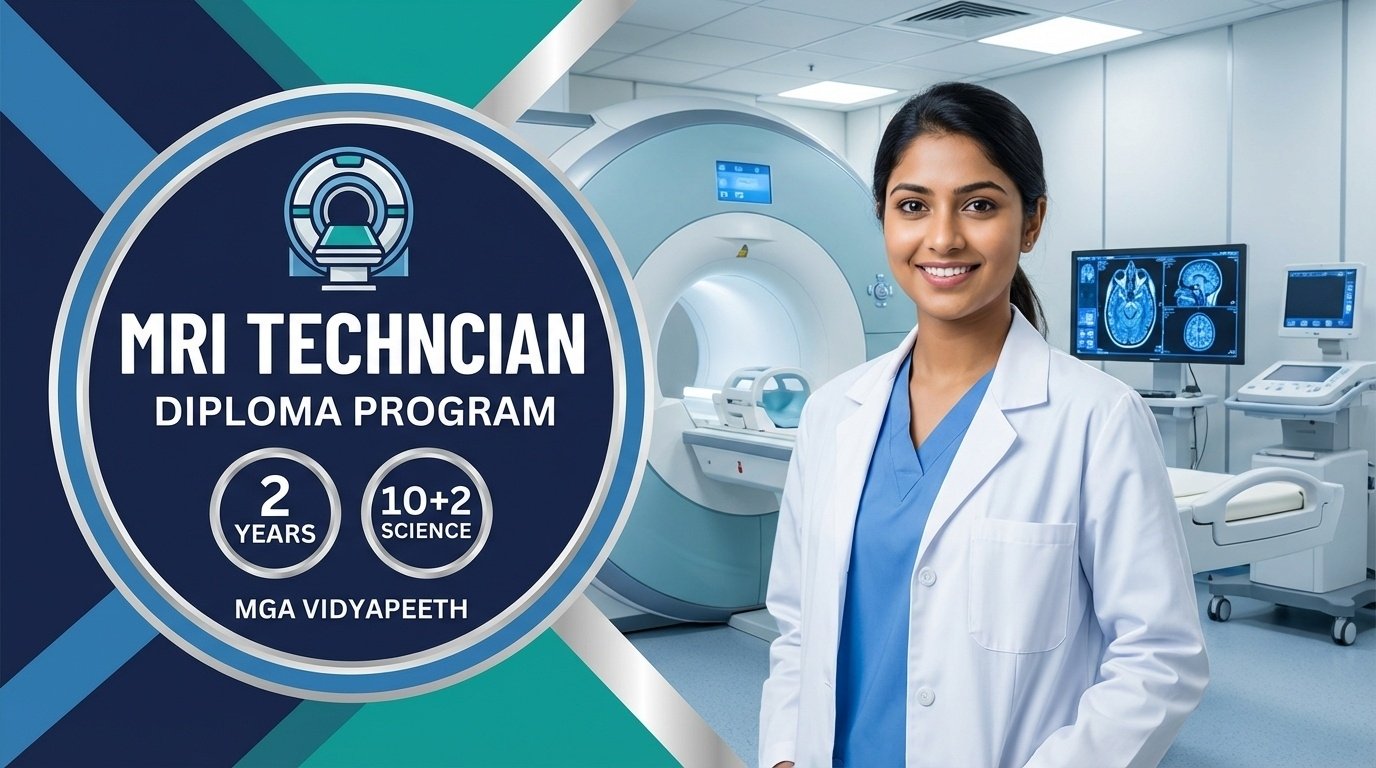
Diploma in MRI Technician
Course Overview
The Diploma in MRI Technician is a highly specialized paramedical program designed to train students in the advanced field of Magnetic Resonance Imaging technology. This 2-year intensive diploma course prepares students to become expert MRI technologists capable of operating sophisticated MRI equipment, producing high-quality diagnostic images, and ensuring patient safety in a magnetic environment. As one of the most sought-after specializations in medical imaging, MRI technology offers excellent career prospects and premium compensation.
Program Highlights
Course Details
- Program Name: Diploma in MRI Technician
- Category: Paramedical / Advanced Medical Imaging
- Duration: 2 Years (4 Semesters)
- Course Fee: ₹1,20,000 (Total Program)
- Eligibility: 10+2 (Science Stream with Physics, Chemistry, Biology)
- Specialization: Magnetic Resonance Imaging Technology
Mahatma Gandhi Ayurvigyan Vidyapeeth
- Premier institution for advanced imaging education
- State-of-the-art MRI training facilities
- Access to latest MRI technology (1.5T and 3T systems)
- Expert faculty with clinical MRI experience
- Strong partnerships with leading hospitals
- Industry-recognized certification
- Excellent placement record in premium hospitals
Course Curriculum
Year 1 - Foundation & MRI Fundamentals
Semester 1: Core Sciences & Basics
- Human Anatomy & Physiology (Detailed Systemic)
- Physics of Magnetism & Electromagnetism
- Basics of Medical Imaging
- Introduction to MRI Technology
- Radiobiology & Radiation Safety
- Patient Care & Communication
- Medical Ethics & Professional Conduct
- Computer Applications in Healthcare
- Medical Terminology
Semester 2: MRI Physics & Technology
- Advanced MRI Physics
- MRI Hardware & Instrumentation
- Magnetic Field Principles
- Radiofrequency Systems
- Gradient Systems
- MRI Safety Standards & Protocols
- Basic MRI Pulse Sequences
- Image Formation & K-Space
- Cross-Sectional Anatomy
- Practical Training I (Basic MRI Operations)
Year 2 - Advanced MRI Techniques & Specialization
Semester 3: Advanced Imaging & Clinical Applications
- Advanced MRI Pulse Sequences
- Spin Echo (SE) and Fast Spin Echo (FSE)
- Gradient Echo (GRE) sequences
- Inversion Recovery techniques
- Echo Planar Imaging (EPI)
- Diffusion-Weighted Imaging (DWI)
- Perfusion-Weighted Imaging (PWI)
- MRI Angiography (MRA)
- Functional MRI (fMRI)
- Cardiac MRI Basics
- Body MRI Protocols
- Neuroimaging Techniques
- Musculoskeletal MRI
- Contrast Agents & Administration
- MRI Artifacts & Troubleshooting
- Practical Training II (Clinical MRI)
Semester 4: Specialized Applications & Professional Practice
- Advanced Neuroimaging
- Pediatric MRI Protocols
- Breast MRI & Women's Imaging
- Abdominal & Pelvic MRI
- Vascular Imaging
- Interventional MRI
- MR Spectroscopy (MRS)
- Advanced Post-Processing Techniques
- Quality Assurance & Quality Control
- MRI Safety Management
- PACS & DICOM Integration
- Hospital Management & Administration
- Research Methodology
- Comprehensive Clinical Internship
- Project Work & Case Studies
- Professional Development
Comprehensive MRI Technology Coverage
Core MRI Concepts:
1. MRI Physics & Principles
- Nuclear magnetic resonance fundamentals
- T1, T2, and proton density contrast
- Magnetic field strength (1.5T, 3T, 7T)
- Gradient systems and spatial encoding
- Radiofrequency pulse design
- Signal reception and processing
- K-space data acquisition
- Image reconstruction algorithms
2. MRI Hardware & Systems
- Superconducting magnets
- Gradient coils and amplifiers
- RF coils (transmit and receive)
- Cooling systems (cryogenics)
- Patient table and positioning aids
- MRI console and computer systems
- Shielding and quenching systems
- Emergency equipment
3. Pulse Sequences & Protocols
- T1-weighted imaging
- T2-weighted imaging
- FLAIR (Fluid Attenuated Inversion Recovery)
- STIR (Short TI Inversion Recovery)
- Gradient echo sequences
- Echo planar imaging (EPI)
- Diffusion and perfusion imaging
- Time-of-flight (TOF) angiography
- Phase contrast imaging
- Balanced steady-state sequences
4. Clinical MRI Applications
Neuroradiology:
- Brain MRI (stroke, tumors, MS)
- Spine imaging (cervical, thoracic, lumbar)
- MR angiography (brain vessels)
- Functional MRI (brain mapping)
- Diffusion tensor imaging (DTI)
- MR spectroscopy (brain metabolism)
Body Imaging:
- Abdominal MRI (liver, pancreas, kidneys)
- Pelvic MRI (prostate, uterus, ovaries)
- MRCP (Magnetic Resonance Cholangiopancreatography)
- Cardiac MRI (heart structure and function)
- Chest MRI (lungs, mediastinum)
Musculoskeletal:
- Joint imaging (knee, shoulder, hip, wrist)
- Soft tissue tumors
- Sports injury assessment
- Spine disorders
- Bone marrow imaging
Specialized Applications:
- Breast MRI (cancer screening)
- Fetal MRI (prenatal diagnosis)
- Pediatric imaging
- Whole-body MRI
- MR-guided interventions
5. MRI Safety - Critical Focus
- MRI safety zones (I, II, III, IV)
- Screening protocols
- Ferromagnetic hazards
- Implant safety assessment
- Pacemaker and ICD protocols
- Projectile accidents prevention
- Acoustic noise management
- Pregnancy considerations
- Claustrophobia management
- Emergency procedures and quenching
- SAR (Specific Absorption Rate) limits
- Cryogen safety
6. Contrast Media in MRI
- Gadolinium-based contrast agents
- Indication and contraindications
- Dosage calculation
- Administration techniques
- Adverse reaction management
- NSF (Nephrogenic Systemic Fibrosis) prevention
- Contrast-enhanced protocols
- Dynamic contrast studies
7. Image Quality & Artifacts
- Signal-to-noise ratio (SNR)
- Spatial resolution optimization
- Temporal resolution
- Motion artifacts
- Magnetic susceptibility artifacts
- Chemical shift artifacts
- Aliasing/wrap-around
- RF artifacts
- Artifact reduction techniques
8. Advanced Techniques
- Parallel imaging (SENSE, GRAPPA)
- Compressed sensing
- Multi-parametric imaging
- Quantitative MRI
- Artificial intelligence in MRI
- 3D and 4D imaging
- Real-time MRI
- MR elastography
Career Opportunities
MRI Technicians are among the highest-paid paramedical professionals with excellent career prospects:
Employment Sectors:
✅ Super-Specialty Hospitals - Leading healthcare chains ✅ Multi-Specialty Hospitals - Corporate and trust hospitals ✅ Diagnostic Imaging Centers - Premium radiology facilities ✅ Medical Colleges & Research Institutes - Academic institutions ✅ Cardiac Centers - Specialized cardiovascular facilities ✅ Neuroscience Centers - Brain and spine specialty hospitals ✅ Cancer Hospitals - Oncology treatment centers ✅ Sports Medicine Centers - Athletic injury assessment ✅ MRI Equipment Companies - Siemens, GE, Philips as application specialists ✅ International Hospitals - Middle East, USA, Canada, UK, Australia ✅ Mobile MRI Services - Advanced field healthcare ✅ Research Organizations - Clinical trials and studies ✅ Government Health Services - AIIMS, PGI, Defense hospitals
???? Job Roles & Positions:
Technical Roles:
- MRI Technologist / MRI Technician
- Senior MRI Specialist
- Advanced MRI Technologist
- Cardiac MRI Technologist
- Neuro MRI Specialist
- Functional MRI Technologist
- MRI Safety Officer
- Chief MRI Technologist
Advanced Positions:
- MRI Application Specialist (Equipment Companies)
- Clinical MRI Trainer
- MRI Quality Control Officer
- MRI Research Coordinator
- MRI Protocol Developer
- MRI Department Manager
- PACS Administrator (MRI Focus)
- Telemedicine MRI Coordinator
Expert Roles:
- MRI Consultant
- Technical Sales Specialist
- Product Development Specialist
- Regional Training Manager
- MRI Center Operations Manager
- Academic Instructor/Faculty
Skills & Competencies Development
Technical Expertise:
Core MRI Skills:
- Operation of 1.5T and 3T MRI scanners
- Advanced patient positioning techniques
- Pulse sequence selection and optimization
- Protocol customization for clinical needs
- Image quality assessment and optimization
- Troubleshooting hardware and software issues
- Coil selection and placement
- Multi-parametric imaging
- Post-processing and 3D reconstruction
- PACS/DICOM workflow management
Safety Management:
- Comprehensive MRI safety screening
- Implant and device safety verification
- Emergency response and quenching procedures
- Zone management and access control
- Patient monitoring in magnetic environment
- Cryogen safety protocols
- SAR monitoring and management
- Acoustic noise protection
Clinical Competencies:
- Patient assessment and preparation
- Claustrophobia management techniques
- Pediatric patient handling
- Contrast administration and monitoring
- Vital sign monitoring during scans
- Emergency medical response
- Communication with radiologists
- Report documentation
Professional Skills:
- Critical thinking and problem-solving
- Attention to detail and precision
- Time management and efficiency
- Multitasking in high-pressure environment
- Team collaboration
- Patient empathy and care
- Technical communication
- Continuous learning mindset
- Ethical decision-making
Technology Proficiency:
- MRI console operation (Siemens, GE, Philips)
- PACS (Picture Archiving Communication System)
- RIS (Radiology Information System)
- DICOM standards and protocols
- 3D visualization software
- Image post-processing workstations
- MRI planning software
- Electronic medical records (EMR)
- Quality control software
Salary & Compensation
Premium Earning Potential:
MRI Technicians command some of the highest salaries in paramedical professions due to specialized expertise:
Fresher Level (0-1 year):
- Entry Position: ₹20,000 - ₹30,000 per month
- Private Hospitals: ₹25,000 - ₹35,000 per month
- Premium Hospitals: ₹30,000 - ₹40,000 per month
- Metro Cities: ₹35,000 - ₹45,000 per month
Early Career (1-3 years):
- Experienced Technologist: ₹35,000 - ₹50,000 per month
- Multi-facility Systems: ₹40,000 - ₹60,000 per month
- Specialized Protocols: ₹45,000 - ₹65,000 per month
Mid Career (3-5 years):
- Senior MRI Technologist: ₹50,000 - ₹75,000 per month
- Cardiac/Neuro Specialist: ₹60,000 - ₹85,000 per month
- Lead Technologist: ₹70,000 - ₹1,00,000 per month
Experienced Professional (5-10 years):
- Chief MRI Technologist: ₹80,000 - ₹1,20,000 per month
- Application Specialist: ₹1,00,000 - ₹1,50,000 per month
- MRI Supervisor/Manager: ₹1,20,000 - ₹1,80,000 per month
Expert Level (10+ years):
- MRI Department Head: ₹1,50,000 - ₹2,50,000+ per month
- Senior Application Specialist: ₹1,80,000 - ₹3,00,000+ per month
- Consultant/Trainer: ₹2,00,000 - ₹3,50,000+ per month
- Independent MRI Center Owner: ₹3,00,000 - ₹5,00,000+ per month
International Salaries:
- USA: $50,000 - $85,000 per year (₹42-71 lakhs)
- Canada: CAD 55,000 - 80,000 per year (₹35-50 lakhs)
- UK: £28,000 - £45,000 per year (₹30-48 lakhs)
- UAE/Middle East: AED 8,000 - 15,000 per month (₹1.8-3.4 lakhs)
- Australia: AUD 60,000 - 90,000 per year (₹35-52 lakhs)
Additional Income Sources:
- Night shift differential (30-50% extra)
- Weekend and holiday allowances
- On-call payments
- Overtime opportunities
- Performance bonuses
- Equipment training fees
- Freelance consultation
- Part-time imaging services
Comprehensive Benefits:
- Health and life insurance
- Provident fund and gratuity
- Annual performance bonuses (2-4 months salary)
- Professional development allowances
- Conference and training sponsorship
- Housing assistance (government sector)
- Travel allowances
- Medical benefits for family
- Retirement benefits
Note: MRI Technicians earn 40-60% more than general radiographers due to specialized expertise. Salaries in metro cities (Mumbai, Delhi, Bangalore) are 30-50% higher than tier-2 cities.
Admission Requirements
Eligibility Criteria:
Academic Qualifications:
- 10+2 (Higher Secondary) from recognized board
- Mandatory Subjects: Physics, Chemistry, and Biology (PCB)
- Minimum Percentage: 50% aggregate marks (45% for reserved categories)
- Strong foundation in Physics is highly advantageous
- Mathematics/Computer Science as additional subject is beneficial
Age Requirements:
- Minimum age: 17 years (completed on admission date)
- Maximum age: 35 years (age relaxation for reserved categories as per norms)
Physical & Medical Requirements:
- Medically fit for working in magnetic environments
- No metallic implants or ferromagnetic objects in body
- Good physical stamina (standing for 6-8 hours)
- No claustrophobia or anxiety disorders
- Good hand-eye coordination
- Normal color vision (for image assessment)
- Ability to lift and assist patients (up to 15-20 kg)
Personal Attributes:
- Strong interest in physics and technology
- Detail-oriented personality
- Good communication skills
- Ability to work under pressure
- Patient and empathetic nature
- Technical aptitude
Selection Process:
Step 1: Application Submission
- Online application through admission portal
- Document upload
- Application fee payment
Step 2: Merit Assessment
- Based on 12th standard marks (Physics, Chemistry, Biology)
- Special weightage to Physics marks
- Overall academic performance
Step 3: Entrance Test (if applicable)
- Physics, Chemistry, Biology (MCQ format)
- General aptitude
- Technical reasoning
Step 4: Personal Interview
- Technical aptitude assessment
- Communication skills evaluation
- Career motivation and interest
- Understanding of MRI technology
- Problem-solving abilities
Step 5: Medical Examination
- General health checkup
- Fitness certificate
- Screening for metallic implants
- Magnetic environment compatibility
Step 6: Document Verification
- Original certificates verification
- Eligibility confirmation
- Background verification
Step 7: Final Admission
- Seat allocation
- Fee payment
- Course enrollment
Required Documents:
Academic Certificates:
- 10th mark sheet and certificate (original + 3 copies)
- 12th mark sheet and certificate (original + 3 copies)
- Transfer certificate (TC) from last institution
- Migration certificate (if from different board/state)
- Character certificate (recent)
- Gap certificate (if applicable with reason)
- Provisional certificate (if final certificate pending)
Identity & Residence Proof:
- Aadhar card (mandatory - original + 3 copies)
- PAN card (if available)
- Passport (if available)
- Voter ID card (if applicable)
- Domicile certificate
- Address proof (electricity bill/bank statement)
Category Certificates:
- SC/ST certificate (if applicable - from competent authority)
- OBC-NCL certificate (recent - within 1 year)
- EWS certificate (if applicable)
- Disability certificate (if applicable with % mentioned)
- Minority community certificate (if applicable)
Medical Documents:
- Medical fitness certificate from registered medical practitioner
- COVID-19 vaccination certificate
- Blood group report
- Recent health checkup report
- Implant declaration form (nil report)
Photographs:
- 10-12 recent passport size photographs
- 2-3 stamp size photographs
- Digital photograph (soft copy)
Other Documents:
- Birth certificate or age proof
- Income certificate (for scholarship/fee concession)
- Bank account details
- Guardian/parent contact information
- Previous course certificates (if any)
- Affidavit (if required for any declarations)
Why Choose Diploma in MRI Technician?
Premium Career Advantages:
✨ Highest Salary Potential: Among the best-paid paramedical specializations
✨ Advanced Technology: Work with cutting-edge medical imaging equipment
✨ Specialized Expertise: Focused training in high-demand niche field
✨ Rapid Career Growth: Fast track to senior positions and management roles
✨ Global Opportunities: International demand with premium compensation
✨ Job Security: Limited supply of qualified MRI technicians ensures stability
✨ Prestigious Positions: Work in premier hospitals and imaging centers
✨ Continuous Learning: Exposure to latest MRI technology and innovations
✨ Multiple Career Paths: Clinical, commercial, academic, and research options
✨ Work-Life Balance: Structured shifts with premium compensation
✨ Professional Recognition: Highly respected specialized medical professional
✨ Future-Proof Career: Growing demand due to expanding diagnostic needs
Why MG Ayurvigyan Vidyapeeth for MRI Training:
✅ Advanced Infrastructure:
- Access to 1.5T and 3T MRI systems
- Latest Siemens, GE, and Philips equipment
- Dedicated MRI simulation labs
- Safety training facilities
- Post-processing workstations
✅ Expert Faculty:
- Qualified MRI radiographers with 10+ years experience
- Guest lectures from radiologists
- Industry trainers from equipment companies
- International certification holders
- Continuous faculty development
✅ Clinical Excellence:
- Partnerships with 20+ hospitals having MRI facilities
- Hands-on training on multiple MRI platforms
- Exposure to diverse clinical cases
- Real-world emergency handling
- Internship in premium imaging centers
✅ Industry Connections:
- Tie-ups with Siemens, GE Healthcare, Philips
- Guest sessions from application specialists
- Equipment company training programs
- Direct recruitment opportunities
- Vendor certification possibilities
✅ Placement Support:
- 95%+ placement rate
- Average starting salary ₹25,000-35,000
- Premium hospital placements
- International placement assistance
- Application specialist opportunities
- Lifetime career support
✅ Comprehensive Training:
- 70% practical, 30% theory ratio
- Hands-on equipment training
- Safety certification included
- Multiple pulse sequence expertise
- Troubleshooting and problem-solving focus
Future Prospects & Career Advancement
Higher Education Pathways:
Undergraduate Programs:
- B.Sc. in MRI Technology (Specialized)
- B.Sc. in Medical Imaging Technology (Lateral Entry)
- B.Sc. in Radiology & Imaging Technology
- Bachelor of Advanced Medical Imaging
Postgraduate Options:
- M.Sc. in MRI Technology
- M.Sc. in Medical Imaging
- M.Sc. in Medical Physics (MRI specialization)
- MBA in Hospital Administration (with technical background)
- MPH - Master of Public Health
Specialized Certifications:
-
Advanced MRI Certifications:
- Cardiac MRI Specialist
- Neuro MRI Advanced Techniques
- Functional MRI (fMRI) Certification
- MR Spectroscopy Training
- Interventional MRI
- Pediatric MRI Specialist
-
Vendor Certifications:
- Siemens MRI Technology Certification
- GE Healthcare MRI Specialist
- Philips MRI Advanced User
- Canon/Toshiba MRI Training
-
International Certifications:
- ARRT-MRI (American Registry of Radiologic Technologists)
- CAMRT (Canadian Association of Medical Radiation Technologists)
- SCoR (Society of Radiographers - UK)
- ASMIRT (Australian Society of Medical Imaging)
-
Safety Certifications:
- MRI Safety Officer Certification
- ACR MRI Safety Training
- MRI Screening Level I & II
-
Technology Certifications:
- PACS/DICOM Administrator
- AI in MRI Imaging
- 3D Post-Processing Expert
Career Progression Path:
Level 1: Entry (0-2 years) - Foundation Building
- Position: Junior MRI Technologist
- Salary: ₹20,000 - ₹35,000/month
- Focus: Learning standard protocols, safety procedures, basic operations
- Key Activities: Supervised scanning, patient positioning, routine examinations
Level 2: Early Career (2-4 years) - Skill Development
- Position: MRI Technologist
- Salary: ₹35,000 - ₹55,000/month
- Focus: Independent operations, protocol optimization, complex cases
- Key Activities: Unsupervised scanning, quality control, training juniors
Level 3: Mid Career (4-7 years) - Specialization
- Position: Senior MRI Technologist / Specialist
- Salary: ₹55,000 - ₹85,000/month
- Focus: Specialized protocols (cardiac/neuro), advanced techniques
- Key Activities: Complex examinations, protocol development, mentoring
Level 4: Senior Professional (7-12 years) - Leadership
- Position: Chief MRI Technologist / Supervisor
- Salary: ₹80,000 - ₹1,40,000/month
- Focus: Team management, quality assurance, department coordination
- Key Activities: Staff scheduling, quality programs, vendor liaison
Level 5: Expert (12-15 years) - Management
- Position: MRI Department Manager / Application Specialist
- Salary: ₹1,20,000 - ₹2,00,000/month
- Focus: Strategic planning, equipment procurement, training programs
- Key Activities: Budget management, policy development, cross-department coordination
Level 6: Master (15+ years) - Executive/Consultant
- Position: Director of Imaging Services / Senior Consultant
- Salary: ₹1,80,000 - ₹3,50,000+/month
- Focus: Organizational leadership, industry advisory, innovation
- Key Activities: Strategic direction, consulting, training and development, research
Alternative Career Paths:
1. Equipment Company Route:
- Application Specialist → Senior Application Specialist → Regional Manager → National Sales Manager
2. Academic Path:
- Clinical Instructor → Senior Lecturer → Program Coordinator → Department Head
3. Entrepreneurship:
- Technologist → Senior Technologist → Mobile MRI Services → Independent Imaging Center Owner
4. Research Path:
- Clinical MRI Tech → Research Coordinator → Clinical Trials Manager → Principal Investigator Support
5. International Career:
- Certification (ARRT-MRI) → International Placement → Permanent Residence → Consultant
Work Environment & Lifestyle
Work Settings:
- Hospital MRI Departments: Well-equipped, climate-controlled facilities
- Imaging Centers: Dedicated diagnostic facilities with multiple scanners
- Research Facilities: University hospitals and clinical trial centers
- Mobile MRI Units: Advanced mobile diagnostic services
- Equipment Companies: Training centers and demonstration facilities
⏰ Work Schedule:
- Standard Shifts: 8-10 hour shifts (day/evening/night)
- Rotational Duty: Weekly or monthly rotation
- On-Call: Emergency availability (with premium pay)
- Flexible Options: Part-time positions available
- Work-Life Balance: Generally better than general radiology due to scheduled appointments
Physical Demands:
- Standing for extended periods (6-8 hours)
- Patient positioning and assistance (lifting up to 20kg)
- Working in confined spaces (magnet bore area)
- Wearing personal protective equipment
- Quick response during emergencies
- Precise hand movements for coil placement
Work Environment:
- Temperature: Climate-controlled (20-22°C)
- Noise Levels: High during scanning (80-110 dB) - ear protection provided
- Magnetic Field: Constant exposure to static magnetic field
- Safety: Strict protocols and zoned access
- Team: Collaborative environment with radiologists, nurses, support staff
- Technology: Continuous updates and new techniques
Typical Daily Responsibilities:
- Patient screening and safety checks
- Equipment preparation and quality control
- Patient positioning and coil selection
- Pulse sequence optimization
- Image acquisition and monitoring
- Quality assessment and post-processing
- PACS upload and documentation
- Equipment maintenance coordination
- Emergency response readiness
- Communication with radiologists and referring physicians
MRI Safety - Critical Component
⚠️ Comprehensive Safety Training:
Zone Management:
- Zone I: Public area (unrestricted)
- Zone II: Patient reception (controlled)
- Zone III: Control room (restricted)
- Zone IV: Magnet room (highly restricted)
Screening Protocols:
- Metal detector screening
- Detailed questionnaire
- Implant verification
- Previous surgery history
- Occupational exposure history
- Pregnancy declaration
Critical Safety Risks:
- Projectile Effect: Ferromagnetic objects becoming dangerous projectiles
- Implant Interactions: Pacemaker malfunction, implant heating
- Acoustic Damage: Loud gradient noise (up to 110 dB)
- Burns: RF-induced heating from loops and cables
- Cryogen Hazards: Oxygen displacement, cold burns
Emergency Procedures:
- Code blue in MRI environment
- Quench procedures (last resort)
- Fire safety protocols
- Patient extraction methods
- Emergency equipment (MRI-safe)
Contraindications:
- Cardiac pacemakers (most older models)
- Cochlear implants (non-MRI compatible)
- Some aneurysm clips
- Metallic foreign bodies in eyes
- Some prosthetic heart valves
- Neurostimulators (older models)
Note: Many modern implants are now MRI-conditional - requires verification
Technology Trends & Future Scope
Emerging MRI Technologies:
Hardware Advances:
- 7 Tesla (7T) and higher field strength systems
- Compact and portable MRI systems
- Open MRI designs for claustrophobic patients
- Hybrid imaging (PET-MRI)
- Point-of-care MRI devices
Software Innovations:
- Artificial Intelligence (AI) in image reconstruction
- AI-powered protocol selection
- Automated scan planning
- Deep learning denoising
- Synthetic MRI (multi-contrast from single acquisition)
- Compressed sensing
- Simultaneous multi-slice imaging
Clinical Applications:
- Real-time MRI guidance for interventions
- Molecular imaging
- Quantitative MRI biomarkers
- MRI-guided focused ultrasound
- Whole-body screening protocols
- Fetal MRI advances
- MR elastography (tissue stiffness)
Future Career Impact:
- Increased demand for AI-trained technologists
- Hybrid imaging specialists needed
- Point-of-care MRI operators
- Interventional MRI specialists
- Research protocol developers
Industry Demand & Job Market
???? Market Analysis:
Growing Demand Factors:
- Increasing cancer screening programs
- Rising neurological disorder cases
- Sports medicine expansion
- Cardiac imaging growth
- Research and clinical trials
- Replacement of CT for radiation-free imaging
- Aging population requiring advanced diagnostics
- Government healthcare expansion
Supply-Demand Gap:
- Current Shortage: 30-40% shortage of qualified MRI technicians
- Increasing MRI Installations: 12-15% annual growth
- Job Security: Extremely high due to limited trained professionals
- Competition: Low compared to general radiography
Employment Statistics:
- Placement Rate: 95-100% within 3 months for qualified candidates
- Job Postings: 500+ monthly vacancies nationwide
- Career Longevity: 30-35 years active career potential
- Retirement Age: Extended careers due to non-radiation exposure
Student Support & Facilities
Academic Support:
- Dedicated academic mentors
- Doubt clearing sessions (daily)
- Supplementary study materials
- Online learning portal
- Video lectures and demonstrations
- Case study library
- Mock examinations
- Peer study groups
- Faculty office hours
Infrastructure & Facilities:
- MRI Training Labs: Access to 1.5T and 3T systems
- Simulation Centers: MRI console simulators for practice
- Anatomy Lab: 3D models and cross-sectional anatomy
- Computer Labs: 50+ workstations with imaging software
- Library: 5,000+ books, journals, and e-resources
- Digital Library: Access to Radiopaedia, MRI educational portals
- Safety Training Room: Mock magnet room for safety drills
Campus Facilities:
- Hostel: Separate accommodation for boys and girls
- Mess/Cafeteria: Hygienic food with varied menu
- Medical Room: First aid and basic healthcare
- Sports Complex: Indoor and outdoor facilities
- Wi-Fi Campus: High-speed internet throughout
- Transport: College buses from key locations
- Security: 24/7 security with CCTV surveillance
- Counseling: Personal and career counseling services
Placement Support:
-
Pre-Placement Training:
- Resume writing workshops
- Interview preparation sessions
- Group discussions and mock interviews
- Communication skills development
- Professional etiquette training
- Aptitude test preparation
-
Placement Services:
- Campus recruitment drives
- Job notifications and alerts
- Direct hospital tie-ups (50+ hospitals)
- Equipment company placements
- International placement assistance
- Internship to permanent conversion support
- Alumni networking platform
- Lifetime placement assistance
-
Career Guidance:
- One-on-one counseling
- Career path planning
- Specialization guidance
- Higher education advice
- Certification roadmap
- Industry mentor connect