
Mahatma Gandhi Ayurved Vidyapeeth
Loading...
ANNOUNCEMENT Admissions Open: 2025-26 : BNYS | DNYS| MHA | CMS & ED | Electropathy Course | BEMS | DEMS | Paramedical Diploma | MD Naturopathy | PG Diploma | Ayurvedacharya Guru Shishya Program
Professional Course

Diploma in Ophthalmic Technology

Category: PARAMEDICAL
★★★★ ☆
4.0
Created by mgavidyapeeth
Diploma in Ophthalmic Technology
Course Preview

Course Overview

Everything you need to know about this course

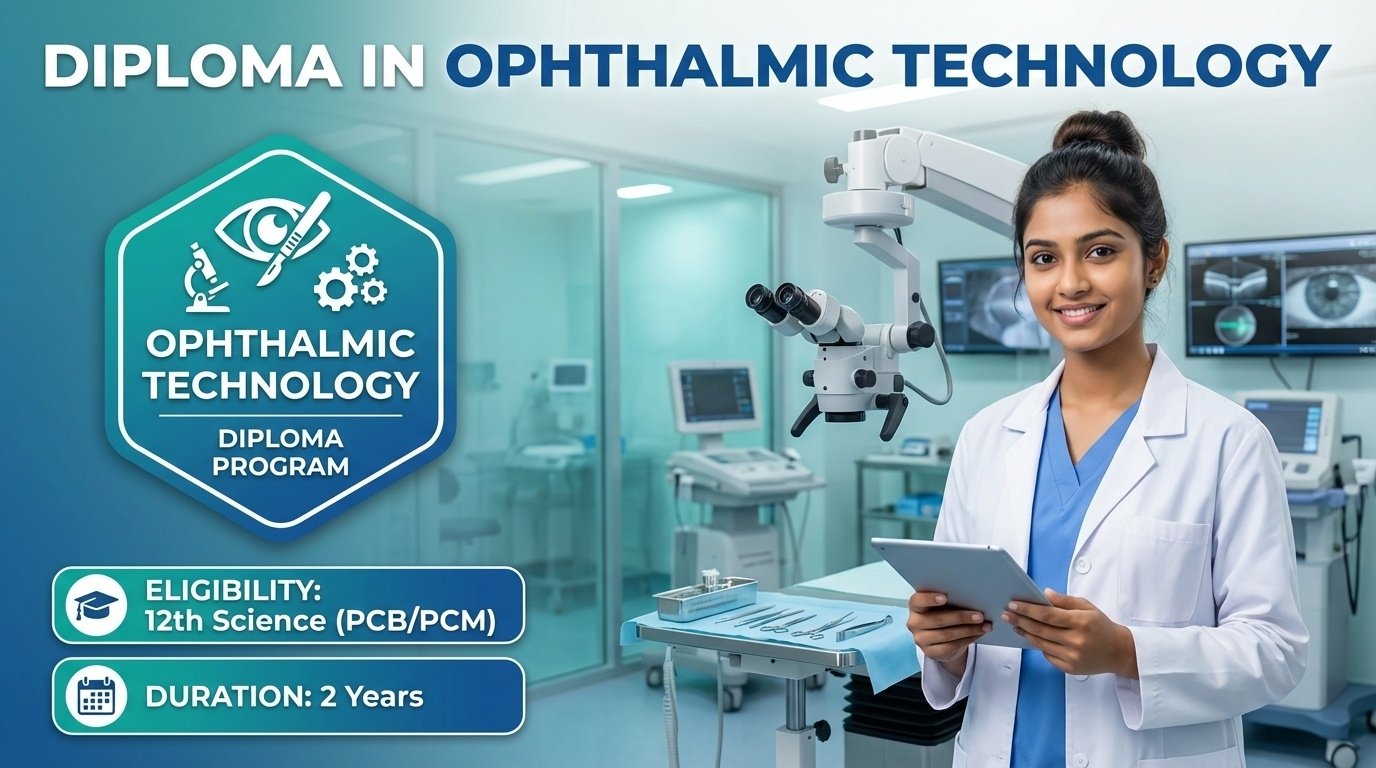
The Diploma in Ophthalmic Technology is a specialized paramedical program designed to create highly skilled technical professionals who work alongside ophthalmologists in the diagnosis, treatment, and surgical management of eye diseases. This comprehensive 2-year diploma provides advanced training in ophthalmic diagnostic procedures, surgical assistance, patient care, and operation of sophisticated ophthalmic equipment.

As the demand for quality eye care continues to surge globally, ophthalmic technicians have emerged as indispensable members of the eye care team, bridging the gap between ophthalmologists and patients while ensuring seamless delivery of comprehensive eye care services.


 Course Highlights

Aspect Details
Course Name Diploma in Ophthalmic Technology
Category Paramedical / Allied Health Sciences
Duration 2 Years
Course Type Full-time Diploma Program
Eligibility 10+2 (Science Stream)
Total Fee ₹70,000
Institute Mahatma Gandhi Ayurvigyan Vidyapeeth

 What is Ophthalmic Technology?

Ophthalmic Technology is a specialized healthcare discipline focused on providing technical support to ophthalmologists in clinical and surgical settings. Ophthalmic technicians are trained professionals who:

✅ Perform advanced diagnostic tests on eyes
✅ Assist in ophthalmic surgeries (cataract, LASIK, retinal procedures)
✅ Operate complex ophthalmic diagnostic equipment
✅ Conduct pre-operative and post-operative patient assessments
✅ Maintain surgical instruments and operation theatre readiness
✅ Educate patients about eye care and post-treatment protocols
✅ Manage clinical workflows in eye care facilities

Key Difference: While optometrists focus on vision testing and prescribing corrective lenses, ophthalmic technicians specialize in surgical assistance and advanced diagnostic procedures working directly with ophthalmologists.


 Comprehensive Curriculum & Subjects

The program features an industry-aligned curriculum emphasizing clinical skills and surgical assistance:

Year 1 - Foundation & Basic Clinical Skills

Basic Medical Sciences

  • Human Anatomy & Physiology

    • General body systems overview
    • Detailed ocular anatomy (anterior & posterior segments)
    • Orbital anatomy and adnexa
    • Extraocular muscles and movements
    • Visual pathway neuroanatomy
  • Biochemistry & Pharmacology

    • Basic biochemistry principles
    • Ocular pharmacology
    • Ophthalmic drugs and their actions
    • Drug administration routes in ophthalmology
    • Adverse drug reactions
  • Microbiology & Pathology

    • Microbiology of eye infections
    • Ocular pathology fundamentals
    • Infection control in ophthalmology
    • Sterilization techniques

Ophthalmic Sciences

  • Optics & Refraction

    • Geometrical and physical optics
    • Clinical refraction techniques
    • Retinoscopy fundamentals
    • Lensometry and keratometry
  • Basic Ophthalmology

    • Introduction to eye diseases
    • Common ocular conditions
    • Ocular emergencies
    • Patient history taking
  • Clinical Examination Techniques

    • External eye examination
    • Slit lamp biomicroscopy basics
    • Ophthalmoscopy (direct & indirect)
    • Intraocular pressure measurement

Diagnostic Procedures I

  • Basic Diagnostic Tests

    • Visual acuity assessment
    • Color vision testing
    • Visual field screening
    • Amsler grid testing
    • Tonometry (applanation, non-contact)
  • Ocular Imaging Fundamentals

    • External eye photography
    • Fundus photography basics
    • Anterior segment imaging

Year 2 - Advanced Clinical & Surgical Training

Advanced Ophthalmology

  • Systemic Ophthalmology
    • Anterior segment diseases (cornea, conjunctiva, sclera)
    • Cataract and lens disorders
    • Glaucoma - types, diagnosis, management
    • Uveal disorders
    • Posterior segment diseases (retina, vitreous, choroid)
    • Diabetic retinopathy
    • Age-related macular degeneration
    • Retinal detachment
    • Neuro-ophthalmology essentials
    • Pediatric ophthalmology
    • Oculoplasty basics

Advanced Diagnostic Procedures

  • Specialized Investigations
    • OCT (Optical Coherence Tomography) - operation and interpretation
    • Fundus Fluorescein Angiography (FFA)
    • Indocyanine Green Angiography (ICGA)
    • B-Scan Ultrasonography
    • A-Scan Biometry (for IOL power calculation)
    • Ultrasound Biomicroscopy (UBM)
    • Corneal Topography & Tomography
    • Specular Microscopy
    • Automated Perimetry
    • OCT Angiography
    • Pachymetry
    • Gonioscopy
    • Electrophysiology (ERG, VEP)

Surgical Assistance & OT Management

  • Ophthalmic Surgical Procedures

    • Cataract Surgery - Phacoemulsification, SICS
    • Refractive Surgery - LASIK, PRK, SMILE
    • Glaucoma Surgery - Trabeculectomy, tube shunts
    • Retinal Surgery - Vitrectomy, scleral buckling
    • Corneal Transplantation - PKP, DALK, DSEK, DMEK
    • Oculoplastic Surgery - Ptosis correction, DCR
    • Squint Surgery
    • Laser Procedures - YAG capsulotomy, Laser iridotomy, PRP
  • Operation Theatre Protocols

    • OT sterilization and preparation
    • Surgical instrument handling
    • Scrubbing and gowning techniques
    • Assisting surgeon during procedures
    • Surgical tray preparation
    • Emergency protocols
  • Anaesthesia in Ophthalmology

    • Topical, local, regional, and general anaesthesia
    • Patient preparation
    • Monitoring during procedures

Clinical Practice & Patient Management

  • Pre-Operative Assessment

    • Patient counseling
    • Pre-op investigations
    • Consent documentation
    • Risk assessment
  • Post-Operative Care

    • Post-op monitoring
    • Complication detection
    • Patient discharge instructions
    • Follow-up protocols
  • Patient Education & Counseling

    • Disease awareness
    • Medication compliance
    • Lifestyle modifications
    • Preventive eye care

Practice Management

  • Hospital Administration

    • Clinical workflow management
    • Electronic medical records (EMR)
    • Inventory management
    • Quality assurance
  • Equipment Maintenance

    • Calibration protocols
    • Troubleshooting
    • Preventive maintenance
    • Documentation
  • Professional Ethics & Communication

    • Medical ethics in ophthalmology
    • Patient rights
    • Effective communication skills
    • Team collaboration
  • Clinical Internship

    • Minimum 6 months supervised clinical training
    • Exposure to outpatient departments
    • Operation theatre rotations
    • Emergency department experience
    • Special clinics (retina, glaucoma, cornea, pediatrics)

 Career Opportunities & Job Roles

Graduates enjoy excellent employment prospects across diverse eye care settings:

Clinical & Hospital Roles

Position Primary Responsibilities
Ophthalmic Technician Diagnostic testing, patient assessment, equipment operation
 Ophthalmic Assistant Support ophthalmologists in clinics and OPDs
 Ophthalmic Technologist Advanced imaging, diagnostic procedures
 Surgical Technician Assist in ophthalmic surgeries, OT management
 Diagnostic Imaging Specialist OCT, FFA, B-scan operations
 Pediatric Ophthalmic Technician Specialized pediatric eye care
 Retina Clinic Technician Retinal imaging and testing
 Glaucoma Clinic Technician Visual field testing, tonometry
 Cornea Clinic Technician Corneal topography, pachymetry
 Refractive Surgery Coordinator LASIK pre/post-op care
 Emergency Eye Care Technician Trauma assessment, emergency procedures

Specialized Positions

Role Work Environment
 Clinical Research Coordinator Ophthalmic research projects, pharmaceutical trials
 Ophthalmic Educator/Trainer Teaching institutions, training programs
 Medical Equipment Sales Representative Ophthalmic equipment companies
 Application Specialist Medical device companies, technical support
 Ophthalmic Scribe Documentation, EMR management
 Practice Administrator Eye clinic/hospital management
 Clinical Instructor Teaching hospitals, training centers
 Telemedicine Technician Remote eye care services


 Salary & Growth Prospects

Earning Potential in India (2026)

Experience Level Monthly Salary Annual Package
Fresher (0-1 year) ₹15,000 - ₹30,000 ₹1,80,000 - ₹3,60,000
Junior (1-3 years) ₹25,000 - ₹40,000 ₹3,00,000 - ₹4,80,000
Mid-Level (3-5 years) ₹35,000 - ₹55,000 ₹4,20,000 - ₹6,60,000
Senior (5-8 years) ₹50,000 - ₹80,000 ₹6,00,000 - ₹9,60,000
Chief Technician/Specialist ₹80,000 - ₹1,50,000+ ₹9,60,000 - ₹18,00,000+

Average Salary: ₹4,67,595 per annum (nationwide average)

Salary by Specialization

Specialization Average Annual Salary
Surgical Technician (OT) ₹4,50,000 - ₹8,00,000
Retina Imaging Specialist ₹4,00,000 - ₹7,50,000
Refractive Surgery Coordinator ₹3,80,000 - ₹7,00,000
Glaucoma Technician ₹3,50,000 - ₹6,50,000
Research Coordinator ₹4,00,000 - ₹8,00,000
Equipment Application Specialist ₹5,00,000 - ₹10,00,000

Salary by Organization Type

Sector Salary Range
Corporate Eye Hospitals ₹4,00,000 - ₹8,00,000
Government Hospitals/AIIMS ₹3,00,000 - ₹6,50,000 (with benefits)
Private Eye Clinics ₹2,40,000 - ₹5,00,000
Equipment Companies ₹4,50,000 - ₹10,00,000
Research Institutions ₹3,50,000 - ₹7,00,000
Medical Colleges ₹3,00,000 - ₹6,00,000

Additional Benefits & Perks

 Night Shift Allowances (for emergency duty)
 Overtime Pay (in hospital settings)
Health Insurance and medical benefits
 Continuing Education sponsorship
 Performance Bonuses (in corporate hospitals)
 Housing Allowances (select organizations)


Skills You'll Master

Technical Skills

✅ Advanced ophthalmic diagnostic testing
✅ OCT operation and basic interpretation
✅ Fundus fluorescein angiography (FFA)
✅ B-scan ultrasonography
✅ A-scan biometry for IOL calculations
✅ Corneal topography and tomography
✅ Automated perimetry
✅ Slit lamp biomicroscopy (advanced)
✅ Gonioscopy techniques
✅ Surgical instrument handling and sterilization
✅ OT preparation and assistance protocols
✅ Patient positioning for surgeries
✅ Emergency eye care procedures

Surgical Assistance Skills

✅ Pre-operative patient preparation
✅ Surgical tray arrangement
✅ Assisting during cataract surgery
✅ LASIK procedure coordination
✅ Retinal surgery assistance
✅ Post-operative monitoring
✅ Complication recognition
✅ Emergency management in OT

Clinical Skills

✅ Comprehensive patient assessment
✅ Detailed medical history documentation
✅ Pre-op and post-op counseling
✅ Visual acuity assessment (all age groups)
✅ Intraocular pressure measurement
✅ Refraction basics
✅ Contact lens handling
✅ Ocular medication administration

Professional Skills

✅ Medical terminology proficiency
✅ Electronic medical records (EMR) management
✅ HIPAA/patient confidentiality compliance
✅ Effective patient communication
✅ Multi-disciplinary team collaboration
✅ Time management in clinical settings
✅ Quality control and safety protocols
✅ Equipment maintenance and troubleshooting

Soft Skills

✅ Empathy and patient care excellence
✅ Attention to detail and precision
✅ Stress management in high-pressure situations
✅ Problem-solving abilities
✅ Adaptability to new technologies
✅ Professional ethics and integrity


✅ Eligibility Criteria

Educational Qualification

  • Minimum Requirement: 10+2 (Higher Secondary) from a recognized board
  • Stream: Science with Physics, Chemistry, Biology (PCB) preferred
    • PCM (Physics, Chemistry, Mathematics) also accepted
  • Minimum Marks: 50% aggregate in 10+2
    • 45% for SC/ST/OBC candidates (as per state/central norms)

Age Limit

  • Minimum Age: 17 years (as of admission date)
  • Maximum Age: Generally 30-35 years
    • Age relaxation for reserved categories as per government rules

Preferred Candidates

Students with:

  • Strong interest in medical sciences and surgery
  • Good hand-eye coordination
  • Attention to detail and precision
  • Ability to work under pressure
  • Compassionate patient-care attitude
  • Interest in medical technology

Additional Requirements

  • Medical fitness certificate
  • Normal color vision (mandatory for certain procedures)
  • Good visual acuity (corrected vision acceptable)
  • No communicable diseases
  • Hepatitis B vaccination recommended

Desirable Attributes

  • Basic computer literacy
  • Good communication skills
  • Team player mentality
  • Willingness to work in clinical environments
  • Interest in continuous learning

 Why Choose Diploma in Ophthalmic Technology?

1. Critical Healthcare Demand

With 63+ million Indians visually impaired and rising eye disease prevalence, demand for skilled ophthalmic technicians has never been higher.

2. Surgical Specialization ⚕️

Unique opportunity to work in operation theatres and assist in life-changing surgical procedures.

3. Advanced Technology Exposure

Work with cutting-edge diagnostic equipment worth crores - OCT, FFA, LASIK systems, surgical microscopes.

4. Excellent ROI

Course fee of ₹70,000 with starting salaries of ₹1.8-3.6 lakhs recovers investment within first year.

5. Hospital-Based Career

Direct employment in reputed eye hospitals and corporate healthcare chains.

6. Surgical Theater Experience 

Hands-on OT training - a rare opportunity in 2-year diploma programs.

7. U.S. News Recognized 

Listed as one of the best healthcare support jobs with 25% growth (2014-2024).

8. Diverse Specializations 

Choose your path - retina, cornea, glaucoma, refractive surgery, or pediatrics.

9. Global Career Mobility 

JCAHPO certification opens doors to international opportunities.

10. Recession-Proof Profession 

Eye care remains essential healthcare regardless of economic conditions.

11. Quick Career Launch ⚡

Start working in just 2 years in one of medicine's most respected fields.

12. Work-Life Balance ⚖️

Regular shifts (except emergency duty), good working conditions, professional environment.

13. Continuous Innovation 

Dynamic field with constant technological advancements keeping work exciting.

14. Social Impact ❤️

Directly participate in restoring sight - one of the most rewarding healthcare experiences.

15. Clear Growth Path 

Progress from technician → senior technician → specialist → supervisor → manager.


 About Mahatma Gandhi Ayurvigyan Vidyapeeth

Mahatma Gandhi Ayurvigyan Vidyapeeth is recognized for excellence in paramedical education with specialized focus on eye care training.

World-Class Infrastructure

Clinical Training Facilities

  •  State-of-the-Art Diagnostic Lab

    • OCT machines (Spectral-domain & Swept-source)
    • Fundus cameras and FFA systems
    • B-scan and A-scan ultrasonography
    • Automated perimeters
    • Corneal topographers and tomographers
    • Specular microscopes
    • Pachymeters and tonometers
  • ⚕️ Simulated Operation Theatre

    • Surgical microscopes
    • Phacoemulsification machines
    • Vitrectomy systems
    • Laser equipment (YAG, Argon)
    • Complete surgical instrument sets
    • OT sterilization equipment
  •  Clinical Examination Rooms

    • Slit lamps with imaging systems
    • Trial lens sets and phoropters
    • Ophthalmoscopes (direct & indirect)
    • Auto-refractors and keratometers
    • Visual acuity testing equipment

Learning Resources

  • Specialized Library - ophthalmology journals, textbooks, e-resources
  •  Computer Lab - EMR software training, medical imaging software
  •  Surgical Video Library - recorded procedures for learning
  •  Optics Laboratory - hands-on optical science experiments

Academic Excellence

Expert Faculty Team

  •  Experienced Ophthalmologists as clinical guides
  •  Certified Ophthalmic Technologists as practical trainers
  •  Equipment Specialists from industry partners
  •  Medical Educators with teaching credentials
  •  Guest Lecturers from top eye hospitals

Training Methodology

  • Theory: 30% classroom instruction
  •  Practical: 50% hands-on laboratory training
  •  Clinical: 20% hospital rotations
  • Competency-Based learning approach
  •  Regular Assessments with feedback
  •  Video-Assisted learning modules

Hospital Partnerships

Clinical Training Partners

Tie-ups with premier eye care institutions:

  •  Leading super-specialty eye hospitals
  •  Corporate hospital ophthalmology departments
  • Government medical college eye departments
  •  Ophthalmic research centers
  •  Multi-specialty private hospitals

Internship Rotations

  • Outpatient Department (OPD) - patient assessment, diagnostics
  • Operation Theatre (OT) - surgical assistance, sterilization
  • Emergency Department - trauma care, urgent procedures
  • Specialty Clinics - retina, cornea, glaucoma, pediatrics, oculoplasty
  • Diagnostic Center - imaging, special investigations
  • Low Vision Clinic - rehabilitation services

Placement Excellence

Recruitment Partners

  • Super-Specialty Eye Hospitals: Sankara Nethralaya, LV Prasad, Aravind
  •  Corporate Hospitals: Apollo, Fortis, Max, Narayana Health
  •  Equipment Companies: Alcon, Zeiss, Bausch+Lomb, Topcon, Essilor
  •  Research Organizations: Clinical trial units, pharmaceutical companies
  • Telemedicine Platforms: Emerging digital eye care companies

Placement Support

✅ Dedicated Placement Cell with industry connections
✅ Resume Building workshops
✅ Mock Interviews and personality development
✅ Campus Recruitment Drives from top hospitals
✅ Internship-to-Employment conversion opportunities
✅ Job Alerts and career guidance
✅ Alumni Network for referrals
✅ Industry Networking events

Placement Statistics

  • 90%+ placement rate within 6 months of graduation
  • Average starting salary: ₹2.5 lakhs per annum
  • Top recruiters return year after year
  • International placement assistance available

 Course Structure & Schedule

Academic Framework

  • Total Duration: 2 Years (4 Semesters)
  • Theory Classes: 30%
  • Laboratory Practicals: 40%
  • Clinical Training: 30%
  • Weekly Hours: 30-35 hours
  • Internship: Minimum 6 months (final semester)

Semester Breakdown

Semester 1 (Foundation)

  • Basic medical sciences
  • Ocular anatomy and physiology
  • Optics fundamentals
  • Basic examination techniques
  • Clinical observation

Semester 2 (Basic Clinical)

  • Clinical ophthalmology
  • Basic diagnostic procedures
  • Equipment operation training
  • Patient care basics
  • Clinical rotations begin

Semester 3 (Advanced Clinical)

  • Advanced ophthalmology
  • Specialized diagnostic tests
  • OT protocols and surgical assistance
  • Advanced imaging techniques
  • Intensive clinical training

Semester 4 (Internship & Specialization)

  • Full-time hospital internship
  • Surgical assistance experience
  • Specialty clinic rotations
  • Research project/case studies
  • Final comprehensive assessments

Evaluation System

  • Theory Exams: 60% weightage

    • Mid-semester tests
    • End-semester examinations
    • Multiple choice and descriptive questions
  • Practical Exams: 40% weightage

    • Hands-on skill assessments
    • Equipment operation tests
    • Clinical case presentations
    • OSCE (Objective Structured Clinical Examination)
  • Continuous Assessment:

    • Attendance and participation
    • Laboratory work
    • Clinical logbook maintenance
    • Assignments and projects
  • Internship Evaluation:

    • Supervisor assessments
    • Clinical competency checklist
    • Logbook verification
    • Final viva voce

Attendance Requirements

  • Theory Classes: Minimum 75%
  • Practical Sessions: Minimum 80%
  • Clinical Rotations: Minimum 90%
  • Internship: 100% completion mandatory

Learning Outcomes

Upon successful completion, graduates will be proficient in:

✔️ Operating advanced ophthalmic diagnostic equipment independently
✔️ Performing OCT, FFA, B-scan, perimetry, and other specialized tests
✔️ Assisting ophthalmologists during surgical procedures
✔️ Preparing operation theatre and maintaining sterility
✔️ Conducting comprehensive pre-operative patient assessments
✔️ Monitoring post-operative patients for complications
✔️ Recognizing ocular emergencies and initiating appropriate response
✔️ Maintaining and troubleshooting ophthalmic equipment
✔️ Documenting clinical findings accurately in EMR systems
✔️ Educating patients about procedures and post-treatment care
✔️ Collaborating effectively with ophthalmologists and healthcare teams
✔️ Adhering to safety protocols and infection control measures
✔️ Managing clinical workflows efficiently
✔️ Interpreting basic diagnostic test results
✔️ Demonstrating professional ethics and patient-centered care


 Admission Process

Step-by-Step Guide

Step 1: Online Registration
Visit mgavidyapeeth.com/addmission-form and create your application account.

Step 2: Application Form
Complete the detailed application form:

  • Personal information
  • Educational qualifications
  • Contact details
  • Course preferences
  • Category/reservation status

Step 3: Document Submission
Upload scanned copies (clear, legible):

Academic Documents:

  • ✅ 10th standard mark sheet and certificate
  • ✅ 12th standard mark sheet and certificate (Science stream)
  • ✅ Transfer certificate from previous institution
  • ✅ Migration certificate (if from different board)
  • ✅ Character certificate

Identity Documents:

  • ✅ Aadhar card / Government-issued photo ID
  • ✅ PAN card (if available)
  • ✅ Domicile certificate (if applicable)

Category Documents:

  • ✅ SC/ST/OBC certificate (if claiming reservation)
  • ✅ EWS certificate (if applicable)
  • ✅ PWD certificate (if applicable)

Other Documents:

  • ✅ Recent passport-size photographs (4 copies)
  • ✅ Medical fitness certificate
  • ✅ Color vision test certificate
  • ✅ Income certificate (for scholarship eligibility)
  • ✅ Bonafide certificate

Step 4: Application Fee Payment
Pay non-refundable application fee via:

  • Online payment (credit/debit card, net banking, UPI)
  • Demand draft favoring the institute

Step 5: Entrance Test/Interview 
(If applicable based on institute policy)

  • Written aptitude test (basic science, reasoning)
  • Personal interview with faculty panel
  • Document verification

Step 6: Merit List Publication 
Merit-based selection according to:

  • 10+2 marks (primary criteria)
  • Entrance test scores (if conducted)
  • Interview performance
  • Reservation policy compliance

Step 7: Counseling & Seat Allocation 

  • Attend counseling session (online/offline)
  • Choose specialization preferences (if offered)
  • Provisional seat allotment

Step 8: Admission Confirmation ✅

  • Pay course fees (full or first installment)
  • Submit original documents for verification
  • Complete admission formalities
  • Receive admission letter and student ID
  • Get hostel accommodation (if required)

Step 9: Orientation Program
Attend mandatory orientation covering:

  • Course structure and expectations
  • Campus facilities tour
  • Faculty introduction
  • Academic regulations
  • Hostel rules and student code

 Certifications & Professional Development

Upon Course Completion

 Diploma Certificate from Mahatma Gandhi Ayurvigyan Vidyapeeth


Specialized:

  • Ophthalmic Surgical Assisting certification
  • OCT Interpretation certification
  • Fundus Fluorescein Angiography certification
  • Contact Lens Fitting certification
  • Low Vision Rehabilitation certification

Higher Education Pathways

  1. Bachelor of Optometry (B.Optom)

    • Lateral entry available
    • Additional 2-3 years
  2. Bachelor in Ophthalmic Technology

    • Advanced degree option
    • Better career prospects
  3. Specialized Diplomas:

    • Advanced Ophthalmic Imaging
    • Refractive Surgery Technology
    • Retinal Imaging Specialist
  4. Master's Programs (after bachelor's)

    • M.Sc. in Ophthalmology
    • MBA in Hospital Administration (specialized in ophthalmology)

Career Advancement Path

Year 0-2: Junior Ophthalmic Technician
↓
Year 2-5: Ophthalmic Technician
↓
Year 5-8: Senior Ophthalmic Technician
↓
Year 8-12: Specialist/Team Lead
↓
Year 12+: Chief Technician/Manager/Educator


 Unique Program Features

Surgical Focus

✅ 200+ hours of OT exposure during training
✅ Hands-on assistance in actual surgeries
✅ Interaction with renowned ophthalmologists
✅ Experience with latest surgical technologies

Advanced Equipment Training

✅ Training on equipment worth ₹5+ crores
✅ Certification in multiple diagnostic modalities
✅ Industry-recognized competency assessments
✅ Equipment manufacturer partnerships

Clinical Excellence

✅ 1500+ hours supervised clinical practice
✅ Exposure to 1000+ patient cases
✅ Multi-specialty clinic rotations
✅ Emergency department experience

Industry Integration

✅ Regular industry expert workshops
✅ Equipment company tie-ups for training
✅ Live surgical observation opportunities
✅ Internship-to-employment pathways

Professional Development

✅ Medical communication workshops
✅ Research methodology training
✅ Soft skills development programs
✅ Career counseling and guidance


 Industry Insights & Future Trends

Why Ophthalmic Technology is Booming

Growing Disease Burden:

  • 63 million visually impaired in India
  • 8 million blind individuals
  • Rising diabetes → diabetic retinopathy epidemic
  • Aging population → cataract, glaucoma, AMD surge

 Technological Revolution:

  • AI-integrated diagnostic equipment
  • Minimally invasive surgical techniques
  • Telemedicine expansion
  • Advanced imaging modalities

 Healthcare Investment:

  • Government focus on eye care under National Blindness Control Program
  • Private equity investment in eye hospital chains
  • Medical tourism growth
  • Insurance coverage expansion

Emerging Career Opportunities

 AI & Machine Learning:

  • AI-assisted diagnostic interpretation
  • Automated disease screening
  • Deep learning fundus image analysis

 Digital Health:

  • Telemedicine eye care platforms
  • Mobile app-based vision testing
  • Remote monitoring systems

Advanced Therapies:

  • Gene therapy support teams
  • Stem cell treatment assistance
  • Regenerative medicine procedures

 Global Opportunities:

  • International medical tourism support
  • Remote surgical assistance
  • Cross-border telemedicine

 Launch Your Eye Care Career Today!

 Limited Seats - Act Fast!

Join an elite profession where your technical expertise directly contributes to restoring sight and transforming lives. With world-class training, advanced equipment exposure, and excellent career prospects, your journey to becoming a skilled ophthalmic technician starts here!


 Ready to See Your Future Clearly?

Need Help? Enquiry Now