
Mahatma Gandhi
Ayurved Vidyapeeth
Loading...
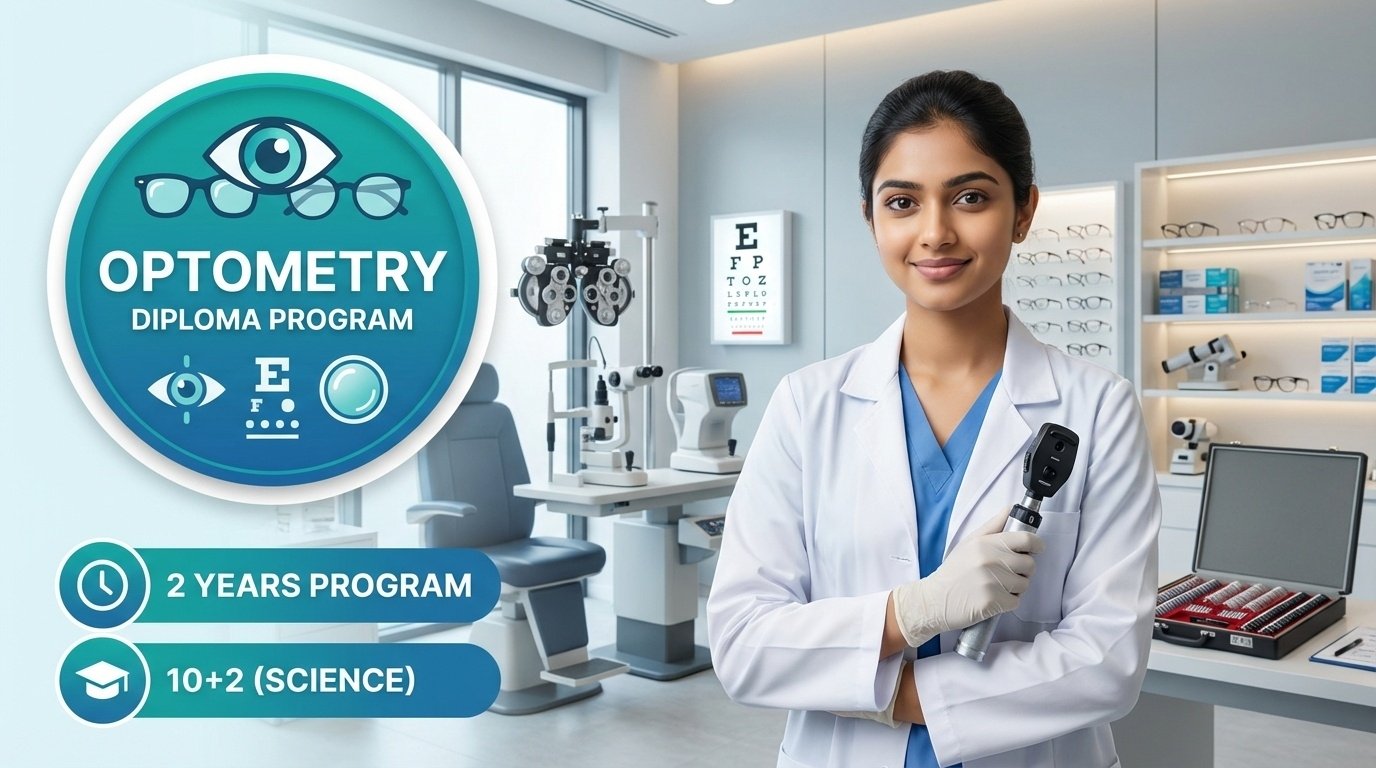
The Diploma in Optometry is a specialized paramedical program designed to train skilled eye care professionals who play a crucial role in primary vision care delivery. This comprehensive 2-year diploma equips students with advanced theoretical knowledge and extensive hands-on clinical skills in vision testing, diagnosis of eye conditions, optical dispensing, and management of refractive errors.
With increasing screen time, aging populations, and rising awareness about eye health, qualified optometrists have become essential healthcare professionals, serving as the first line of defense in preventing blindness and preserving vision quality across all age groups.
| Aspect | Details |
|---|---|
| Course Name | Diploma in Optometry |
| Category | Paramedical / Allied Health Sciences |
| Duration | 2 Years |
| Course Type | Full-time Diploma Program |
| Eligibility | 10+2 (Science Stream) |
| Total Fee | ₹80,000 |
| Institute | Mahatma Gandhi Ayurvigyan Vidyapeeth |
Optometry is a healthcare profession focused on examining, diagnosing, treating, and managing diseases and disorders of the visual system and associated structures. Optometrists are primary healthcare providers who:
✅ Conduct comprehensive eye examinations
✅ Diagnose refractive errors and prescribe corrective lenses
✅ Detect eye diseases and abnormalities
✅ Provide pre- and post-operative care
✅ Prescribe medications for certain eye conditions
✅ Manage low vision and vision therapy
✅ Educate patients on eye health and preventive care
The program offers a meticulously designed curriculum combining optical science with clinical practice:
Human Anatomy & Physiology
Biochemistry & Microbiology
General Pathology
Geometrical & Physical Optics
Ocular Anatomy & Physiology
Basic Optometry
Refraction Techniques
Ocular Motility & Binocular Vision
Contact Lens Practice
Clinical Ophthalmology
Systemic Diseases & Eye
Visual Fields & Perimetry
Low Vision Assessment & Management
Pediatric Optometry
Geriatric Optometry
Ophthalmic & Optometric Instruments
Optical Dispensing
Clinical Practice & Internship
Practice Management & Professional Ethics
Graduates can pursue diverse and rewarding careers across multiple healthcare settings:
| Position | Primary Responsibilities |
|---|---|
| Clinical Optometrist | Comprehensive eye examinations, vision testing, diagnosis |
| Hospital Optometrist | Pre/post-operative care, clinical assessments in eye departments |
| Pediatric Optometrist | Children's vision screening and management |
| Ophthalmic Technician | Assist ophthalmologists, operate diagnostic equipment |
| Vision Therapist | Conduct vision therapy programs for binocular vision disorders |
| Contact Lens Specialist | Contact lens fitting, care education, complication management |
| Low Vision Specialist | Assess and rehabilitate patients with low vision |
| Corporate Vision Consultant | Workplace vision screening, ergonomic assessments |
| Position | Work Environment |
|---|---|
| Optical Dispenser | Optical retail stores, eyewear boutiques |
| Optical Shop Manager | Manage optical retail operations |
| Sales Representative | Optical instruments, eyewear companies |
| Product Specialist | Contact lens & eyewear companies |
| Technical Support Specialist | Optical equipment manufacturers |
| Experience Level | Monthly Salary | Annual Package |
|---|---|---|
| Fresher (Entry-Level) | ₹20,000 - ₹40,000 | ₹2,40,000 - ₹4,80,000 |
| Junior (1-3 years) | ₹30,000 - ₹50,000 | ₹3,60,000 - ₹6,00,000 |
| Mid-Level (3-7 years) | ₹50,000 - ₹83,000 | ₹6,00,000 - ₹10,00,000 |
| Senior (7+ years) | ₹83,000 - ₹1,50,000+ | ₹10,00,000 - ₹18,00,000+ |
| Specialist/Manager | ₹1,00,000 - ₹2,00,000+ | ₹12,00,000 - ₹24,00,000+ |
Average Gross Salary: ₹6,76,000 per annum (experienced professionals)
| Sector | Average Annual Salary |
|---|---|
| Corporate Eye Hospitals | ₹4,00,000 - ₹8,00,000 |
| Private Clinics | ₹3,00,000 - ₹6,00,000 |
| Optical Retail Chains | ₹2,40,000 - ₹5,00,000 |
| Own Practice | ₹6,00,000 - ₹18,00,000+ |
| Government Hospitals | ₹3,50,000 - ₹7,00,000 |
| Corporate Companies | ₹4,00,000 - ₹8,00,000 |
| Educational Institutions | ₹3,00,000 - ₹6,00,000 |
Part-Time Clinics: ₹1,000 - ₹3,000 per session
Home Eye Checkups: ₹500 - ₹2,000 per visit
Corporate Workshops: ₹3,000 - ₹10,000 per session
Freelance Consultations: ₹500 - ₹1,500 per consultation
Product Commissions: 10-20% on eyewear sales
Optometry is a globally recognized profession with excellent opportunities abroad:
Note: International practice may require additional licensing/registration
✅ Comprehensive eye examination techniques
✅ Retinoscopy and subjective refraction
✅ Slit lamp biomicroscopy
✅ Ophthalmoscopy (direct & indirect)
✅ Tonometry (IOP measurement)
✅ Keratometry and corneal assessment
✅ Visual field testing (perimetry)
✅ Contact lens fitting and management
✅ Optical dispensing and frame fitting
✅ Low vision assessment and rehabilitation
✅ Binocular vision evaluation
✅ Pediatric vision screening
✅ Patient history taking
✅ Diagnosis of refractive errors
✅ Recognition of ocular pathologies
✅ Pre- and post-operative eye care
✅ Emergency eye care management
✅ Patient counseling and education
✅ Clinical decision-making
✅ Medical documentation
✅ Healthcare ethics and patient confidentiality
✅ Effective communication with patients
✅ Teamwork with ophthalmologists and staff
✅ Practice management basics
✅ Inventory and supply management
✅ Quality control in optical services
✅ Professional development mindset
✅ Operation of advanced diagnostic equipment
✅ Electronic health records (EHR) systems
✅ Optical prescription software
✅ Lens ordering and tracking systems
✅ Telemedicine platforms
Students with:
With over 63 million Indians suffering from vision impairment and increasing screen time, eye care services are in unprecedented demand.
Vision care is essential healthcare - people always need eye checkups, glasses, and contact lenses regardless of economic conditions.
Start earning within 2 years compared to 4+ years for professional degrees, with excellent return on investment.
Course fee of ₹80,000 with starting salaries of ₹2.4-4.8 lakhs means you recover investment within the first year.
Work in hospitals, private clinics, retail optical chains, corporate settings, research, education, or start your own optical practice.
Bureau of Labor Statistics projects 10% growth in optometry jobs (2021-2031), with 1,700 annual openings.
Work with cutting-edge diagnostic equipment, digital refraction systems, and advanced lens technologies.
Start your own optical store with manageable investment and establish a profitable business.
Regular working hours (typically 9-6 or 10-7), weekends off in many settings, minimal night shifts.
Directly improve quality of life by restoring vision - one of humanity's most precious senses.
Optometry is a universally recognized profession with opportunities to work internationally.
Dynamic field with constant innovations in lenses, contact lenses, diagnostic tools, and treatment methods.
Recognized as primary eye care providers with professional autonomy and respect in healthcare.
Specialize in contact lenses, low vision, pediatric optometry, vision therapy, or sports vision.
Mahatma Gandhi Ayurvigyan Vidyapeeth stands as a premier institution committed to excellence in paramedical and allied health education.
✅ 100% Placement Assistance with dedicated placement cell
✅ Career Counseling from industry experts
✅ Resume Building and interview preparation workshops
✅ Entrepreneurship Guidance for starting optical practices
✅ Alumni Network for mentorship and opportunities
✅ Industry Exposure through visits and internships
✅ Scholarship Programs for meritorious and needy students
Semester 1 & 2 (Year 1)
Semester 3 & 4 (Year 2)
Upon successful completion, graduates will be competent to:
✔️ Conduct comprehensive eye examinations independently
✔️ Perform refraction (subjective and objective) accurately
✔️ Operate advanced optometric and ophthalmic instruments
✔️ Diagnose refractive errors and prescribe corrective lenses
✔️ Fit and dispense eyeglasses with proper measurements
✔️ Manage contact lens fittings and patient education
✔️ Recognize ocular pathologies and refer appropriately
✔️ Assess binocular vision anomalies
✔️ Evaluate low vision patients and recommend aids
✔️ Screen for common eye diseases (glaucoma, cataracts, diabetic retinopathy)
✔️ Educate patients on eye health and preventive care
✔️ Maintain professional standards and ethical practice
✔️ Manage optical practice operations effectively
✔️ Collaborate with ophthalmologists and healthcare teams
✔️ Document clinical findings accurately and legally
Step 1: Online Registration
Visit the official admission portal at mgavidyapeeth.com and register your account.
Step 2: Application Form Completion
Fill out the comprehensive application form with accurate details:
Step 3: Document Upload
Submit scanned copies of:
Step 4: Application Fee Payment
Pay the non-refundable application fee through:
Step 5: Application Review
Institute reviews applications and verifies documents.
Step 6: Merit List & Selection
Step 7: Admission Confirmation ✅
Step 8: Orientation
Attend mandatory orientation program before classes begin.
Original certificates (for verification)
4 passport-size photographs
Address proof
Parent/guardian details
Blood group certificate
Bonafide certificate from previous institution
Bachelor of Optometry (B.Optom) - 4-year degree program
Bachelor of Science in Optometry - Allied upgrade option
Post-Graduate Diploma in Specialized Areas:
Master's Programs (after B.Optom):
International Certifications:
Years 0-2: Junior Optometrist → Years 2-5: Optometrist → Years 5-8: Senior Optometrist → Years 8+: Specialist/Manager/Owner
✅ 1000+ hours of supervised clinical practice
✅ Real patient interactions from first year
✅ Exposure to diverse eye conditions
✅ Modern equipment operation training
✅ Updated according to latest industry standards
✅ Focus on employability skills
✅ Soft skills development programs
✅ Business management basics
✅ 90%+ placement record
✅ On-campus recruitment drives
✅ Tie-ups with leading optical chains
✅ Internship-to-employment conversion opportunities
✅ Personality development workshops
✅ Communication skills training
✅ Leadership development programs
✅ Industry expert guest lectures
Digital Eye Strain: 70% increase in digital device users seeking eye care
Aging Population: Growing elderly population needs vision care
COVID Impact: Increased awareness about eye health post-pandemic
School Programs: Government mandating vision screening in schools
Corporate Wellness: Companies offering eye care benefits
Telemedicine: Online eye consultations becoming mainstream
Medical Tourism: India becoming hub for affordable eye care
AI Integration: Automated refraction and diagnosis
Mobile Apps: Vision testing and prescription apps
VR/AR: Virtual reality vision therapy
Advanced Imaging: OCT and topography becoming standard
Cloud-Based Systems: Electronic health records
Join one of the fastest-growing healthcare professions and become a crucial part of the eye care ecosystem. With excellent job prospects, competitive salaries, and the satisfaction of restoring vision, your future in optometry starts here!
⏰ Hurry! Seats Fill Up Fast - Apply Today!
Q: Can I practice independently after this diploma?
A: Yes, you can work as an optometrist in clinics, hospitals, and optical stores. For independent practice, additional registration may be required based on state regulations.
Q: Is mathematics mandatory for admission?
A: No, either PCB (Physics, Chemistry, Biology) or PCM (Physics, Chemistry, Mathematics) is acceptable.
Q: What's the difference between optometrist and ophthalmologist?
A: Ophthalmologists are medical doctors who can perform surgery. Optometrists are primary eye care providers who perform eye exams, prescribe lenses, and detect eye diseases.
Q: Can I pursue B.Optom after this diploma?
A: Yes, many universities offer lateral entry into B.Optom programs for diploma holders.
Q: Are there government jobs for optometrists?
A: Yes, government hospitals, AIIMS, district hospitals, and vision screening programs regularly recruit optometrists.
Q: Can I work abroad with this diploma?
A: The diploma provides a strong foundation, but international practice may require additional qualifications or licensing specific to that country.
Imagine a career where:
This isn't just a dream - it's your future in optometry!

Quality education, practical learning and professional development for a brighter and successful future.