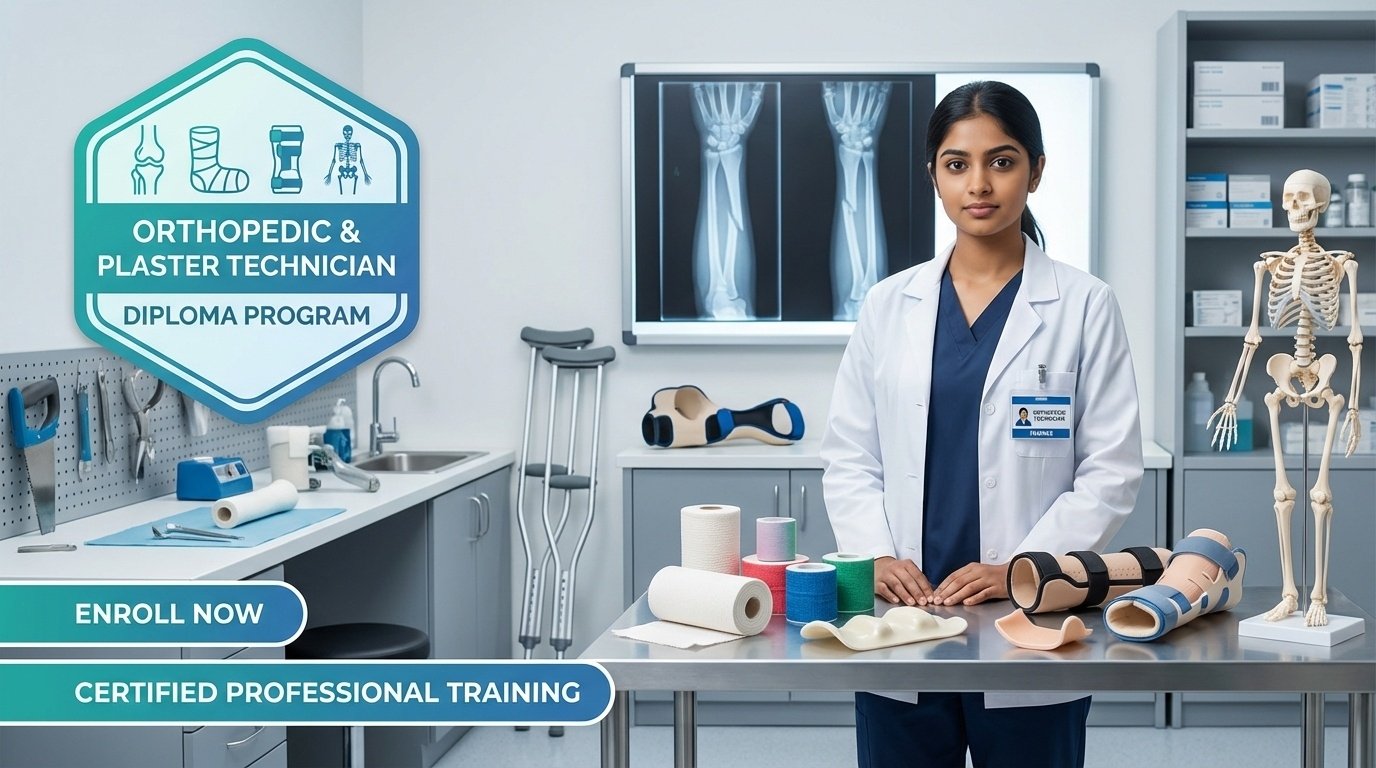
Diploma in Orthopedic & Plaster Technician
The Diploma in Orthopedic & Plaster Technician (DOPT) is a specialized paramedical program designed to train healthcare professionals in the field of orthopedics. Orthopedic technicians are experts in casting, splinting, and immobilization techniques who work under the supervision of orthopedic surgeons to manage patient care in clinics, operation theatres, and emergency settings. The course focuses on both invasive and non-invasive orthopedic procedures, preparing students to assist in orthopedic surgeries, apply and remove casts/splints, and support the comprehensive treatment of musculoskeletal conditions.
What is an Orthopedic & Plaster Technician?
An Orthopedic & Plaster Technician (also called Orthopedic Technologist) is a specialized physician extender who:
- Applies and removes all types of casts, splints, and plasters
- Assists with fracture and dislocation reduction
- Provides wound closure and care
- Supports patients through education and follow-up care
- Assists as first assistant in operating suites
- Operates imaging equipment like C-arm
- Manages traction devices and immobilization equipment
- Works with orthopedic implants and surgical instruments
Course Duration & Type
- Duration: 2 years (Full-time)
- Some institutions offer 1-year diploma programs
- Standard duration is 2 years divided into 4 semesters
- Course Type: Full-time, campus-based
- Course Level: Diploma/Paramedical Diploma
Course Objectives
The diploma program aims to prepare orthopedic technicians who can:
- Assist in all types of plasters, casts, splints, and immobilization techniques
- Prepare operation theatre before surgery including sterilization processes
- Assist common orthopedic surgeries as first assistant to surgeons
- Use C-arm and other imaging devices effectively
- Take care of patients in post-operative rooms
- Read and interpret relevant X-rays
- Maintain all medical records and documentation
- Perform CPR (Cardiopulmonary Resuscitation)
- Perform basic nursing procedures including:
- IV/IM/SC injections
- IV cannulation
- Nebulization
- Catheterization
- Oxygen therapy
- Bandaging and dressings
- Understand musculoskeletal anatomy and apply knowledge to practical situations
Eligibility Criteria
Educational Qualification:
- Standard Requirement: Passed Class 12 (10+2) from a recognized board
- Subject Combinations:
- Physics, Chemistry, Biology (PCB) - Preferred
- OR Physics, Chemistry, Mathematics (PCM)
- Minimum Marks:
- 35-50% aggregate in Class 12 (varies by institution)
- General/OBC: 50% marks
- SC/ST: 45% marks
Alternative Entry (Some Institutions):
- Passed Class 10 (Matriculation) - for certificate programs
- Minimum 50% marks for General/OBC (45% for SC/ST)
Age Requirements:
- Candidate must have completed 17 years of age as of 31st December of the admission year
- No maximum age limit for most institutions
Language Proficiency:
- Proficiency in English or Hindi medium (as per institution)
Physical Requirements:
- Good physical fitness and stamina
- Ability to stand for long hours
- Good manual dexterity for handling instruments
- Normal vision and hearing
- Medical fitness certificate may be required
Admission Process
Types of Admission:
1. Merit-Based Admission:
- Direct admission based on Class 12 marks
- Merit list prepared by institutions
- Counseling and seat allocation
2. Entrance-Based Admission:
- Some institutions conduct entrance examinations
- NEET-based admission for certain medical institutions
- Institute-specific entrance tests
- Exam Pattern: Multiple choice questions in Physics, Chemistry, Biology
- Duration: 1.5-3 hours
- Marking Scheme: +1 for correct, -1/3 for wrong answers
Application Process:
- Online/Offline application through institution website
- Fill application form with accurate details
- Upload required documents:
- Class 10 and 12 mark sheets
- Birth certificate/High school certificate
- Transfer certificate
- Character certificate
- Caste certificate (if applicable - SC/ST/OBC)
- Medical fitness certificate
- Passport size photographs
- Aadhar card
- Migration certificate (for students from other states)
- Pay application fee (₹1,000-1,500 approximately)
- Appear for entrance exam (if applicable)
- Attend counseling based on merit/entrance score
- Document verification with original certificates
- Fee payment to confirm admission
Seat Reservation:
- SC (Scheduled Caste): 15%
- ST (Scheduled Tribe): 7.5%
- OBC (Other Backward Classes): 27%
- EWS (Economically Weaker Section): 10%
- PWBD (Persons with Benchmark Disability): 5% horizontal reservation
Course Fees
- Fee Range: ₹30,000 - ₹1,50,000 for the entire program (2 years)
- Government Institutions: ₹20,000 - ₹50,000
- Private Institutions: ₹50,000 - ₹1,50,000
Fee Components:
- Registration fees
- Tuition fees
- Laboratory fees
- Library fees
- Examination fees
- Hostel fees (if applicable)
- Caution money (refundable)
- Practical training fees
Note: Fees are subject to revision and vary significantly by institution and location.
Course Curriculum & Syllabus
YEAR 1 (First Year)
THEORY CLASSES (9 AM - 12 Noon)
Paper 1: General Anatomy & Physiology + Basic Medical Sciences
A. General Anatomy & Physiology (200 hours)
-
General Orientation (15 hours)
- Parts of human body and anatomical terms
- Total numbers of bones, their names and locations
- Organization of body from cell to organ systems
-
Cell Biology (5 hours)
- Structure of animal cell
- Cell organelles and their functions
-
Human Tissues (10 hours)
- Types, structure, and functions of tissues
-
Body Systems - Basics Only:
- Skin & appendages (2 hours)
- GIT (Gastrointestinal Tract) (10 hours)
- Respiratory tract (20 hours)
- Urinary tract (5 hours)
- Male reproductive system (5 hours)
- Female reproductive system (5 hours)
- Endocrine system (15 hours)
-
Nervous System (30 hours)
- Gross structure of brain & spinal cord
- Functions of different parts
-
Blood (20 hours)
- Composition and functions
- Plasma, RBCs, WBCs, Platelets
- Clotting system
-
Sensory Organs (10 hours)
- Gross structure and functions of eye, ear, nose, tongue
-
Cardiovascular System
- Basic structure of heart
- Vessels entering and leaving heart
- Arterial and venous tree of body
-
Lymphatic System
-
Immune System
- Components and various mechanisms of defense
B. Basic Pathology, Pharmacology & Microbiology (120 hours)
Pathology:
- Acute and chronic inflammation (10 hours)
- Wound healing (10 hours)
- Necrosis and apoptosis (10 hours)
- Shock (5 hours)
- Fracture healing (15 hours)
Microbiology:
- Modes of disease transmission & prevention (5 hours)
- Sterilization methods used in hospitals (10 hours)
- Basic idea about bacteria, viruses, fungi (20 hours)
Pharmacology:
- Routes of drug administration (2 hours)
- Adverse effects and side effects (2 hours)
- Analgesics: Opioids & NSAIDs (5 hours)
- Drugs for cough & expectoration (1 hour)
- Drugs for asthma & COPD (2 hours)
- Antimicrobials (20 hours)
- Antihistamines & corticosteroids (2 hours)
- Anesthetic agents (Local & General) (10 hours)
- Muscle relaxants (3 hours)
Paper 2: Detailed Musculoskeletal Anatomy + Infection Control
A. Detailed Osteology, Myology, Neurology, Joints (350 hours)
-
Detailed Bones of Body (100 hours)
- Surface anatomy
- All major bones with complete details
- Bone landmarks and attachments
-
Major Muscles (40 hours)
- Location, origin, insertion, action
- Nerve supply of important muscles
-
Neurology (100 hours)
- Brachial plexus
- Lumbar and sacral plexi
- Cranial and spinal nerves
-
Joints (350 hours combined)
- Details of all major joints
- Basics of other joints
- Joint movements and mechanics
-
Radiological Anatomy (25 hours)
- X-rays of all bones and joints
- CT scans and MRI of various joints
- DEXA scan interpretation
B. Hand Hygiene & Infection Prevention (10 hours)
- Hand hygiene methods
- Hand washing techniques
- Prevention of cross infection
C. Basic Life Support - BLS & CPR (30 hours)
- Code blue protocols
- Details of Basic Life Support
- Cardiopulmonary Resuscitation techniques and practice
PRACTICAL CLASSES (1 PM - 4 PM) - 780 Hours
First Year Practical Training:
- Students act as "Observers" during first year
- Present in hospital/OT for basic nursing and orthopedics procedures
- Observe surgeries and procedures
Practical Topics:
- Hand wash and scrubbing techniques
- Recording vital signs (temperature, pulse, BP, respiration)
- Injection techniques
- IV, IM, SC injections
- IV cannulation
- Urinary catheterization
- Personal Protective Equipment (PPE)
- Gloving and gowning
- Use of PPE
- Assisting in immobilization
- Splints, casts, and plasters
- Common bandaging and dressing techniques
- Assistance in Operation Theatre
Additional Subjects (No Examination):
- Basic Computer Skills (30 hours)
- Basic English (30 hours)
- Soft Skills (10 hours)
- Interpersonal relationship skills
- Moral education
- Patient communication
YEAR 2 (Second Year)
THEORY CLASSES (9 AM - 12 Noon)
Paper 1: Fractures, Orthopedic Diseases & Nursing Procedures
A. Details about Different Fractures and Orthopedic Diseases (450 hours)
-
Introduction (10 hours)
- History taking
- Orthopedic examination of patient
- Case-sheet filling
- Common clinical terminology
-
Fractures - General Principles:
- Definition, types, and classification (10 hours)
- Fracture healing (10 hours)
- General principles of fracture treatment (15 hours)
- Immobilization, closed reduction
- Traction, open reduction
- Use of implants
- Splints and traction (10 hours)
- Complications of fractures (20 hours)
-
Specific Fractures:
- Clavicle fracture (5 hours)
- Scapula fracture (5 hours)
- Humerus fractures (15 hours)
- Neck, shaft, supracondylar, intercondylar, condyle fractures
- Forearm fractures - Both bones (10 hours)
- Colles' fracture, Smith fracture (10 hours)
- Scaphoid fracture (5 hours)
- Hand fractures (15 hours)
- Pelvis fractures (10 hours)
- Femur fractures (20 hours)
- Neck, trochanteric, shaft, intertrochanteric
- Tibia and fibula fractures (10 hours)
- Patella fracture (5 hours)
- Ankle joint injuries (15 hours)
- Foot fractures (20 hours)
-
Orthopedic Conditions:
- Osteomyelitis (10 hours)
- CTEV (Club Foot) (10 hours)
- Dislocations of common joints (20 hours)
- PIVD and spinal diseases (20 hours)
- Meniscal and ligament injuries (20 hours)
- Ligament and tendon injuries (20 hours)
- TB of bone and spine (20 hours)
- Bone tumors (10 hours)
- Spinal injuries (10 hours)
- Arthritis types (20 hours)
- Osteoarthritis, rheumatoid, gouty, septic
- Ankylosing spondylitis
- Common orthopedic conditions (10 hours)
- Tennis elbow, golfer's elbow
- Carpal tunnel syndrome
- Frozen shoulder, plantar fasciitis
- Metabolic bone diseases (10 hours)
- Rickets, osteomalacia, osteoporosis
- Cerebral palsy (5 hours)
- Poliomyelitis (5 hours)
- Joint replacement surgeries (10 hours)
- Amputation and prosthesis (20 hours)
B. Nursing Procedures (20 hours)
- Vital signs monitoring:
- Temperature, pulse, BP, respiration monitoring
- Injection techniques:
- IM, IV, SC injection administration
- Oxygen therapy
- Nebulization
- IV infusion (including infusion pump)
- Care of unconscious patient
- Urinary catheterization
Paper 2: Plaster Techniques, Orthopedic Surgeries & CSSD
A. Plaster Techniques and Orthopedic Surgeries (250 hours)
- First aid management in fracture cases (20 hours)
- Helping in imaging procedures (10 hours)
- Various immobilization techniques (20 hours)
- Uses of different splints (20 hours)
- Various types of tractions (20 hours)
- Closed and open reduction techniques (50 hours)
- Performing casts, slabs, and plasters (40 hours)
- Plaster of Paris application
- Fiberglass casts
- Synthetic casts
- Use of C-arm in OT (5 hours)
- Patient positioning during orthopedic surgeries (15 hours)
- Assisting various orthopedic surgeries (20 hours)
- Assisting arthroplasty and arthroscopic surgeries (20 hours)
- Use of orthopedic drills (10 hours)
B. CSSD & Sterilization Practices (30 hours)
- Various methods of sterilization (10 hours)
- Aseptic practices (10 hours)
- Biomedical waste management (10 hours)
C. Biomedical Engineering of OT Equipment (30 hours)
- X-ray machine (10 hours)
- C-arm machine (5 hours)
- Orthopedic implants (10 hours)
- Drill machines (5 hours)
PRACTICAL CLASSES (1 PM - 4 PM) - 780 Hours
Second Year Practical Training:
Students actively participate and perform procedures under supervision
Practical Syllabus:
- First aid management in fractures
- Helping in imaging (X-rays, C-arm operation)
- Various immobilization techniques
- Use of different splints
- Application of various types of traction
- Closed and open reduction techniques
- Performing various casts, slabs, and plasters
- Upper limb casts
- Lower limb casts
- Spica casts
- Body casts
- Use of C-arm in operation theatre
- Patient positioning during orthopedic surgeries
- Assisting various orthopedic surgeries as first assistant
- Assisting arthroplasty and arthroscopic surgeries
- Use of drills and power tools
- Knowledge and use of orthopedic implants
- Plates and screws
- Intramedullary nails
- External fixators
- Aseptic OT techniques
- Reading and interpreting X-rays