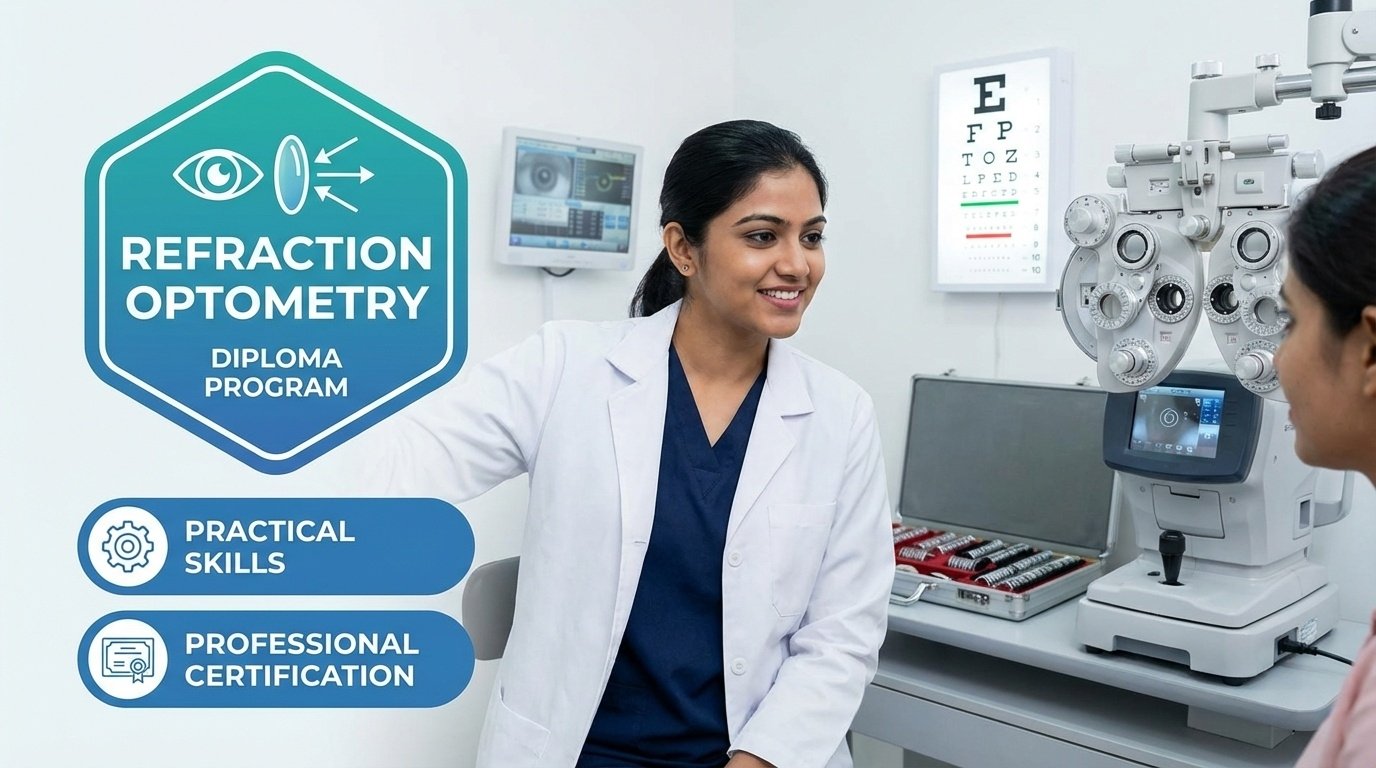
Diploma in Refraction Optometry
The Diploma in Refraction Optometry is a comprehensive 2-3 year paramedical course specifically designed to train students in diagnosing and managing refractive errors and basic eye disorders. This specialized program focuses on the science of measuring the eye's refractive condition (emmetropia or ametropias) and correcting it with optical equipment, primarily spectacles or contact lenses. The course combines theoretical knowledge with extensive clinical and practical training.
Course Highlights
Eligibility Criteria
To pursue a Diploma in Refraction Optometry, candidates must meet the following requirements:
- Educational Qualification: 10+2 or equivalent from a recognized board
- Stream: Science stream preferred (Physics, Chemistry, Biology/Mathematics)
- Minimum Marks: 45-50% aggregate in Class 12
- Age Limit: 17 years and above
- Subjects Required: Physics, Chemistry, Biology, and Mathematics as primary subjects
Course Curriculum & Syllabus
First Year Subjects:
-
General Anatomy & Physiology
- Structure and function of human body systems
- Detailed focus on eye anatomy and related structures
-
Ocular Anatomy and Physiology
- Eye structure and functions in detail
- Ocular circulation and innervation
- Visual pathways
-
General & Ocular Microbiology
- Basic microbiology concepts
- Microorganisms affecting the eye
- Eye infections and their management
-
General & Ocular Pharmacology
- Introduction to pharmaceutical drugs
- Drugs used in eye treatment
- Dosage and administration methods
-
Optics (Physical and Geometrical)
- Light properties: reflection, refraction, dispersion
- Mirrors and lenses in optics
- Optical principles and theories
- Diffraction and interference
-
Basic Orthoptics
- Eye movements and coordination
- Binocular vision
- Eye muscle functions
-
Clinical Refraction (Introduction)
- Visual acuity testing
- Use of trial frames and lenses
- Basic refraction techniques
- Patient examination procedures
Second Year Subjects:
-
Advanced Clinical Refraction
- Subjective refraction techniques
- Objective refraction methods
- Retinoscopy procedures
- Jackson cross cylinder usage
- Presbyopic corrections
- Astigmatism management
-
Contact Lenses
- Types of contact lenses (soft, rigid, gas permeable)
- Contact lens fitting procedures
- Care and maintenance
- Complications and management
-
Dispensing Optics
- Spectacle fitting and adjustment
- Frame types and materials
- Lens types (single vision, bifocal, progressive)
- Lens materials and coatings
- Workshop practices
-
Common Eye Diseases
- Cataract
- Glaucoma
- Refractive errors (myopia, hyperopia, astigmatism)
- Presbyopia
- Retinal vessel occlusion
- Macular degeneration
- Retinal detachment
- Retinitis pigmentosa
-
Optometric Instruments
- Slit lamp biomicroscope
- Tonometer usage
- Autorefractor operation
- Keratometer
- Ophthalmoscope
- Phoropter and refractor
-
Low Vision Aids and Rehabilitation
- Devices for visually impaired
- Magnifiers and telescopes
- Rehabilitation techniques
- Patient counseling
-
Clinical Practicals & Hospital Training
- Supervised refraction sessions
- Handling real patients
- Case reporting and documentation
- Internship in eye hospitals/clinics
Key Learning Areas
Students gain expertise in:
- Refraction Testing: Determining the eye's refractive condition and prescribing corrective lenses
- Visual Acuity Testing: Measuring clarity and sharpness of vision
- Retinoscopy: Objective method for determining refractive error
- Eye Examination: Complete preliminary eye examination techniques
- Spectacle Prescription: Preparing and interpreting eyeglass prescriptions
- Contact Lens Fitting: Proper fitting and management of contact lenses
- Optical Dispensing: Accurate dispensing of spectacles
- Patient Management: History taking and patient care
- Psychology: Understanding patient behavior and needs
- Optometric Retail Management: Business aspects of optical shops
Admission Process
-
Check Eligibility: Ensure you meet the educational qualification (10+2 with Physics, Chemistry, Biology/Mathematics and minimum 45-50% marks)
-
Application Submission: Apply to institutions offering the course through online or offline mode
-
Merit-Based Selection: Most institutions admit based on Class 12 performance
-
Entrance Test: Some universities may conduct entrance examinations
-
Document Verification: Submit required documents (mark sheets, certificates, ID proof)
-
Fee Payment: Pay the course fee to confirm admission
Career Opportunities & Job Roles
After completing the Diploma in Refraction Optometry, graduates have diverse career paths:
Job Positions:
Employment Sectors
Diploma holders can work in:
- Eye Care Hospitals: Specialist eye hospitals and clinics
- Optical Retail Chains: Major optical retail stores
- Government Healthcare Centers: Primary health centers and community hospitals
- Private Clinics: Ophthalmology and optometry clinics
- Lens Manufacturing Companies: Quality control and technical roles
- NGOs and Eye Camps: Community eye care programs
- Medical Colleges: As technical assistants
- Self-Employment: Own optical shop or refraction services
Scope & Future Prospects
Higher Education Options:
- Bachelor's Degree: B.Sc in Refraction Optometry or B.Optometry
- Master's Degree: M.Sc in Optometry or M.Optom
- Doctoral Programs: PhD in Optometry or related fields
- Professional Certification: Doctor of Optometry (OD)
Industry Demand:
- High Demand: Significant growth in eye care hospitals and optical retail chains
- Job Security: Shortage of qualified refractionists ensures employment opportunities
- Internship Placement: Most students receive job offers during internship period
- Growing Market: Increasing prevalence of refractive errors due to digital device usage
- Avoidable Blindness Prevention: Refraction errors are the second leading cause of blindness, creating critical need for professionals
Skills Developed
Students acquire the following competencies:
- Accurate refraction testing and prescription
- Operation of advanced optometric instruments
- Patient communication and counseling
- Spectacle and contact lens dispensing
- Recognition of common eye diseases
- Clinical documentation and record keeping
- Optical workshop skills
- Customer service in optical retail
- Business management for optical shops
Conditions Studied & Managed
The course covers diagnosis and management of:
- Astigmatism: Unclear vision due to eye curvature problems
- Myopia (Nearsightedness): Difficulty seeing distant objects
- Hyperopia (Farsightedness): Difficulty seeing near objects
- Presbyopia: Age-related loss of focusing ability
- Retinal Vessel Occlusion: Blocked blood vessels in the retina
- Macular Degeneration: Age-related central vision loss
- Retinal Detachment: Separation of retina from eye tissue
- Retinitis Pigmentosa: Genetic condition causing retinal damage
Benefits of the Course
- Specialized Training: Focused expertise in refraction and vision correction
- Quick Career Entry: 2-3 years to professional qualification
- High Employability: Guaranteed placement opportunities due to shortage of professionals
- Affordable Education: Lower fees compared to bachelor's programs
- Growing Industry: Expanding optical retail and eye care sectors
- Essential Healthcare Service: Critical role in preventing avoidable blindness
- Entrepreneurship Opportunities: Can establish own optical business
- Work-Life Balance: Regular working hours in clinical settings
- Continuous Learning: Scope for professional development and specialization
Fee Structure
The fee structure varies by institution:
- Government Institutions: ₹30,000 - ₹60,000 (total course)
- Private Institutions: ₹80,000 - ₹1,50,000 (total course)
- Additional costs for clinical materials and internship may apply
Salary Progression
- Fresher (0-1 year): ₹20,000 - ₹40,000/month (₹4-5 LPA)
- Experienced (3-5 years): ₹40,000 - ₹70,000/month (₹6-9 LPA)
- Senior Level (5+ years): ₹70,000 - ₹1,00,000/month (₹9-12 LPA)
- With Higher Qualifications: Up to ₹10+ LPA