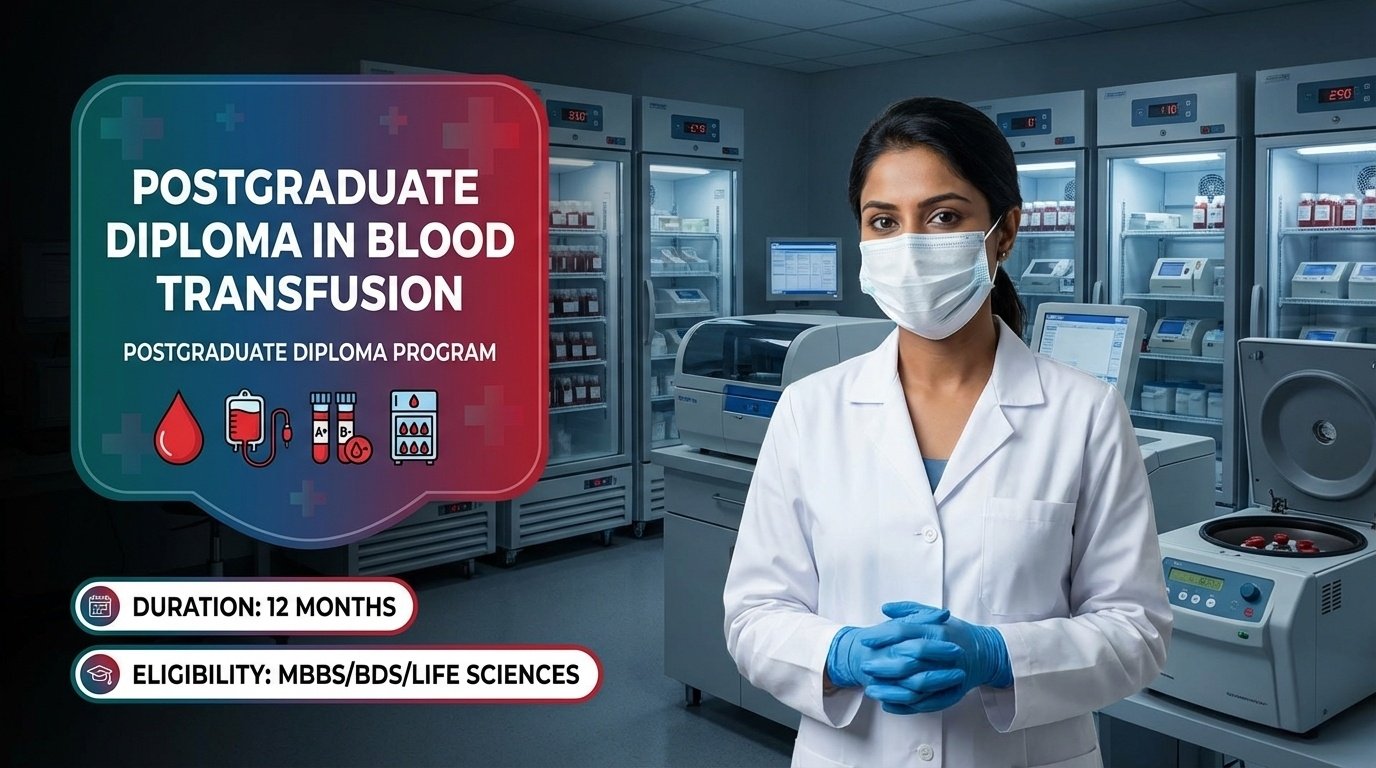
Postgraduate Diploma in Blood Transfusion
Overview
The Postgraduate Diploma in Blood Transfusion is a specialized advanced paramedical program designed for science graduates seeking expertise in transfusion medicine and blood banking. This intensive one-year course provides comprehensive training in blood donor management, blood component preparation, immunohematology, transfusion practices, blood safety, and quality assurance in blood banks. As blood transfusion services are critical for surgical procedures, trauma care, cancer treatment, and managing blood disorders, this program prepares you to become a highly skilled transfusion medicine specialist capable of ensuring safe blood supply and optimal patient care in hospitals, blood banks, and transfusion centers.
Course Details
About the Program
Transfusion medicine is a vital medical specialty that bridges laboratory science and clinical practice. Blood transfusion professionals are responsible for the entire blood supply chain—from donor recruitment to safe transfusion—making them indispensable in modern healthcare. This advanced diploma program develops:
- Comprehensive immunohematology expertise including blood grouping, antibody screening, and compatibility testing
- Blood component therapy mastery preparing platelets, plasma, cryoprecipitate, and specialized products
- Donor management skills ensuring safe collection from voluntary donors
- Transfusion safety proficiency preventing transfusion reactions and managing complications
- Quality assurance capabilities maintaining accreditation standards
- Apheresis technology knowledge for specialized component collection
- Blood bank management competencies for operational excellence
- Regulatory compliance expertise meeting national and international standards
- Clinical transfusion consultation supporting optimal patient care
- Research abilities advancing transfusion medicine science
Key Subjects Covered
Intensive 12-Month Curriculum
Module 1: Fundamentals of Transfusion Medicine (Months 1-2)
-
Introduction to Transfusion Medicine
- History and evolution of blood transfusion
- Organization of blood transfusion services
- Blood transfusion regulations in India
- National Blood Transfusion Council (NBTC) guidelines
- Drugs and Cosmetics Act provisions
- WHO guidelines on blood safety
- Quality system requirements
- Blood bank licensure and accreditation
- Blood safety monitoring
- Organizational models (hospital vs. standalone blood banks)
-
Basic Immunology & Blood Group Systems
- Principles of immunology
- Antigens and antibodies
- Antigen-antibody reactions
- ABO blood group system
- Rh blood group system (D, C, E, c, e)
- Landsteiner's law
- Bombay blood group
- Forward and reverse grouping
- Weak D and partial D
- Subgroups of A and B
- H antigen and Le(a-b-) phenotype
- Clinical significance of blood group systems
-
Advanced Blood Group Systems
- Kell blood group system
- Duffy blood group system
- Kidd blood group system
- Lewis blood group system
- MNS blood group system
- Lutheran blood group system
- P blood group system
- Other blood group systems (33 ISBT systems)
- High-frequency and low-frequency antigens
- Null phenotypes
- Inheritance patterns
- Clinical significance in transfusion
-
Red Cell Serology & Antibody Identification
- Principles of antibody screening
- Indirect antiglobulin test (IAT)
- Direct antiglobulin test (DAT)
- Antibody identification panels
- Crossmatch procedures (immediate spin, AHG phase)
- Electronic crossmatch
- Antibody titration
- Auto-antibodies vs. allo-antibodies
- Cold antibodies
- Warm antibodies
- Elution techniques
- Absorption techniques
- Resolving complex antibody problems
Module 2: Blood Donor Management (Month 3)
-
Donor Recruitment & Selection
- Voluntary blood donation promotion
- Donor motivation strategies
- Replacement vs. voluntary donors
- Paid donor elimination
- Blood donor camps organization
- Mobile blood collection
- Donor registration process
- Donor selection criteria (age, weight, hemoglobin)
- Medical history questionnaire
- Physical examination
- Temporary deferral criteria
- Permanent deferral criteria
- High-risk behavior screening
- Informed consent
- Donor confidentiality
-
Blood Collection Procedures
- Venipuncture techniques
- Blood bag systems (single, double, triple, quadruple)
- Anticoagulants (CPD, CPDA-1, additive solutions)
- Whole blood collection
- Volume requirements
- Adverse donor reactions
- Vasovagal reactions management
- Hematoma prevention
- Citrate toxicity
- Air embolism prevention
- Needlestick injury protocol
- Post-donation care
- Donor follow-up
- Record keeping
-
Apheresis Technology
- Principles of apheresis
- Apheresis equipment operation
- Plateletpheresis
- Plasmapheresis
- Granulocyte collection
- Stem cell collection
- Therapeutic apheresis
- Plasma exchange
- Red cell exchange
- Photopheresis
- LDL apheresis
- Donor management in apheresis
- Complications and troubleshooting
Module 3: Blood Component Preparation (Month 4)
-
Component Preparation Technology
- Principles of component therapy
- Centrifugation principles
- Blood component separators
- Packed red blood cells (PRBC) preparation
- Platelet concentrate preparation
- Fresh frozen plasma (FFP) preparation
- Cryoprecipitate preparation
- Plasma cryoprecipitate reduced
- Buffy coat removal
- Leucodepletion
- Irradiation of blood components
- Volume reduction
- Washing procedures
- Pooling procedures
-
Specialized Blood Components
- Leucoreduced components
- Irradiated components
- Washed red cells
- Frozen red cells
- Granulocyte concentrates
- Cryoprecipitate reduced plasma
- Platelet additive solutions
- Pathogen inactivation
- CMV-negative components
- Neonatal/pediatric components
- Single donor platelets
- Plasma derivatives
- Albumin
- Immunoglobulins
- Coagulation factor concentrates
-
Blood Storage & Preservation
- Storage temperature requirements
- Blood bank refrigerators and freezers
- Storage duration for components
- Storage lesion in red cells
- Platelet storage and agitation
- Plasma freezing techniques
- Cryoprecipitate storage
- Temperature monitoring
- Cold chain maintenance
- Equipment validation
- Inventory management
- FIFO and FEFO principles
- Expiry date management
- Blood wastage reduction
Module 4: Transfusion Practice (Month 5)
-
Clinical Transfusion Medicine
- Indications for blood transfusion
- Red cell transfusion thresholds
- Platelet transfusion indications
- Plasma transfusion indications
- Cryoprecipitate usage
- Massive transfusion protocols
- Trauma transfusion
- Cardiac surgery transfusion
- Obstetric hemorrhage management
- Pediatric transfusion
- Neonatal transfusion
- Exchange transfusion
- Intrauterine transfusion
- Transfusion in specific conditions
- Restrictive vs. liberal strategies
-
Hemolytic Disease of Fetus and Newborn (HDFN)
- Pathophysiology of HDFN
- Rh incompatibility
- ABO incompatibility
- Other antibodies causing HDFN
- Antenatal screening
- Antibody titration in pregnancy
- Amniocentesis and cordocentesis
- Doppler ultrasound monitoring
- Intrauterine transfusion
- Exchange transfusion techniques
- Phototherapy
- IVIG therapy
- Rh immune globulin (RhIG) prophylaxis
- Dose calculation for RhIG
- Timing of RhIG administration
-
Transfusion Reactions & Complications
- Classification of transfusion reactions
- Acute hemolytic transfusion reactions
- Delayed hemolytic transfusion reactions
- Febrile non-hemolytic reactions
- Allergic reactions (mild, moderate, severe)
- Anaphylactic reactions
- Transfusion-related acute lung injury (TRALI)
- Transfusion-associated circulatory overload (TACO)
- Septic transfusions
- Transfusion-associated graft-versus-host disease (TA-GVHD)
- Post-transfusion purpura
- Iron overload
- Hypocalcemia in massive transfusion
- Hypothermia
- Investigation of transfusion reactions
- Management protocols
- Reporting requirements
-
Patient Blood Management (PBM)
- Principles of patient blood management
- Three pillars of PBM
- Preoperative anemia management
- Iron supplementation
- Erythropoietin therapy
- Intraoperative blood conservation
- Cell salvage (autotransfusion)
- Acute normovolemic hemodilution
- Controlled hypotension
- Postoperative blood conservation
- Transfusion alternatives
- PBM program implementation
- Auditing and monitoring
Module 5: Transfusion Safety & Quality (Month 6)
-
Transfusion-Transmitted Infections (TTI)
- Transfusion safety concepts
- Window period
- Mandatory screening tests
- HIV testing (ELISA, NAT)
- Hepatitis B testing (HBsAg, NAT)
- Hepatitis C testing (anti-HCV, NAT)
- Syphilis testing (VDRL, TPHA)
- Malaria testing
- Other TTIs (CMV, HTLV, Chagas, Zika)
- Nucleic acid testing (NAT) technology
- Screening test validation
- Quality control of testing
- Repeat reactive results management
- Donor notification and counseling
- Donor deferral registry
- Look-back procedures
-
Quality Assurance in Blood Banks
- Quality management system
- Quality policy and objectives
- Standard operating procedures (SOPs)
- Process control
- Internal quality control (IQC)
- External quality assurance schemes (EQAS)
- Proficiency testing
- Equipment calibration and maintenance
- Reagent quality control
- Temperature monitoring
- Validation and verification
- Documentation and records
- Corrective and preventive actions (CAPA)
- Non-conformance management
- Continuous improvement
- Quality indicators
-
Accreditation & Regulatory Compliance
- Blood bank licensure requirements
- National Accreditation Board for Testing and Calibration Laboratories (NABL)
- College of American Pathologists (CAP) accreditation
- AABB standards
- ISO 15189 for medical laboratories
- Good Manufacturing Practices (GMP)
- Audit preparation
- Internal audits
- External audits
- Inspection readiness
- Document control
- Change control
- Regulatory updates
- Compliance monitoring
-
Blood Bank Safety & Biosafety
- Laboratory safety principles
- Biosafety levels
- Personal protective equipment (PPE)
- Chemical safety
- Electrical safety
- Fire safety
- Biological waste management
- Sharp instrument safety
- Needlestick injury prevention
- Post-exposure prophylaxis
- Infection control measures
- Disinfection and sterilization
- Equipment safety
- Emergency preparedness
- Occupational health monitoring
Module 6: Advanced Topics & Special Situations (Months 7-8)
-
Advanced Immunohematology
- HLA system and transplantation
- Platelet immunology
- HLA antibodies
- Platelet refractoriness
- HLA typing methods
- Crossmatching for platelets
- Neutrophil antigens
- Transfusion-related acute lung injury (TRALI) mechanism
- Fetomaternal hemorrhage
- Kleihauer-Betke test
- Flow cytometry in transfusion medicine
- Molecular techniques
- PCR-based blood grouping
- Antibody identification by molecular methods
-
Hemostasis & Coagulation
- Coagulation cascade
- Platelet function
- Coagulation factor assays
- PT, APTT, thrombin time
- Fibrinogen levels
- D-dimer testing
- von Willebrand factor testing
- Factor deficiencies
- Hemophilia A and B
- von Willebrand disease
- Acquired coagulation disorders
- Disseminated intravascular coagulation (DIC)
- Massive transfusion and coagulopathy
- Viscoelastic testing (TEG, ROTEM)
- Anticoagulant monitoring
-
Transfusion in Special Populations
- Neonatal and pediatric transfusion
- Geriatric transfusion
- Oncology patients
- Hematology patients
- Sickle cell disease management
- Thalassemia transfusion
- Bone marrow transplant support
- Solid organ transplant
- Cardiovascular surgery
- Liver transplant
- Trauma patients
- Jehovah's Witnesses
- Pregnancy and obstetrics
- Rare blood group patients
-
Therapeutic Apheresis & Cellular Therapy
- Indications for therapeutic apheresis
- Plasma exchange in neurological disorders
- Red cell exchange in sickle cell disease
- Photopheresis for GVHD
- LDL apheresis
- Hematopoietic progenitor cell collection
- Stem cell processing
- Stem cell cryopreservation
- Thawing and infusion
- Cord blood banking
- Chimeric antigen receptor (CAR) T-cell therapy
- Cellular therapy regulations
Module 7: Blood Bank Management & Administration (Month 9)
-
Blood Bank Operations Management
- Blood bank organization structure
- Staffing requirements and ratios
- Job descriptions and responsibilities
- Workflow optimization
- Equipment planning
- Facility design and layout
- Procurement and inventory
- Supply chain management
- Financial management
- Budget preparation
- Cost analysis
- Billing and reimbursement
- Blood utilization review
- Performance metrics
- Key performance indicators (KPIs)
-
Information Systems & Technology
- Blood bank information systems (BBIS)
- Laboratory information systems (LIS)
- Electronic donor management
- Component tracking
- Inventory management software
- Transfusion medicine informatics
- Barcoding technology
- RFID applications
- Electronic crossmatch
- Data analysis and reporting
- Cybersecurity in blood banks
- Backup and disaster recovery
- Automation in blood banking
- Artificial intelligence applications
-
Communication & Consultation
- Effective communication with clinicians
- Transfusion consultation
- Complex antibody case management
- Critical blood shortage communication
- Crisis management communication
- Donor counseling techniques
- Breaking bad news
- Conflict resolution
- Interdisciplinary collaboration
- Medical staff education
- Patient education
- Community outreach
- Media relations
- Professional networking
Module 8: Research, Ethics & Professional Development (Months 10-12)
-
Research Methodology in Transfusion Medicine
- Research question formulation
- Literature review
- Study design (observational, experimental)
- Sample size calculation
- Data collection methods
- Statistical analysis
- Descriptive and inferential statistics
- Research ethics
- Institutional review board (IRB)
- Informed consent in research
- Data management and privacy
- Scientific writing
- Manuscript preparation
- Peer review process
- Grant writing
- Presentation skills
-
Ethics & Medico-Legal Aspects
- Ethical principles in transfusion medicine
- Autonomy and informed consent
- Beneficence and non-maleficence
- Justice in blood allocation
- Confidentiality
- Religious and cultural considerations
- Jehovah's Witnesses
- Advance directives
- Medico-legal issues
- Documentation importance
- Negligence and malpractice
- Blood donor compensation debate
- Commercial vs. voluntary donation
- Legal framework in India
- Case law and precedents
-
Emerging Trends & Future Directions
- Pathogen reduction technology
- Universal blood using enzymes
- Artificial blood and oxygen carriers
- Cryopreservation advances
- Lyophilized platelets
- In vitro blood production
- Stem cell-derived blood cells
- Precision transfusion medicine
- Pharmacogenomics in transfusion
- Point-of-care testing
- Portable blood typing devices
- Global blood supply challenges
- Pandemic preparedness
- Climate change impact on blood supply
-
Dissertation / Research Project
- Original research in transfusion medicine
- Topics: donor studies, component optimization, transfusion practices, quality improvement
- Protocol development
- Ethics approval
- Data collection and analysis
- Results interpretation
- Thesis writing
- Presentation and defense
- Publication preparation
Practical Training & Clinical Exposure
Comprehensive Hands-On Experience:
✓ Blood Grouping & Crossmatching - 500+ samples processed
✓ Antibody Screening & Identification - 200+ cases
✓ Component Preparation - 100+ component preparations
✓ Blood Donation Camps - 20+ camp participations
✓ Donor Management - 300+ donor interactions
✓ Apheresis Procedures - 50+ procedure observations/assistance
✓ Quality Control Activities - Daily QC performance
✓ Transfusion Reaction Investigation - 30+ case analyses
✓ Equipment Operation - All blood bank equipment
✓ TTI Testing - Screening and confirmatory tests
✓ Record Keeping - Documentation practices
✓ Inventory Management - Component tracking
✓ Clinical Rounds - Transfusion medicine consultations
✓ Multidisciplinary Meetings - Case discussions
Training Facilities:
- Hospital blood banks (500+ bed facilities)
- Standalone blood transfusion centers
- Regional blood transfusion centers
- Apheresis units
- Reference laboratories
- Donor recruitment drives
- Mobile blood collection units
Career Opportunities
Graduates enjoy diverse and rewarding career paths:
✅ Blood Bank Officer in hospitals and blood centers
✅ Transfusion Medicine Specialist in multi-specialty hospitals
✅ Technical Officer in blood transfusion councils
✅ Quality Manager for blood bank accreditation
✅ Immunohematology Specialist in reference laboratories
✅ Apheresis Specialist in tertiary care centers
✅ Donor Recruitment Officer for blood banks
✅ Component Preparation Specialist
✅ Research Associate in transfusion medicine
✅ Clinical Educator training blood bank staff
✅ Regulatory Affairs Specialist in blood banking
✅ Laboratory Manager heading blood bank operations
✅ Consultant for blood bank setup and accreditation
✅ Product Specialist for blood banking equipment companies
✅ Scientific Officer in government blood programs
✅ Academic Faculty in paramedical colleges
✅ Blood Safety Officer in health departments
✅ Stem Cell Bank Officer in cell therapy centers
✅ Medical Writer specializing in transfusion medicine
✅ Entrepreneur establishing blood collection/processing centers
Why Choose PG Diploma in Blood Transfusion?
✓ Specialized Niche
Unique specialization with limited trained professionals ensuring excellent job prospects.
✓ High Demand
Every hospital needs blood bank services - guaranteed employment opportunities.
✓ Life-Saving Work
Directly contribute to saving lives through safe blood supply.
✓ Excellent Compensation
Competitive salaries comparable to other laboratory specializations.
✓ Fast-Track Training
One-year intensive program for quick career entry.
✓ Manageable Work-Life Balance
Predictable schedules in most blood bank settings.
✓ Technology-Driven
Work with advanced equipment and emerging technologies.
✓ Research Opportunities
Active research field with publication possibilities.
✓ Job Security
Essential healthcare service ensures stable employment.
✓ Leadership Potential
Quick advancement to supervisory and managerial roles.
✓ Government Opportunities
State blood transfusion councils and national programs recruit specialists.
✓ International Recognition
Transfusion medicine skills valued globally.
Skills You'll Master
Technical Competencies:
- ABO and Rh blood grouping
- Antibody screening and identification
- Crossmatch procedures (all phases)
- Component preparation techniques
- Apheresis procedures
- Quality control testing
- Equipment operation and maintenance
- TTI screening
- Donor phlebotomy
- Transfusion reaction investigation
Clinical Skills:
- Donor selection and counseling
- Transfusion consultation
- Blood product selection
- Massive transfusion protocols
- Adverse reaction management
- Clinical correlation
- Patient blood management
Quality & Safety:
- SOP development and implementation
- IQC and EQA participation
- Validation and verification
- Documentation excellence
- Accreditation preparation
- Biosafety practices
- Incident investigation
- Corrective action implementation
Management Skills:
- Inventory management
- Blood utilization optimization
- Staff supervision
- Donor camp organization
- Budget management
- Vendor relations
- Strategic planning
- Performance monitoring